
In a football world of multi-club ownership and teams betting early on youngsters, choosing the destination of a loan has become something of deep precision and contextualisation.
Each team uses the loan system in its own way: to generate financial return on its academy players (what big clubs such as Chelsea and Real Madrid do), but also to develop their own or signed talent and improve the first team (your Red Bull clubs and Brightons of the world).
Clubs that use the loan system as a direct generator of advantages cannot afford to send a player on loan to any team, because a bad loan could ruin his progression and make the club lose money and time.
They look for teams and leagues where the player can acquire the skills he needs to play a relevant role in the first-team squad or to be sold for a fee that satisfies the seller.
It is a complex process that, for some time now, has become its own section within sporting structures and is led by a person appointed with exclusive duties.

Receiving Leagues: two groups
With the loan data that Driblab collects, we can see that, among the competitions that receive the most young loanees, there are two distinct groups.
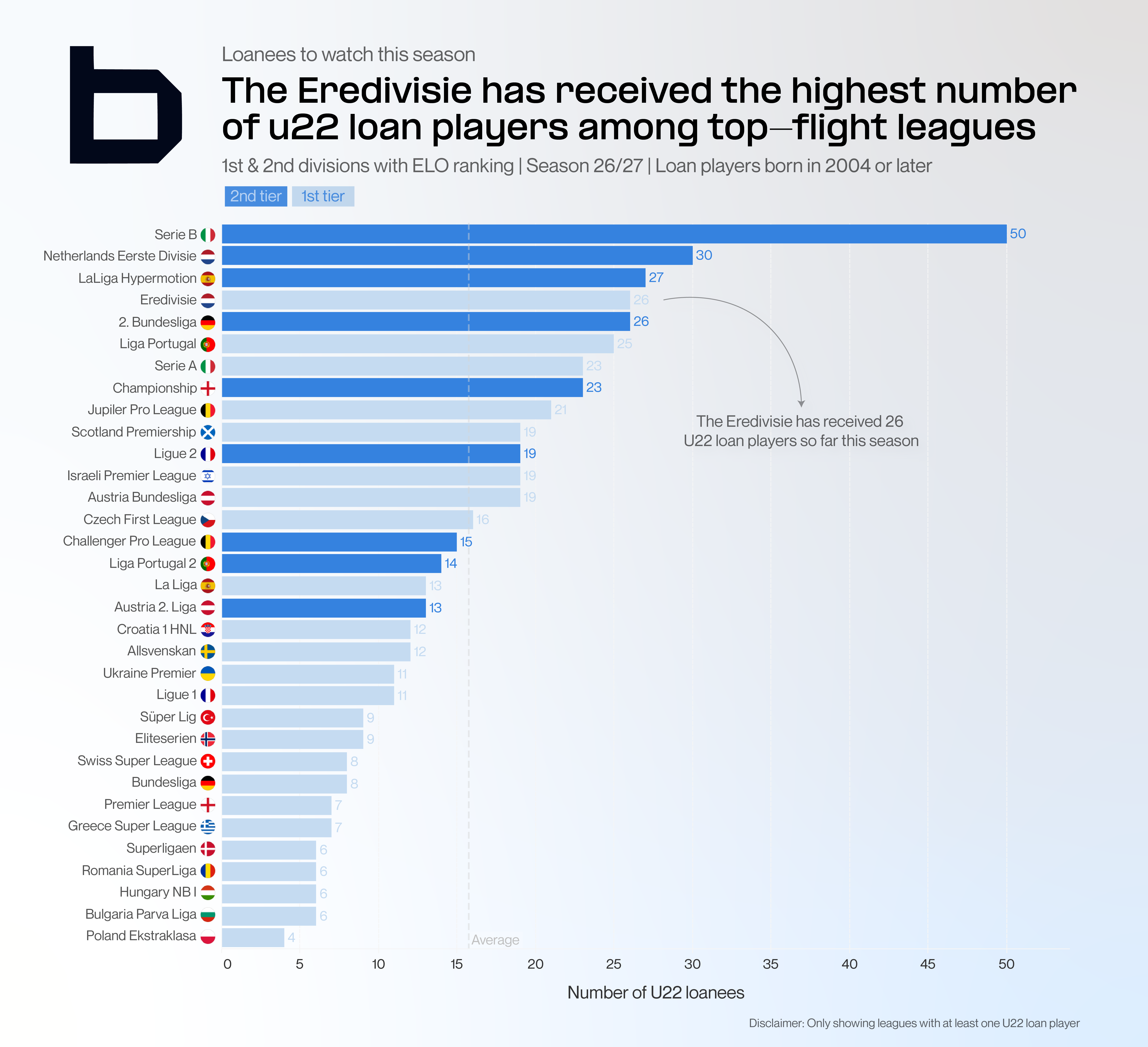
The first group, the most obvious one once you see the chart, is the second divisions of the top five leagues. This group of five leagues has received, so far, 145 loanees born in 2004 or later. Serie B is first with 50 and Ligue 2 is the last in this group of five with 19.
The second group that stands out is made up of the Eredivisie, Liga Portugal and the Jupiler Pro League, the famous "Next Three". The three competitions that follow the top five leagues in terms of level, European ranking, etc.
The two groups are mainly differentiated by the origin of their loanees.
In the first group (Serie B, 2. Bundesliga, LaLiga Hypermotion, Championship and Ligue 2), 76% of the U22 players who arrive on loan come from clubs in the same country.
The clearest example is Serie B: of the 50 loanees it has received, only one does not come from Italian teams (Tommaso Guercio, on loan from Śląsk Wrocław at Carrarese).
It is normal for second divisions to receive many players from teams in the same country. Club executives know each other and deal with each other, and it is a shorter adaptation process for the player for cultural and language reasons.
In addition, for example, for a LaLiga club that wants to prepare a footballer to perform under the demands of its top flight, the second division of the same country usually offers a similar competitive context.
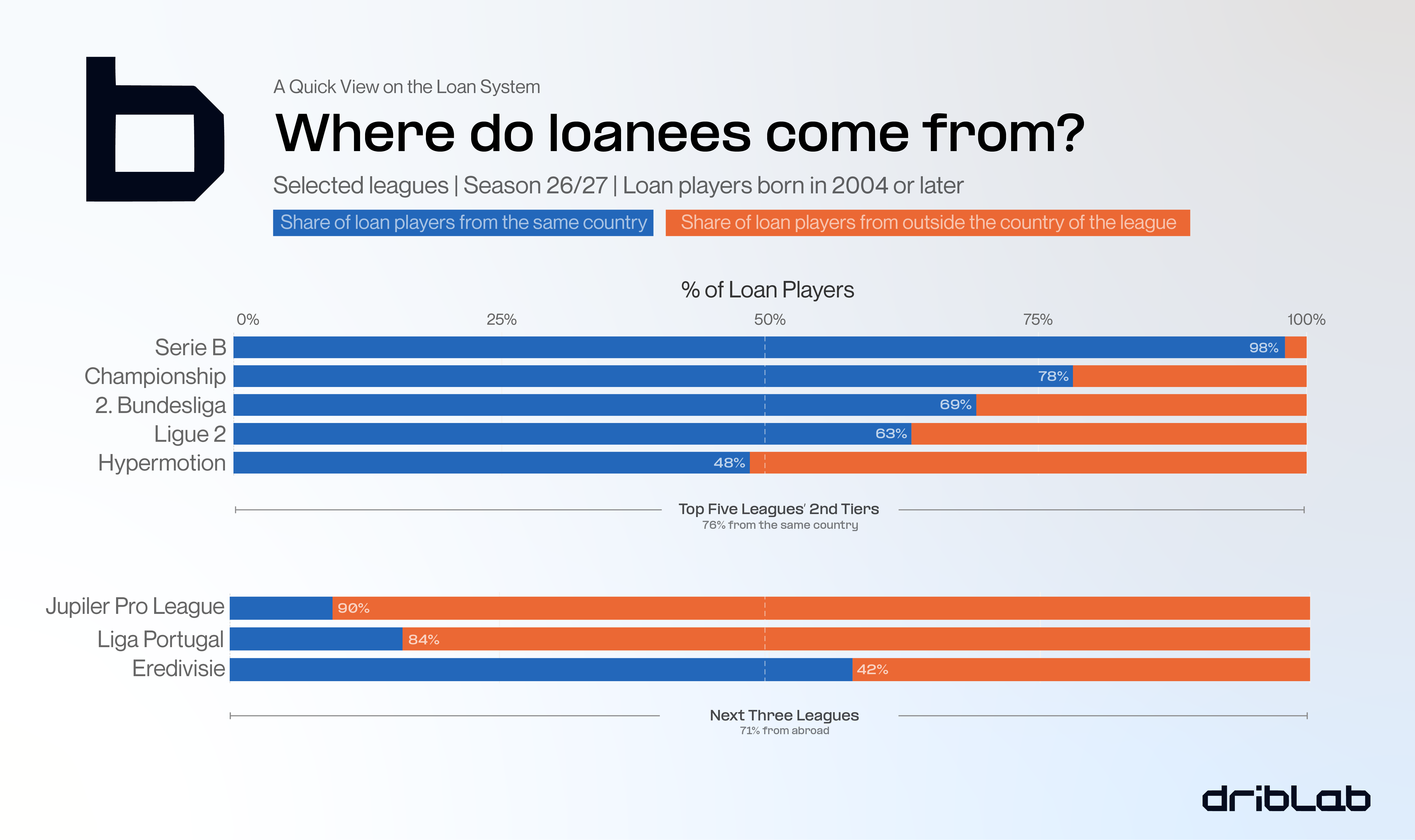
If we excluded Serie B, the percentage would drop from 76% to 64%, but it would still be well above the percentage of loanees from their own countries that the other group receives.
When we add up the Eredivisie, the Jupiler Pro League and Liga Portugal, only 29% of loanees come from teams in the same country. That is, in what from now on we will call the Next Three Leagues, 7 out of 10 young loanees come from teams abroad.
These leagues are a testing ground for the clubs of the top five leagues for several reasons: they have historically given minutes to the youngest players, they work well to develop specific profiles (above all attackers)
Also, because they are not as demanding as the top leagues and there is competitiveness one step below, they've have been used as an intermediate step between America and Europe (a journey that more and more players are making). There is clear openness on the part of some clubs to receiving this loanees.
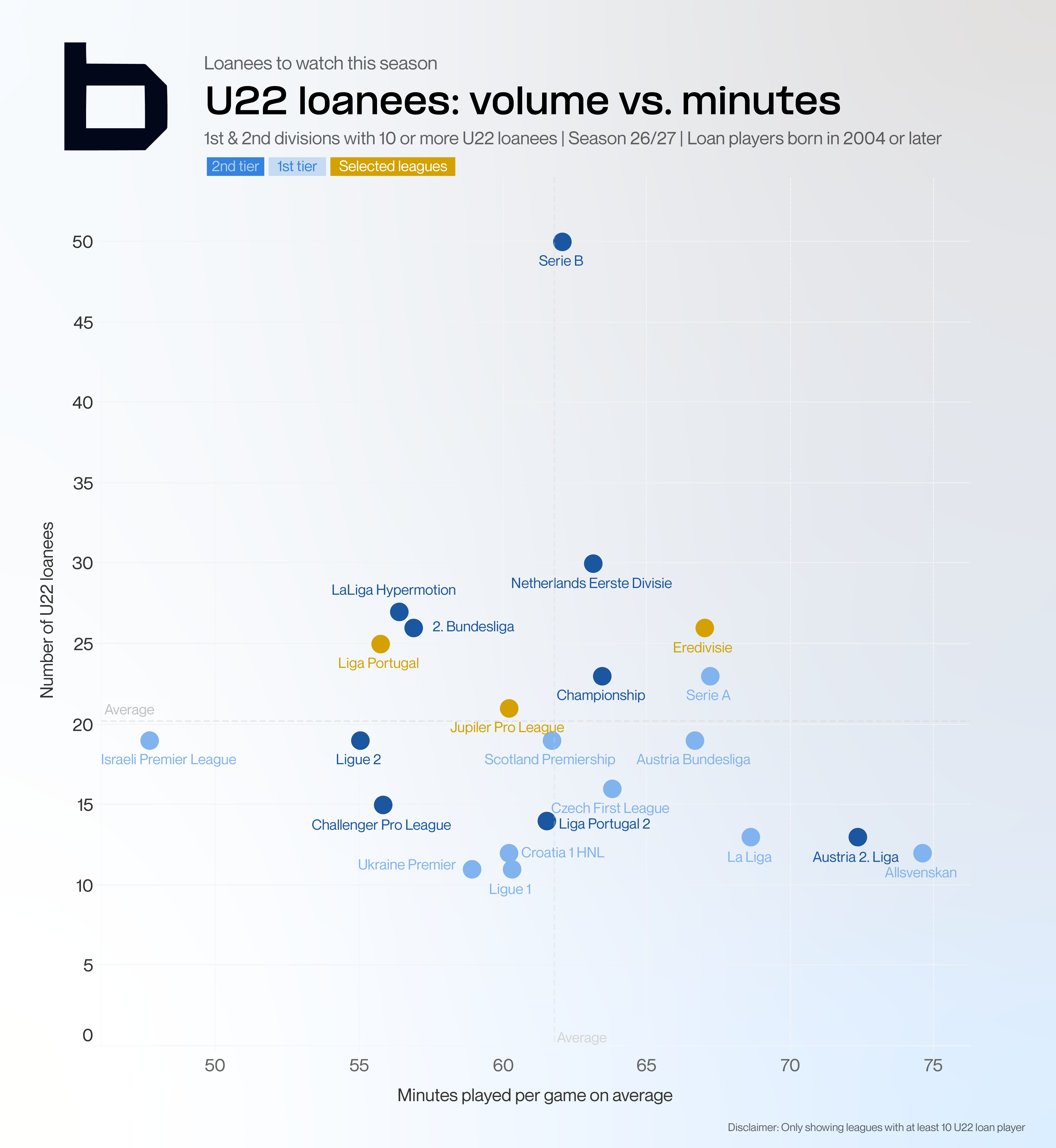
Two of the Next Three Leagues are giving their loanees, on average, 60 or more minutes per game.
Portugal is a particular case because its loanees add up to 56 minutes (the average) per game as a whole, but half of them (the median) play fewer than 35. Several players have accumulated a lot of minutes and others have played, so far, very little.
The home or abroad dilemma
Each league faces a different cultural and sporting context. Some, even within that context, are more open and have networks allowing them to find settings in places not considered by others.
An example of the opposite would be Serie A. Only 24 of the 146 (16%) loanees it has exported this year have left the country. In Italy there are few players willing to go out on loan abroad.
On the other side, the Premier League has sent 43 of its 112 young loanees abroad, 38% in percentage terms. For their part, the Bundesliga (32) and Ligue 1 (17) are at 47% and 40% respectively.
Talking about first tier leagues, the Jupiler Pro League is the first destination outside their country for the Premier League (6 loanees) and Ligue 1 (4 loanees).
As for the Bundesliga, it exports to the Netherlands more than to any other foreign country, but it divides its loanees between the first division and the second (8 in total), with 4 players in each category.
Attackers in the Netherlands and Belgium, midfielders in Portugal
As we've briefly mentioned, the famous Next Three Leagues are leagues that offer a favourable context for certain positions.
This season, the Eredivisie has received, for the most part, attackers. If joint the number of strikers with the figure for wide attackers, the Dutch top flight has received 12 loanees. In the Jupiler Pro League, strikers stand out (6).
They are two leagues that give more opportunities for attackers: the defences are weaker than in Portugal (in the Eredivisie and the Pro League each team concedes 1.44 and 1.37 xG from open play per game, respectively, compared with the 1.17 conceded in Portugal). It is also more vertical game (in the Eredivisie each team touches the ball, on average, 26.6 times in the opposition box, six touches more than in Portugal).
An example of an attacker who could benefit from the style of the Jupiler Pro League is Moise Kabore, a Burkinabé striker on loan from Sweden's Hammarby at SK Beveren.
After finding limited minutes since his arrival from ASEC Mimosas in January 2025, Kabore could do well in Belgium.
His numbers are not record-breaking, but they are decent numbers for someone with barely 770 professional minutes in Europe. He has scored 6 goals from 25 shots, with an xG of 3.5.

However, if we look at his 5.7 xGOT (expected goals on target, which measure the quality of the shot, not the position it is taken from), we see that Kabore adds danger to the theoretical value of his shots.
In his three starts so far, he's been on average responsible for 39.5% of the xG generated by his team. A figure that would place him as the 2nd best striker in this metric.
Kabore is an active and direct off-the-ball runner. He's a pretty good header of the ball and has no problem shooting with both feet.
His physical profile and ability to get quality shots can give him a lot of confidence. in a less demanding environment, at a newly promoted club, and help him fully adapt.
On the other side of the coin is Portugal, with its more measured, more controlled football. 6 midfielders arrived on loan in Portugal, but there were also 5 attacking midfielders.
Based on our Score rating system, none of the U22 loanees in Liga Portugal is performing better than Diogo Prioste.
Adding Prioste is a bit of a cheat: he comes from a club in his own country (he is on loan from Benfica at Gil Vicente). But he is the profile the Portuguese league demands. A pass-first midfielder who takes responsibility when it comes to progressing play, getting involved in build-up and carrying the ball into the box.

Perhaps he is not the most promising talent in Benfica's academy, but he renewed until 2029 a few months ago and now, after a very good year in Liga Portugal 2 with Benfica B, he gets his chance at a Gil Vicente side that is performing above expectations with him as a starter.