
Changing Real Madrid's narrative with data
Real Madrid's disappointing season stems from a long list of factors. For many, the lack of defensive commitment from several of their offensive stars is the primary cause of the team's poor performance.
Some will argue that players of such caliber shouldn't be asked to do too much defensive work. In fact, we know that excessive workload affects a striker's finishing ability.
In terms of workload or match load, Mbappé's last two seasons (PSG 23/24 and Real Madrid 24/25) represent the two lowest figures in both campaigns compared to forwards with over 800 minutes played in either of those two seasons.
In terms of workload or match load, Mbappé's last two seasons (PSG 23/24 and Real Madrid 24/25) represent the two lowest figures in both campaigns compared to forwards with over 800 minutes played in either of those two seasons.
The Frenchman is a forward who has always worked or worn himself down very little. This is also reflected in his physical performance. So far in LaLiga, no other forward averages fewer kilometers covered per match than Mbappé's 8.49.
However, the French star has scored 36 goals across all competitions. A figure that doesn't stop the Bernabéu faithful from whistling but clearly softens the criticism.
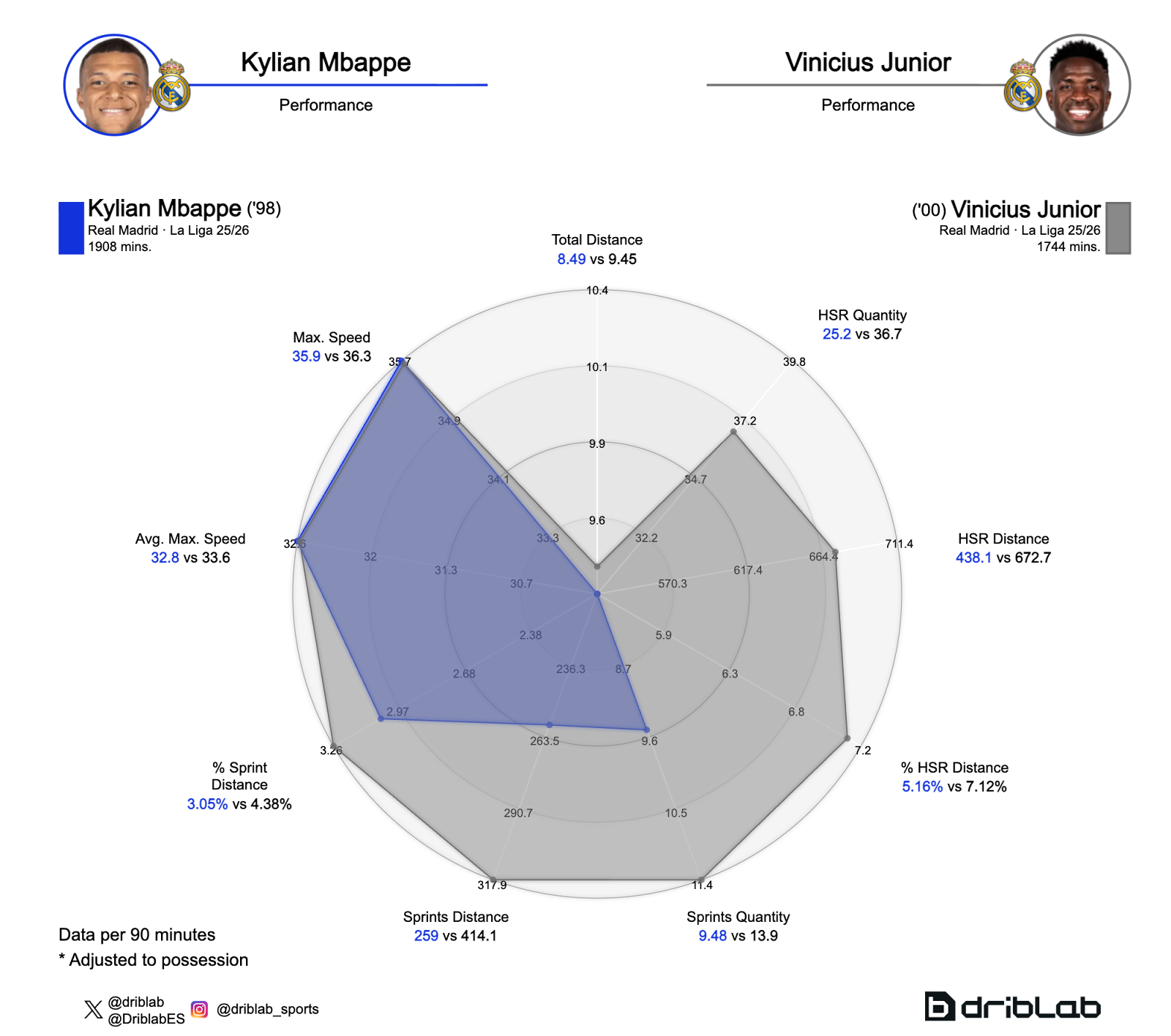
Actually, Mbappé's season in terms of goal production masks a notable lack of involvement in the game.
Just as Mbappé runs little, so does Vinicius Jr, though not quite as little. However, the Brazilian star performs significantly more sprints and more high-intensity movements than the Frenchman and covers more distance at high speeds. Vini Jr. is the second LaLiga winger who covers the highest percentage of his match distance at sprint speed and the fifth who covers the most percentage at high-intensity speed - HSR (between 17.8 km/h and 25.2 km/h).
Anyway, the numbers are clear: Vinicius's production has been so far from Mbappe's figure of 41 goals produced this season. The Brazilian sits at 16, and that's not enough for the white faithful.
Though, the situation would balance out a bit more If Real Madrid fans had access to the off-ball movement numbers of both players. The Brazilian moves considerably more than Mbappé without the ball. Vini Jr.'s 17.4 off-ball runs per game exceed the average for attackers in the Spanish league. Mbappé, on the other hand, is among the bottom 20% for off-ball movement.
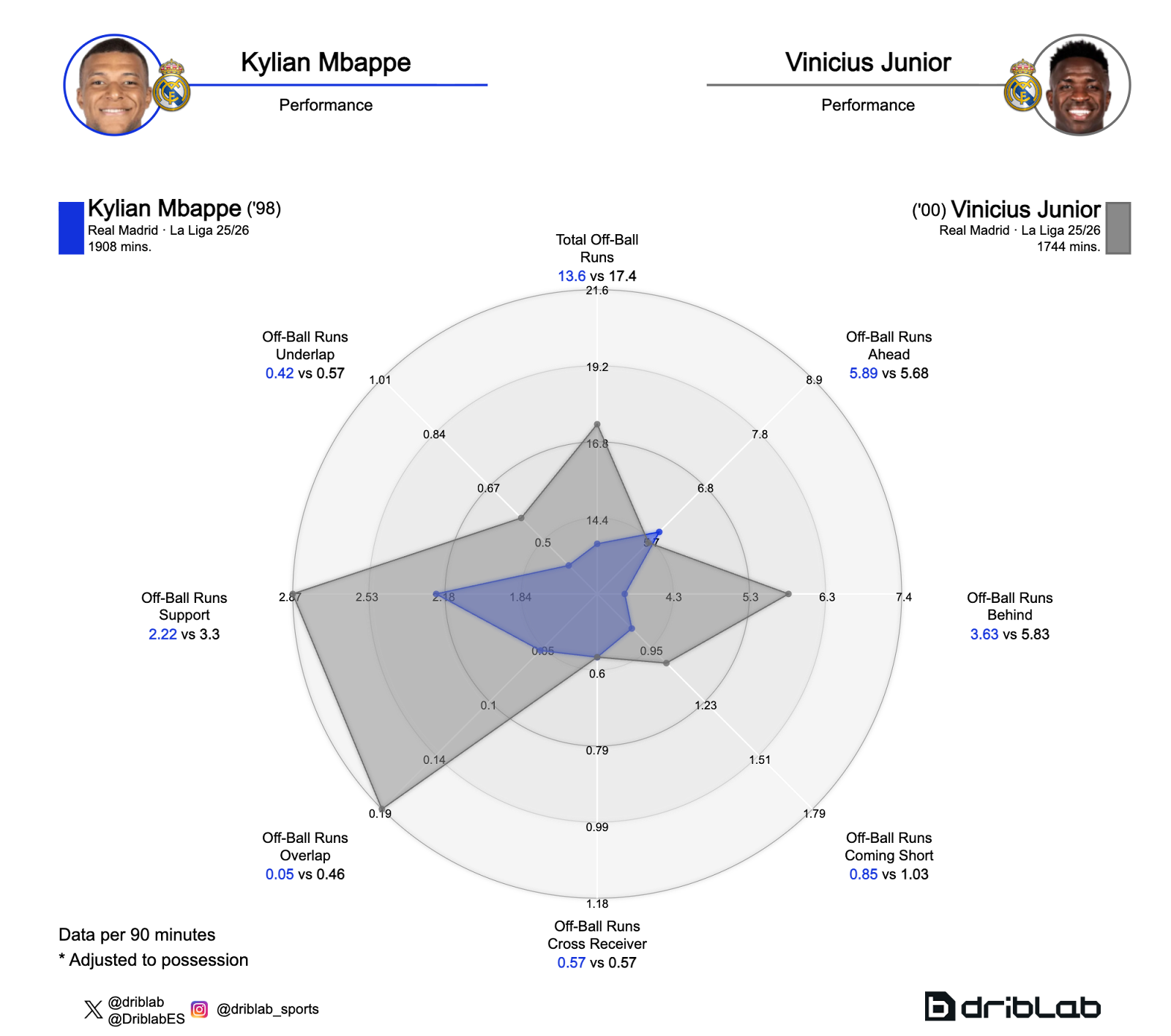
What's most striking is that it's Vinicius and not Mbappé who makes more runs in behind the opposition defense, when one typically starts from the wing and the other from the center.
The Frenchman has developed his game in such a way that, without having the creativity of others, he needs the ball to reach his feet as quickly as possible to execute his play, even if that means not making runs to receive it in theoretically easier scoring situations. With 38 goals and 3 assists in 30 matches, it's always going to be hard to convince Mbappé to work at the same level as everyone else.

Iraola's Bournemouth as the gold standard for high intensity
Football can be a difficult game to understand at certain moments. However, if you watch a Bournemouth match under Andoni Iraola, you quickly realize there are many players who are in one part of the pitch and within seconds are able to appear at the other end.
It's not magic. It's physical preparation. The reliability of our data and the level of precision it brings to analysis, surpassing our competitors', allows us to confirm this with certainty.
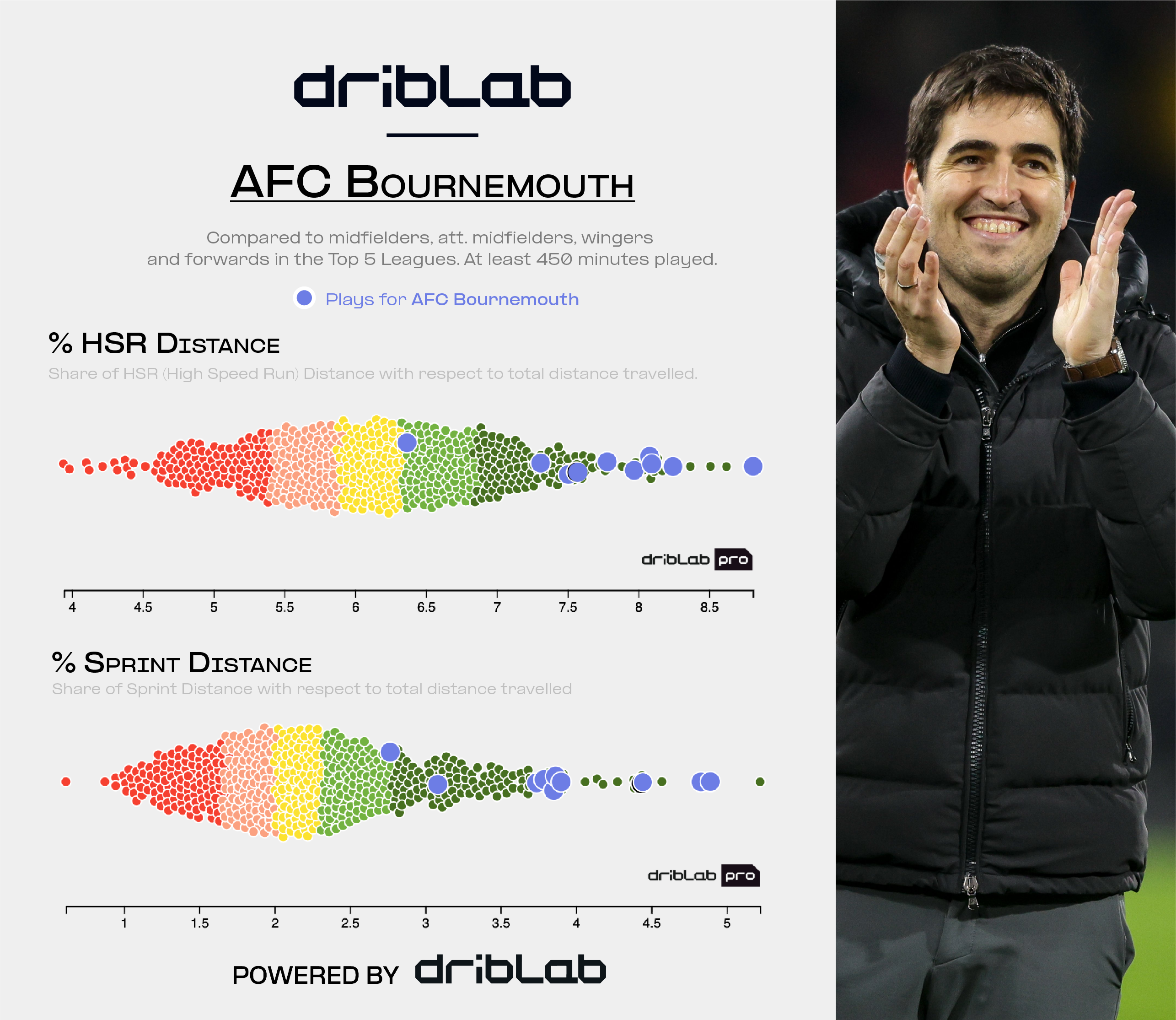
If we look at all those players who aren't center-backs, fullbacks, or goalkeepers, Bournemouth places 8 players among the top 50 who cover the highest percentage of their total distance through high-intensity movements.
If we do the same with percentage of distance covered at sprint speed, 4 of the top 20 are from the English team.
If we combine the figures for all players with at least 800 minutes played who aren't goalkeepers, every player who meets these conditions at Bournemouth averages a percentage of distance at sprint speed that's above average. 16 players have a percentage of distance covered at sprint speed greater than 2.5%.
Managing the load: Tottenham's injury puzzle
Injuries are an increasingly present aspect of modern football. In a single season of a competition, hundreds of injuries occur. The ability to control players' physical load is key to preventing a season from going off the rails due to an injury crisis. If not, just ask Tottenham, who once again are the team whose players accumulate the most days lost to injury.
However, in terms of availability there's good news for Spurs. Specifically in the continuity that Micky Van de Ven has finally been able to have, who has already racked up 2441 minutes in the Premier League so far this season.
The Dutchman was only available for 13 matches throughout last season, accumulating a mere 1094 minutes.
With his physical radar we can observe how the change in Tottenham's playing style following the switch from Postecoglou to Frank has influenced his ability to stay healthy. He's gone from performing 45.4 high-intensity movements to 24.3 per match and from 23 sprints to 8.52.
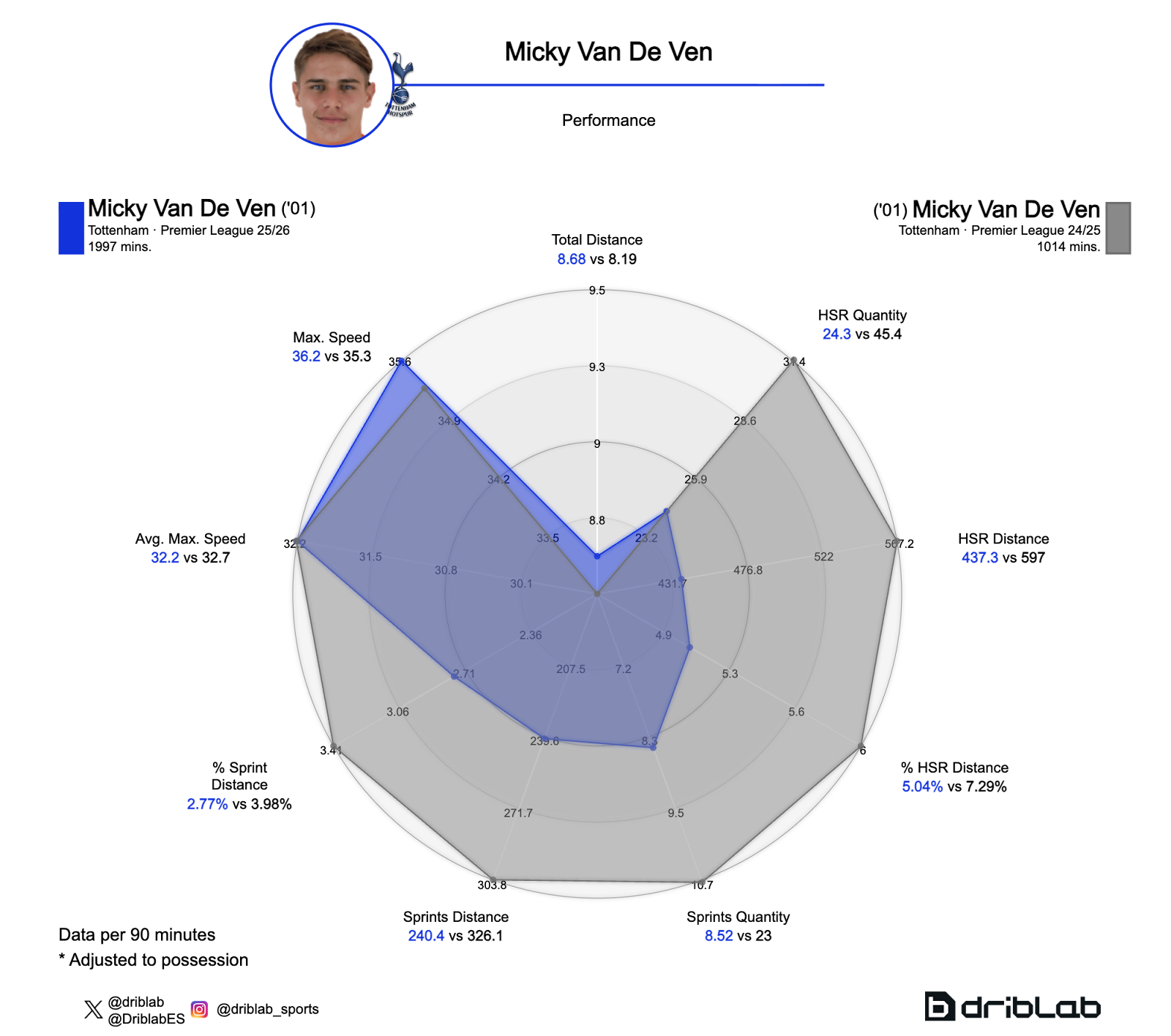
Frank has proven to be a manager much more focused on protecting his two center-backs. Additionally, Tottenham's 25/26 matches have less tempo than what occurred in matches under the command of the Greek-Australian Postecoglou, with more stoppages and more time to prepare throw-ins and corners. Van de Ven has scored 4 league goals and is the team's third-top scorer.
The recently sacked Frank leaves Tottenham after - it seems - having resolved Van de Ven's physical problems. However, there's been another player who continues to suffer constant injuries whom Frank hasn't been able to help: Destiny Udogie.
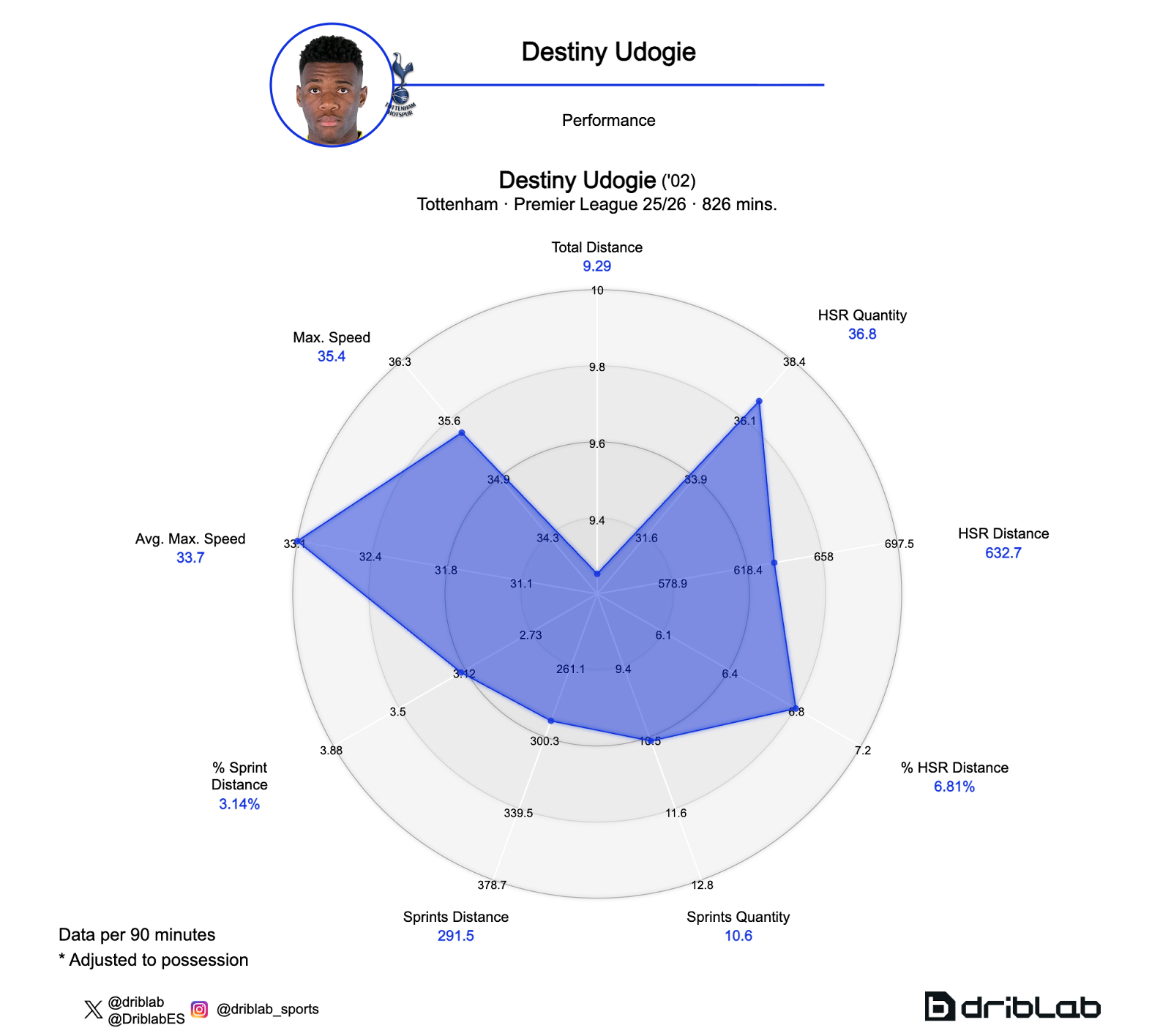
The Italian fullback has spent three seasons in the Premier League and his percentage of minutes played has been declining from 68% in his first season to 35% in the current one.
If Van de Ven benefited from the stoppages and low tempo of the game proposed by Frank, the Dane's demonstrated need for his fullbacks to get high up the flanks hasn't benefited Udogie. The left-back needs constant rhythm, something that injuries and lack of continuity haven't given him either.
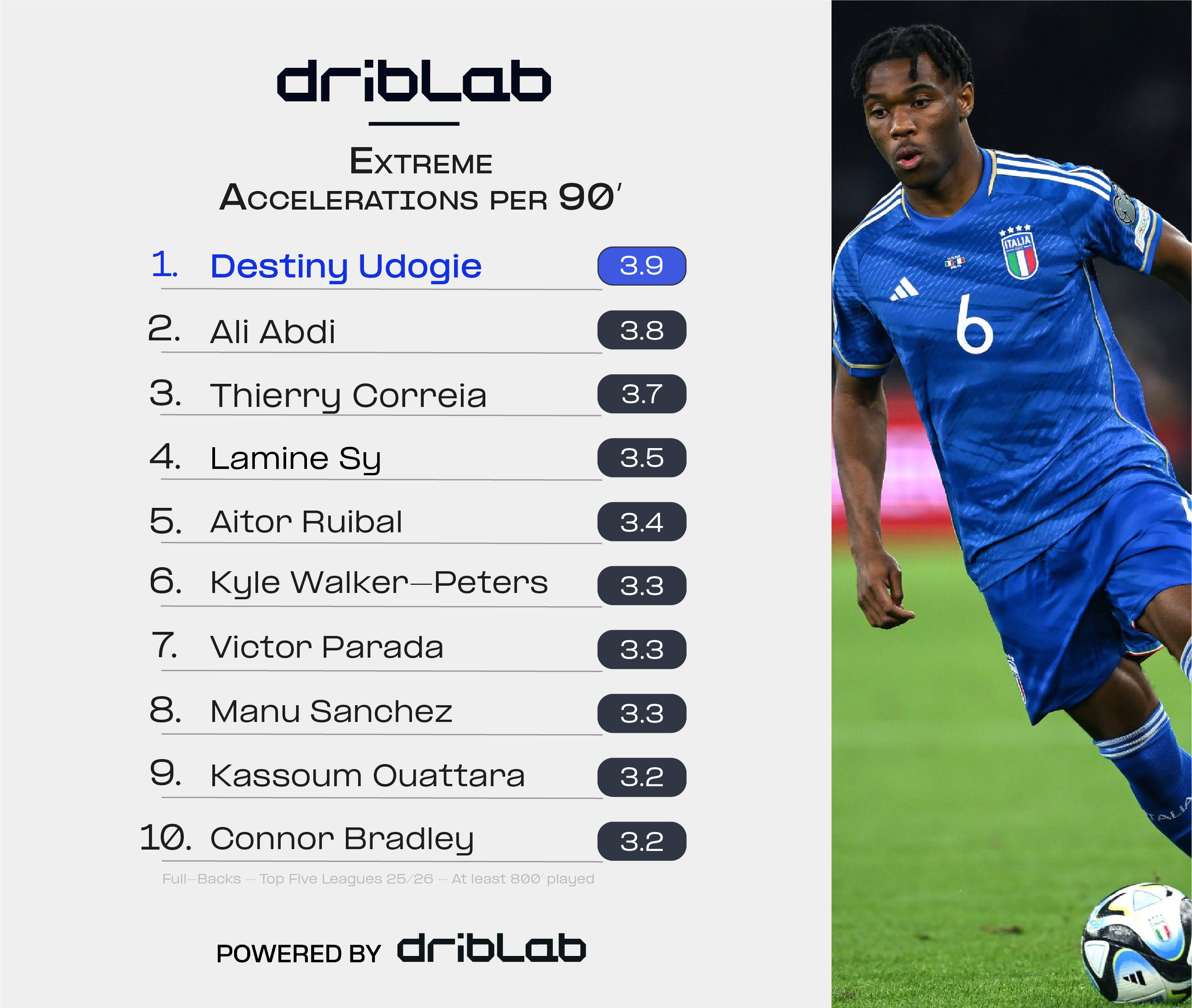
His explosive profile is, at the same time, his greatest weakness and strength. When he bursts forward, no one can stop him. But many times his muscles suffer and force him to stop. Udogie is the fullback from Europe's five major leagues who averages the most extreme accelerations per match.



