At Driblab, we see innovation as an unquestionable, continuous and demanding process, in which the accuracy and reliability of data are the foundation of all our products.
In line with our goal of offering as much information as possible, down to the smallest detail, we are presenting Driblab's latest innovation: you can now check the physical performance of any player and team based on their in-possession and out-of-possession phases.
We have been improving, refining and expanding our Physical Data product since its launch. Our tracking system has a proven level of quality that sets a new benchmark in the global market.

What are we aiming for?
This innovation takes the granularity of our Physical Data a step further, giving our clients a level of precision that provides essential competitive advantages.
Being able to distinguish between in-possession and out-of-possession moments in a player's physical performance moves us away from treating physical data as an absolute value. The extra specificity we gain by splitting the data into phases produces a range of metrics that describe specific moments and situations, rather than absolute values and simply good or bad performances.
The more we can break down physical data, the more detailed the information we get. That means a greater ability to detect and understand specific patterns of play, and also a greater capacity to separate players into different profiles and roles.
Our physical data is now more concise and less absolute, with greater significance and specificity.
Driblab's Physical Data is now available In Possession and Out of Possession.
Don't worry, this isn't just a promotional piece. We're going to use this announcement to talk about how we can apply the advantages of phase-split physical data in our analysis.
To do that, we'll take a look at LaLiga. Before we start, we should point out that the metrics we use have more complicated names than usual.
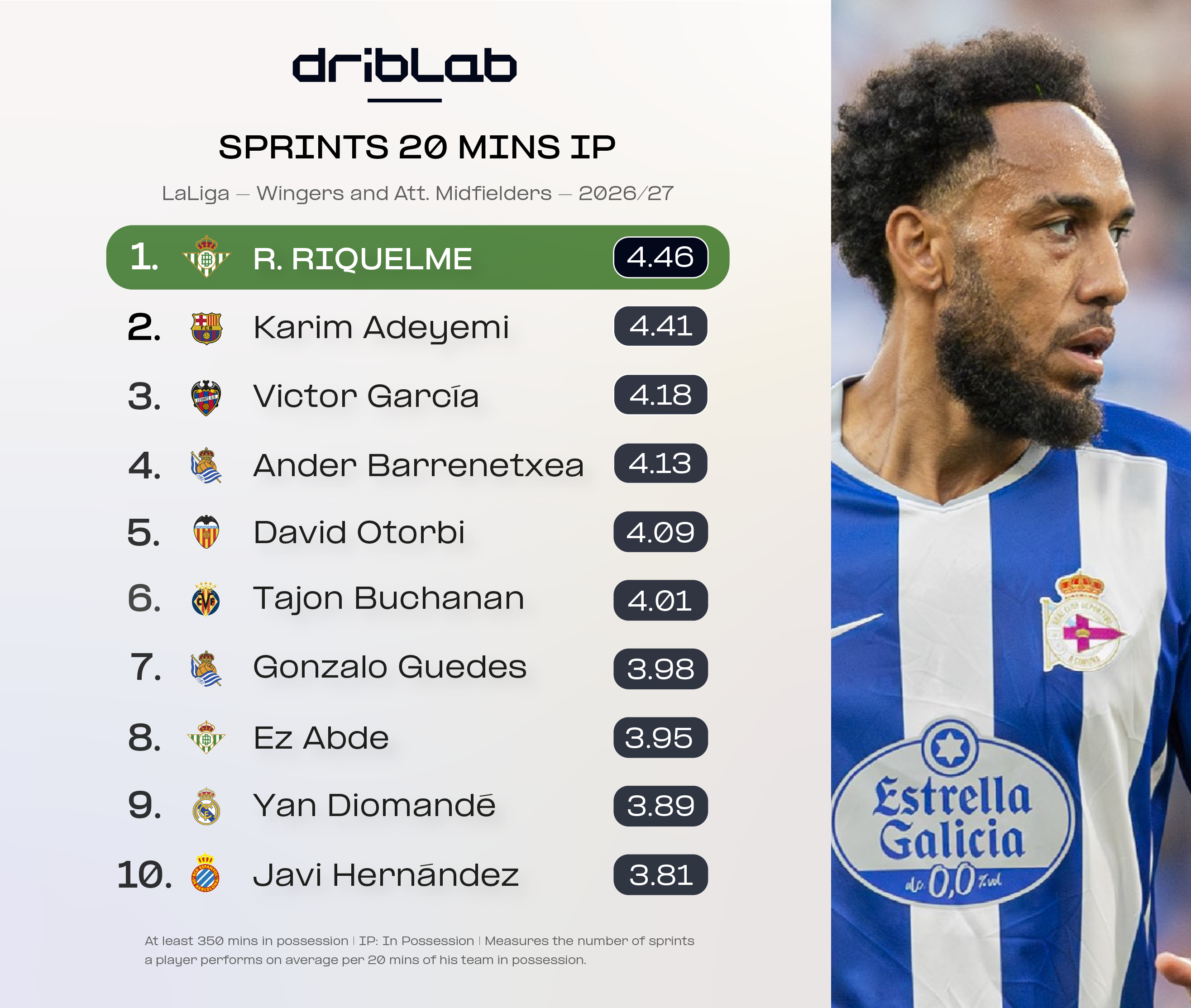
Where we used to see them like this (Sprints per 90'), we'll now see them like this (Sprints 20 Mins IP). In this piece and in future ones, you'll notice we use slightly different terminology. IP stands for In Possession and refers to the physical efforts each player makes when his team has the ball. OOP stands for Out of Possession and measures the opposite: a player's efforts when his team doesn't have the ball.
All metrics are normalised per 20 minutes. So Sprints 20 Mins IP shows the average number of sprints a player makes for every 20 minutes of his team's possession.
Our Physical Data brings us ever closer to reality, and above all it does so in a more precise and consistent way. It helps us understand that a player's physical output is, more often than not, shaped by his team's context and game model.
His physical performance is conditioned by, and a product of, the role he plays within the team. Let's look at two examples.
Andrei Ratiu: A Specific Profile
With the phase split, we can see how balanced (or unbalanced) a player's physical performance is with and without the ball. In Andrei Ratiu's case, we notice clear differences in the type and number of efforts he makes depending on the phase of play.
The Rayo Vallecano player has been one of the best full-backs in LaLiga over recent seasons. He stands out for his physical, up-and-down profile and has attracted interest from the Premier League, where a profile like his is valued like almost nowhere else.

If we look at our radar, we see Ratiu's absolute values: he is in the 92nd percentile for High Speed Running (HSR) distance and the 76th percentile for number of high-intensity runs per 90 minutes.
Likewise, he is in the 94th percentile for Sprint Distance and the 75th percentile for number of Sprints per 90 minutes. He is also in the 81st percentile for Total Distance Covered.
This overall picture tells us that, on paper, Ratiu is a player with a remarkable physical profile, but it says nothing about his impact on his team's play. Splitting his physical data into phases clears this up.
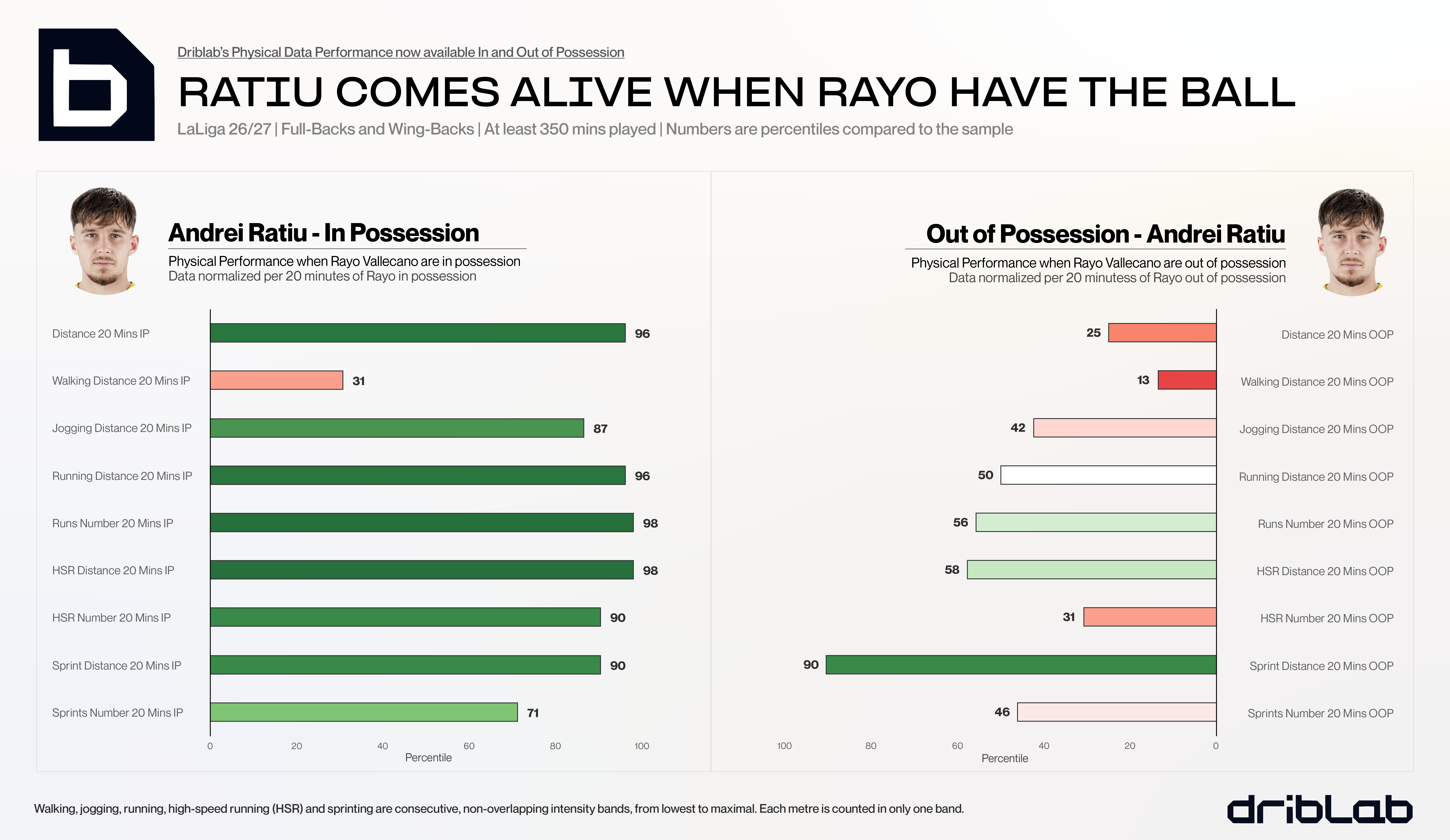
This chart shows the contrasts in the Romanian's profile: a full-back who switches on when Rayo have the ball and cuts down the flank like a knife. He covers more distance than 96% of full-backs and wing-backs, and he does it through high- and maximum-intensity efforts.
Defensively, the picture changes. Across every metric his percentiles drop noticeably, except for Sprint Distance. He is a full-back who limits himself to protecting the space behind the defensive line and correcting transition situations. He does this through long but infrequent sprints.
When his team is out of possession, Ratiu's sprints are the longest of any full-back or wing-back in LaLiga in that phase.
This shows how Rayo use Ratiu as a key attacking weapon while allowing him to rest and play a very limited role without the ball.
The Two Faces of Yassir Zabiri
We've seen the contrasts in Ratiu, who multiplies his efforts when his team has the ball. But there are also examples of players who optimise their physical profile according to their role.
That's what one of the most surprising players in LaLiga this season is doing: Yassir Zabiri.

His overall radar shows that he handles physically demanding situations well, but he doesn't stand out either for covering a lot of ground or for his top speed.
However, once we dig into his phase-split physical performance, we can see that the conclusions we drew from his overall radar need to be heavily qualified.
In possession, as we said, he barely covers any distance. Even so, two percentiles stand out: the distance he covers walking and the distance he covers sprinting. The data confirms something you notice after ten minutes of watching Zabiri: he can go from zero to a hundred with nothing in between.
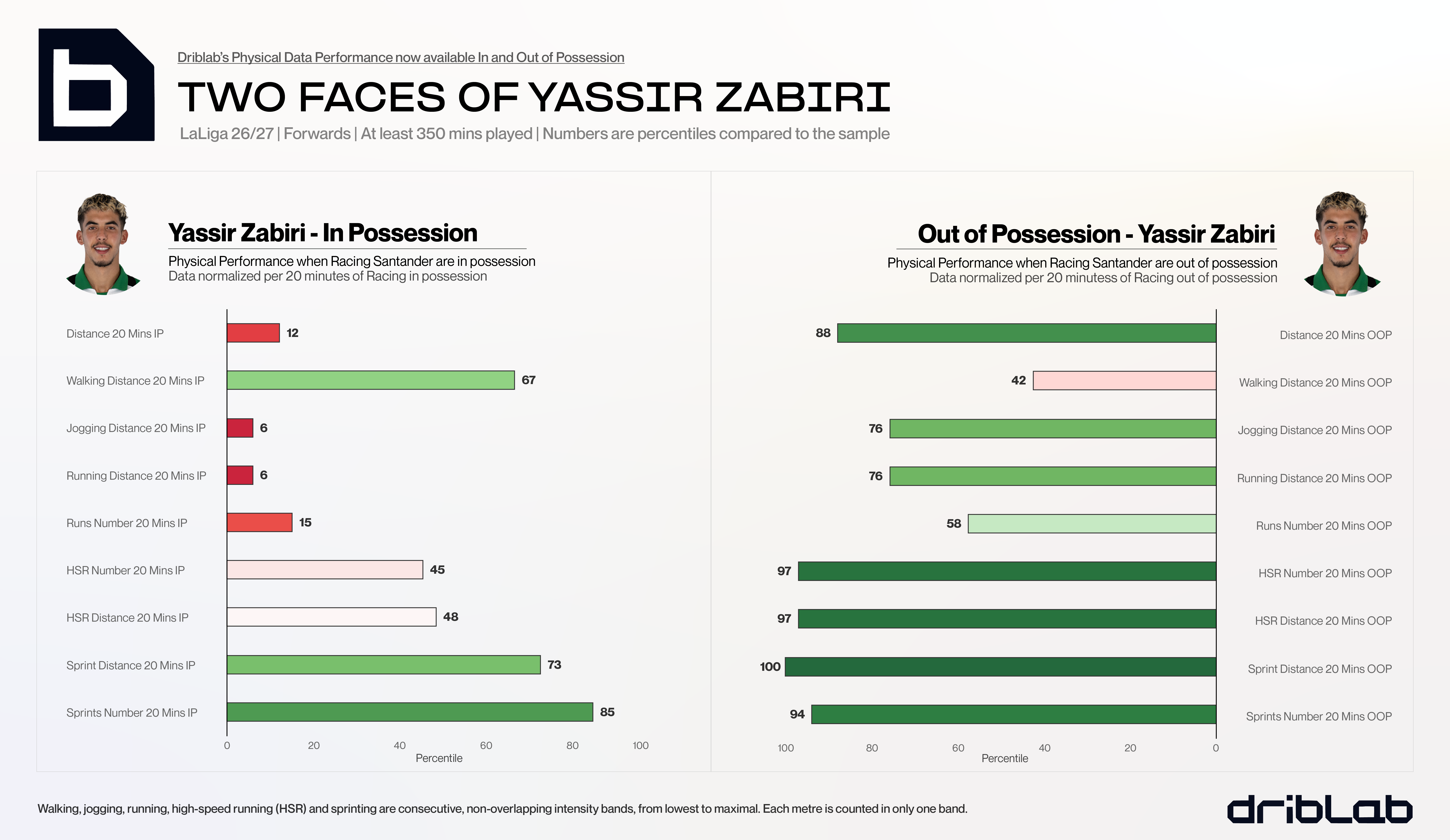
The Moroccan follows the play until the moment comes to strike. That's when he switches on, and his acceleration and ability to explode from a standing start come into play.
In the defensive phase, the way he performs changes completely, and we have to qualify our claim that he "doesn't stand out for covering a lot of ground". For every 20 minutes out of possession, Zabiri covers more distance than 88% of LaLiga forwards. As for walking, he goes from the 67th percentile in possession to below average for walking distance out of possession. He stops walking and makes above-average high-intensity efforts: pressing and counter-pressing efforts that are key to Racing de Santander's game.
Put simply, although his sprint numbers are similar in both phases, he gets there differently depending on the situation. In possession, Zabiri walks and then suddenly sprints to create danger. Out of possession, it's a more gradual process in which walking is much less present. He moves up the ladder from jogging to running, to high-intensity speeds, to sprinting.
It's a very clear example of how what his team asks of him forces Zabiri to shape his physical output to optimise his efforts.
These have been two examples of the insights we can get from Driblab's new Physical Data: greater precision, more context, and the ability to make our analysis more reliable through more granular and less absolute data.
This data is now available on DriblabPro: request your demo here.