Today we're going to talk about time. Time as something that passes. Specifically, as something that passes while two football teams face each other. And we do so at a moment when time is more present than ever in football discourse: possession time, effective time, time to take a set piece, wasted time.
With our data, Driblab offers analytical advantages not only for industry professionals. It also helps those from the outside who want to research and create narratives to reach an audience. We're talking about media outlets, freelancers or content creators with an analytical eye and the will to go further in the way they talk football.
And that's precisely what we're going to do today. We'll ask ourselves how time is used in football and how it shapes our understanding of the game.
To start, a question as simple as it is revealing: which teams have the ball the most?
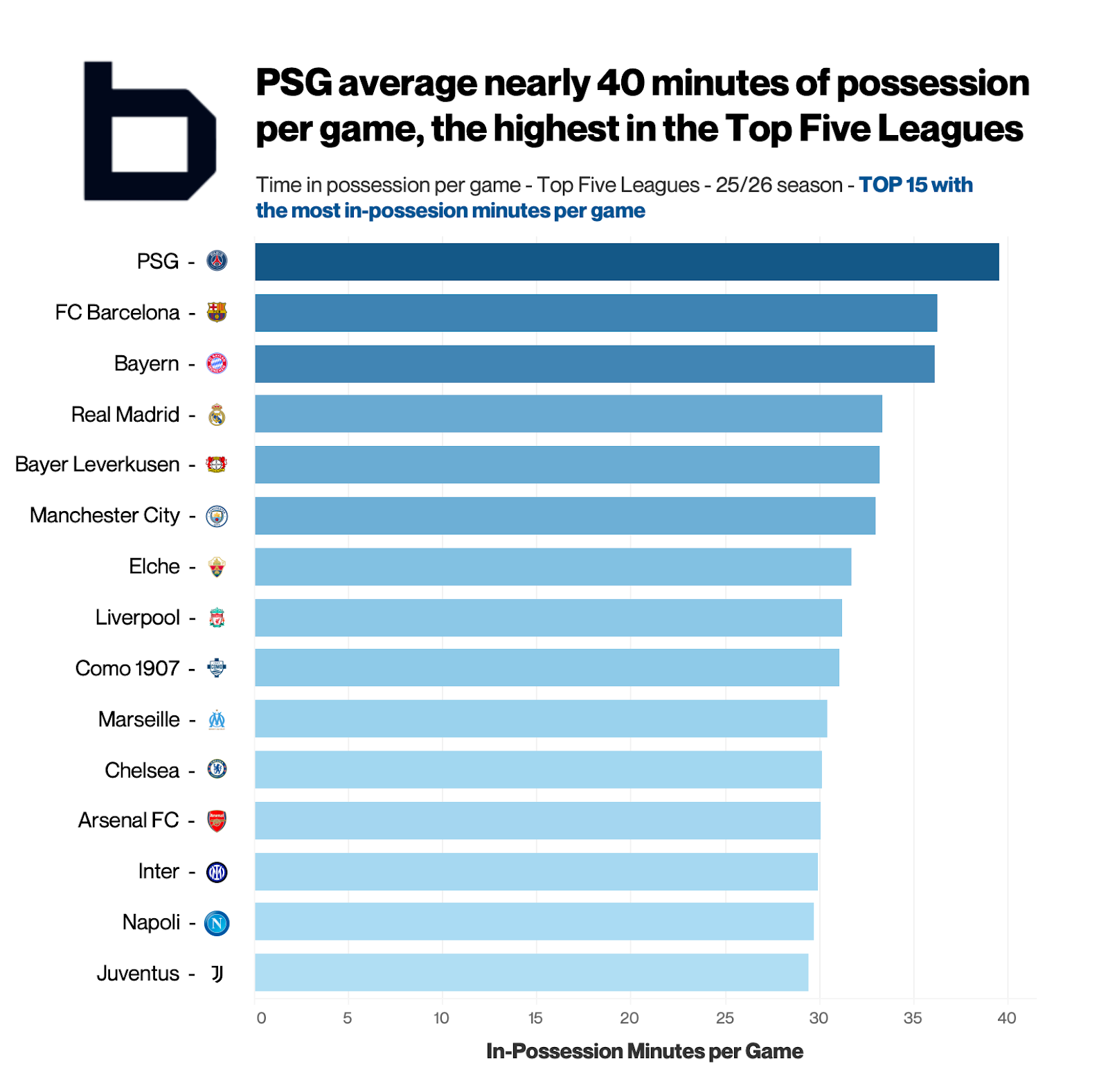
At first glance, most of the fifteen teams in this group are historically dominant sides in their respective countries. Real Madrid, Bayern, Manchester City or Inter, among others.
PSG's presence at the top is hardly a surprise. Luis Enrique's teams have always wanted the ball at all costs. We could pick countless metrics to prove this. But we'll settle for one: no team in the top five leagues has completed more possessions of 10 or more passes than PSG (641). FC Barcelona have completed 600, the 2nd most.
The most notable appearance on the list is Elche. Under Eder Sarabia, Elche have shown an attractive style of play and a clear identity. Their 4.2 passes per possession rank fifth highest in LaLiga. When in possession, they advance, on average, 1.14 metres per second. Only FC Barcelona advance more slowly. That is proof of their calm and steady build-up.
We have seen how managers with similar ideas at clubs with more limited resources have ended up at top clubs. Kompany is one example. Something similar could happen to Sarabia. His idea is perfect for big clubs that want to dominate possession and impose themselves on every opponent. But to do so, these teams also need high-level players who provide individual solutions. That is precisely what Elche have lacked.
Their average of 47.7 passes per shot is the highest in the entire Spanish league. A telling statistic for a team that often arrives into dangerous areas but lacks the individual quality to open defences or generate shots frequently. Elche are the 9th lowest-shooting team per game in Spain. Many of their possessions are sterile and it has taken its toll. After being the breakout team of the first half of the season, they are now fighting for survival.
Several of Elche's direct rivals sit at the opposite end of the spectrum.
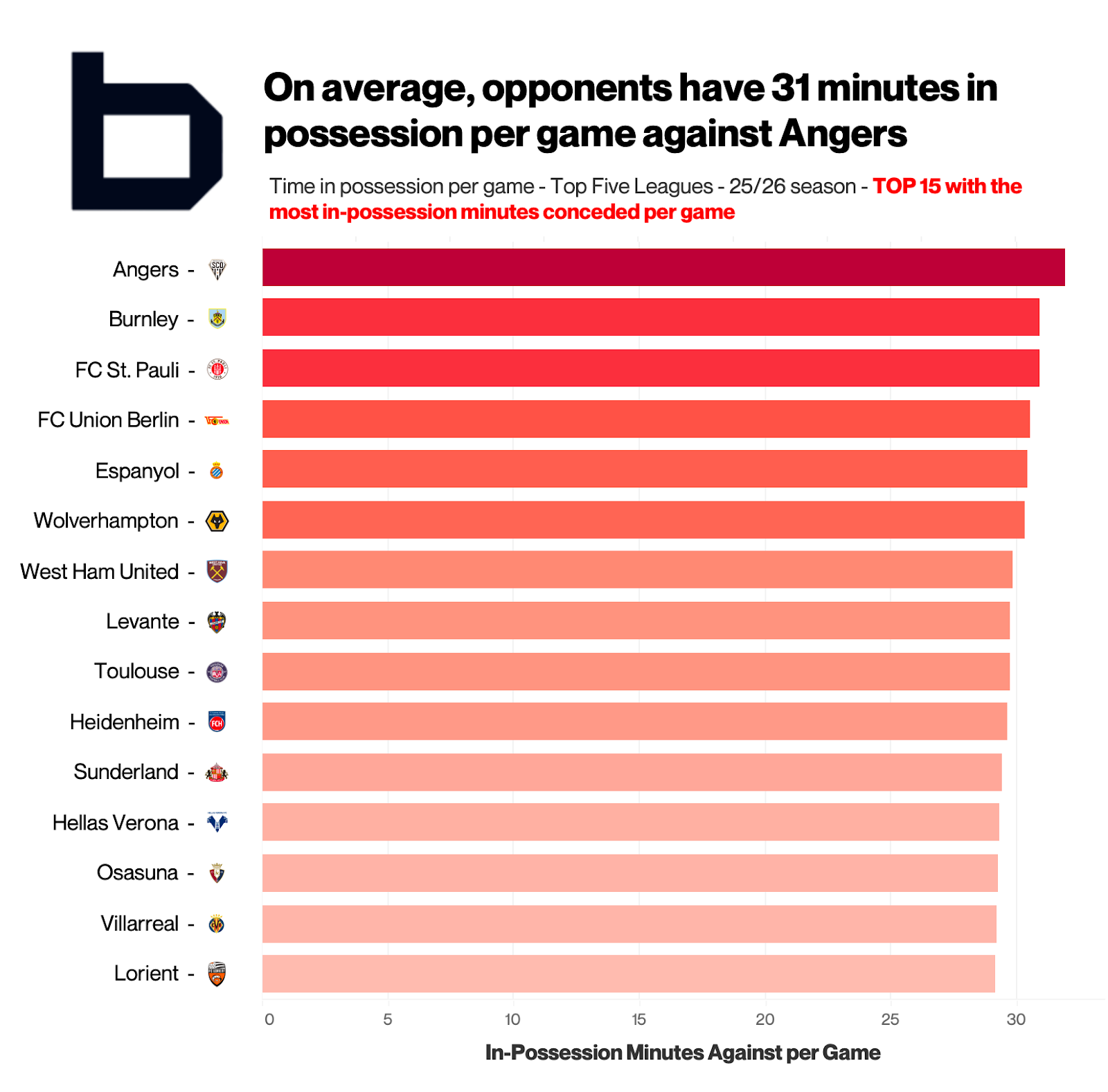
Whether by choice or forced by their opponents, most of the teams that concede the most possession time to their rivals are relegation-threatened sides. 8 of the 15 in the list occupy one of the bottom five places in their respective leagues.
However, inviting your opponent to have the ball should not mean total surrender. Some of the most successful managers ever have based their game on defending through space rather than through possession.
Without reaching those heights, Toulouse under Carles Martínez are a good example. They get results while conceding significant ball time to their opponents. What matters is knowing where they concede that time and where they allow the opponent to have the ball.
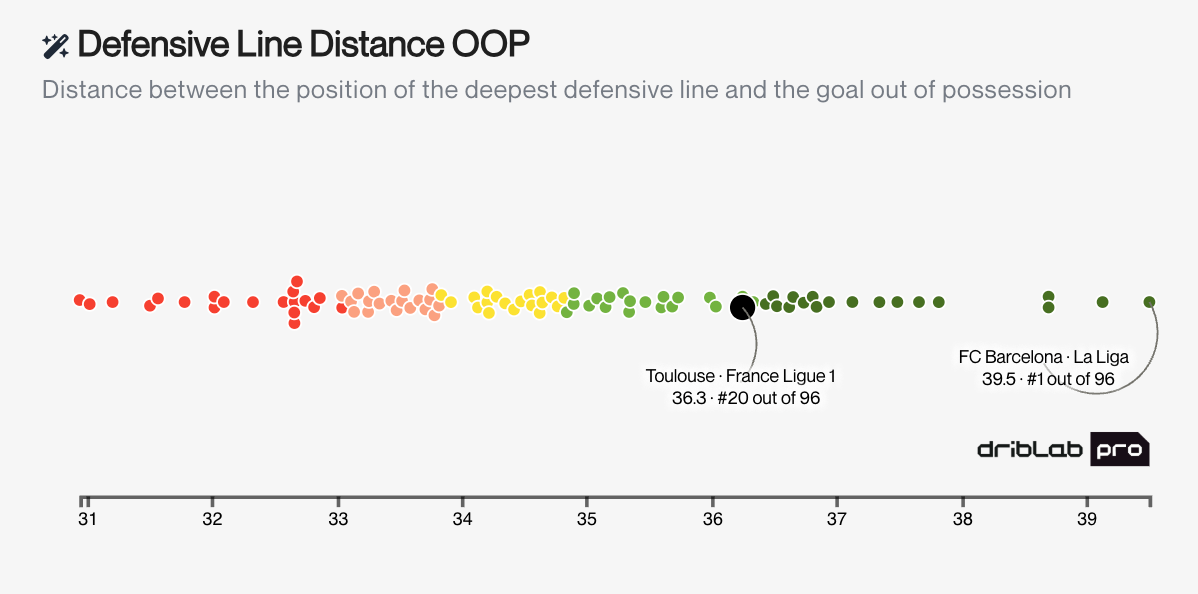
Compared to the 96 teams across the top five leagues, Toulouse average 6.96 high recoveries (in the final 40 metres of the pitch). That is more than 81% of teams. In terms of defensive actions in general, not just recoveries, almost 1 in every 2 actions are classified as high. That means at least 40 metres from their own goal.
They are a very young team, with an average age of 24.2 years, and with the physical capacity to press high. Their defensive line in out-of-possession moments sits at an average of 36.3 metres from their own goal. The 20th highest figure among the 96 teams.

Let's pause here. If we set aside our analytical role and focus on entertainment, we can use our possession time data to help supporters. If you want to watch matches with few interruptions or with a lot of playing time on average, look at this list.
PSG remain the team whose matches feature the most effective minutes of play. Further down, however, we find Celta under Claudio Giráldez. Their in-possession and out-of-possession minutes are roughly equal. We have rounded the figures to show whole numbers.
Celta are a remarkably adaptable team. Giráldez has managed to make his side concede little and generate a lot, despite the end-to-end nature of most of their matches. They concede the third lowest xG per shot (0.10) in LaLiga while generating high-quality shots (0.14 xG per shot, the fourth highest figure).
They adapt to all circumstances. When they need to attack, they stretch their lines and cover a lot of ground to make opponents run without the ball. In possession, they are the third team in LaLiga with the biggest distance between lines. But when defending, the lines get tighter and the block becomes a very compact unit. Only three teams average less distance between their last and first outfield player in out-of-possession moments (27.5 metres).


We have talked about teams' possession time. Those who have the most and those who have the least. But what influence does possession time have on the ability to win matches?
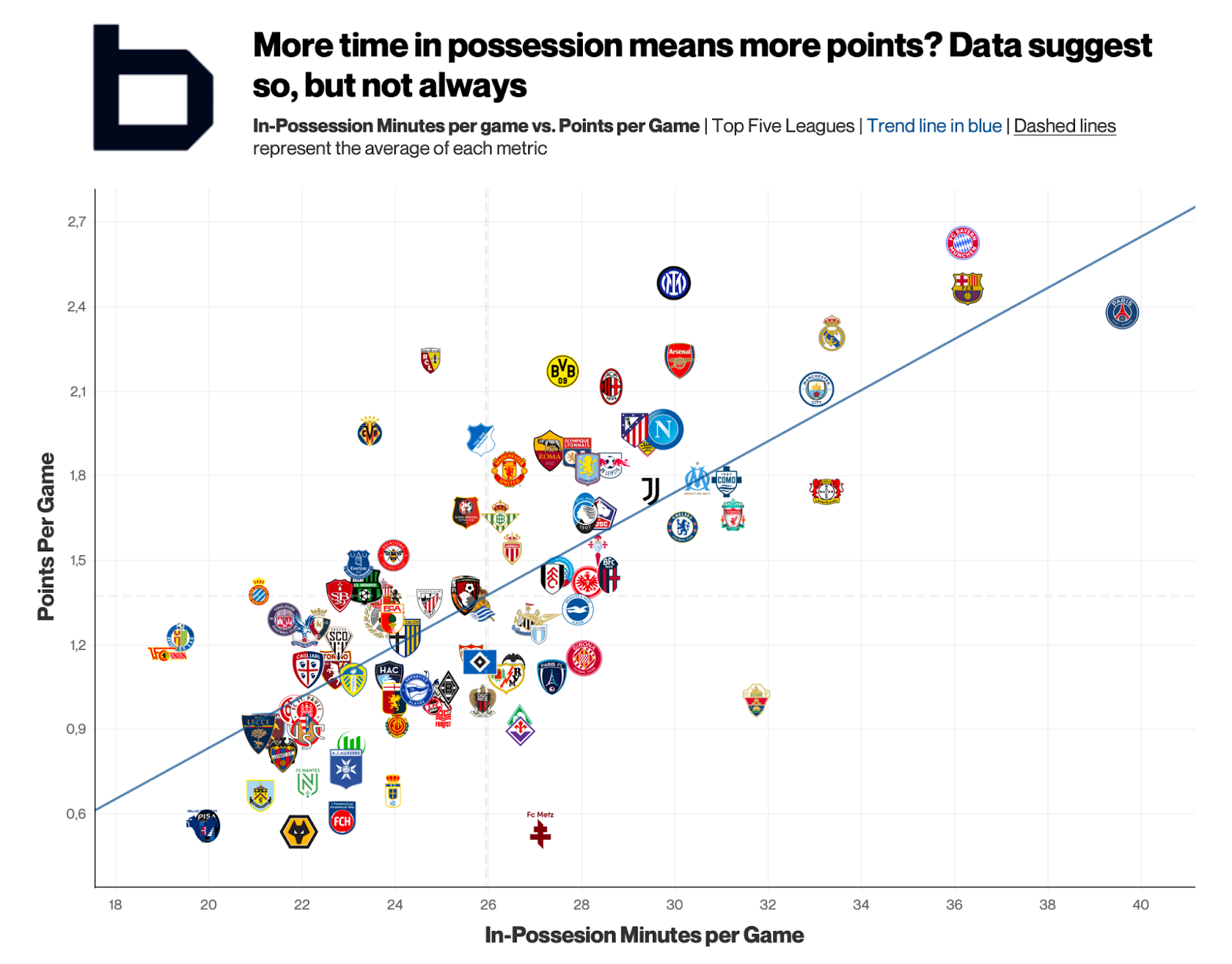
There are reasons to think that a playing model built around keeping the ball tends to lead to more points and more wins.
However, there are always teams that are the exception to the rule. The most notable are Villarreal and Lens, who are picking up more points than their possession time would suggest.
The Lens case is striking. Pierre Sage has optimised his squad to the point that, despite having the ball considerably less than average, they barely concede dangerous chances. Only PSG allow fewer open-play xG than Lens (0.8 per game). They are also the 5th team that faces the fewest shots.
The key for this lies in two aspects. First, they are proactive in their out-of-possession moments. They don't wait for the opponent to make a move — they go and press high. In those zones, they are the second team with the most high recoveries (8.3 per game).
The other side of the coin is their ability to prevent opponents from entering dangerous areas. Six teams concede fewer passes in the final third. However, only PSG allow fewer touches in the opponent's box than Lens.
In our Spatial Coverage: How does your team play? investigation from October we already discussed the notable shift in Lens's style. More vertical, less measured and elaborate.

With Driblab's data, the possibilities go far beyond the traditional use cases. Whether you are a club professional looking for a competitive edge in recruitment or a journalist trying to tell a story that goes deeper than the surface, the data is there to support you. Possession time is just one example of how a single metric can open up an entire conversation about how football is played and won.
That is precisely the spirit behind this piece. Using Driblab's tools, we have built a narrative around time in possession that works for analysts, for scouts and for content creators alike. The numbers are the same for everyone. What changes is the story you choose to tell with them.

.jpg)