Two years have passed since the turbulent end of the season that led to Xavi's dismissal as FC Barcelona coach, and we know he's done a bit of everything over the last twenty-four months.
Out-of-work coaches typically go one of three ways: resting, picking up new ideas or improving their own. Xavi's first three games in charge of the Netherlands firmly place him in the last group. The ideas and concepts he's brought to the 'Oranje' take us back to what his LaLiga-winning Barcelona side did in the 2022/23 campagin.
With Xavi's return to football as our excuse, today we'll show how our event data helps us analyse games and teams in fine detail.
The Netherlands have faced three different tests so far this extended international break, in terms of level and approach from the opposition. We're focusing on the first two, which were polar opposites.
On matchday one of the Nations League, Germany tested the Netherlands' ability to control the game. On matchday two, Serbia's low-block-and-counter gameplan evaluated his side's patience and ability to open up a compact defence.
Results were mixed, but performances were largely positive.
The Catalan coach named two starting XIs built on the same core of players, with slight tweaks in the form of different profiles: in both games, Denzel Dumfries, Van Hecke, Van Dijk and Van de Ven made up the back line; Gravenberch and Reijnders operated at different heights in midfield; and Gakpo and Summerville took the flanks in attack.
Against Klopp's team, the main tweak was the introduction of Quinten Timber, a strong-legged, press-resistant midfielder who could hold firm against the Germans' high press but also protect the defensive transition against Germany's pace.
To replace Timber against a Serbia side uninterested in pressing high, Xavi made space for the metronomic passing of Joey Veerman, with the aim of helping the team open up a compact low defensive block.
A comitted positionalist, Xavi has started from two formations that on paper would be either a 4-3-3 or 4-2-3-1 (depending on how high Gravenberch played), but which take a diferent shape on the pitch. We can check this in the pass map that follows.
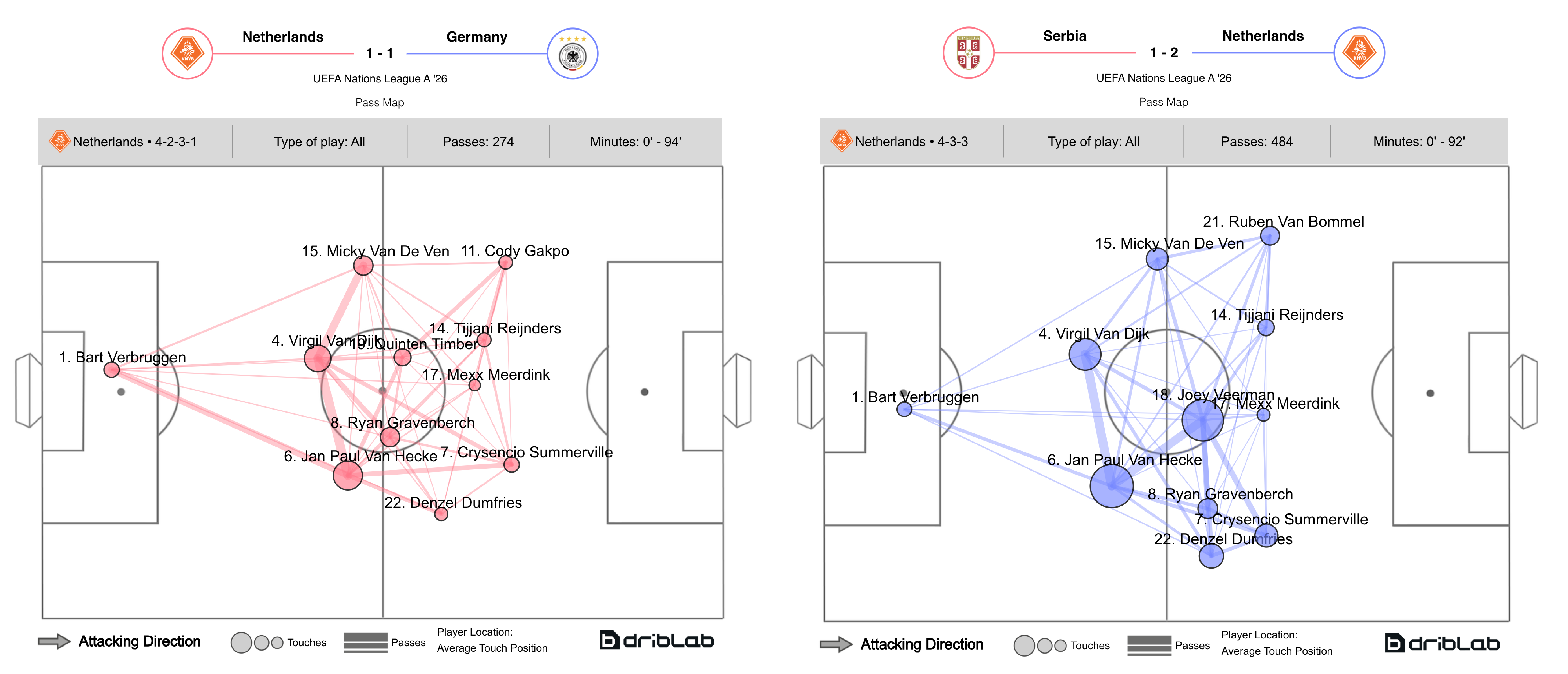
On the ball, the Netherlands did not use the conventional back four the on-paper formation could suggest. On the right, Dumfries pushes high and provides width. When the Netherlands have the ball, the Real Madrid player's job is to get into dangerous areas, whether to deliver a cross or to get on the end of moves that develop down the left.
On the opposite flank, Van de Ven, who's used as a centre-back at Tottenham Hotspur, takes on the role of a defensive or low full-back. His recovery pace and power to defend the space behind the back line make him a vital asset for a team that, as we'll see, wants to make intensity and a high press key weapons in its game.
When defending in their own half, both actually operated as conventional full-backs. They are two highly athletic players who compete well in individual duels.
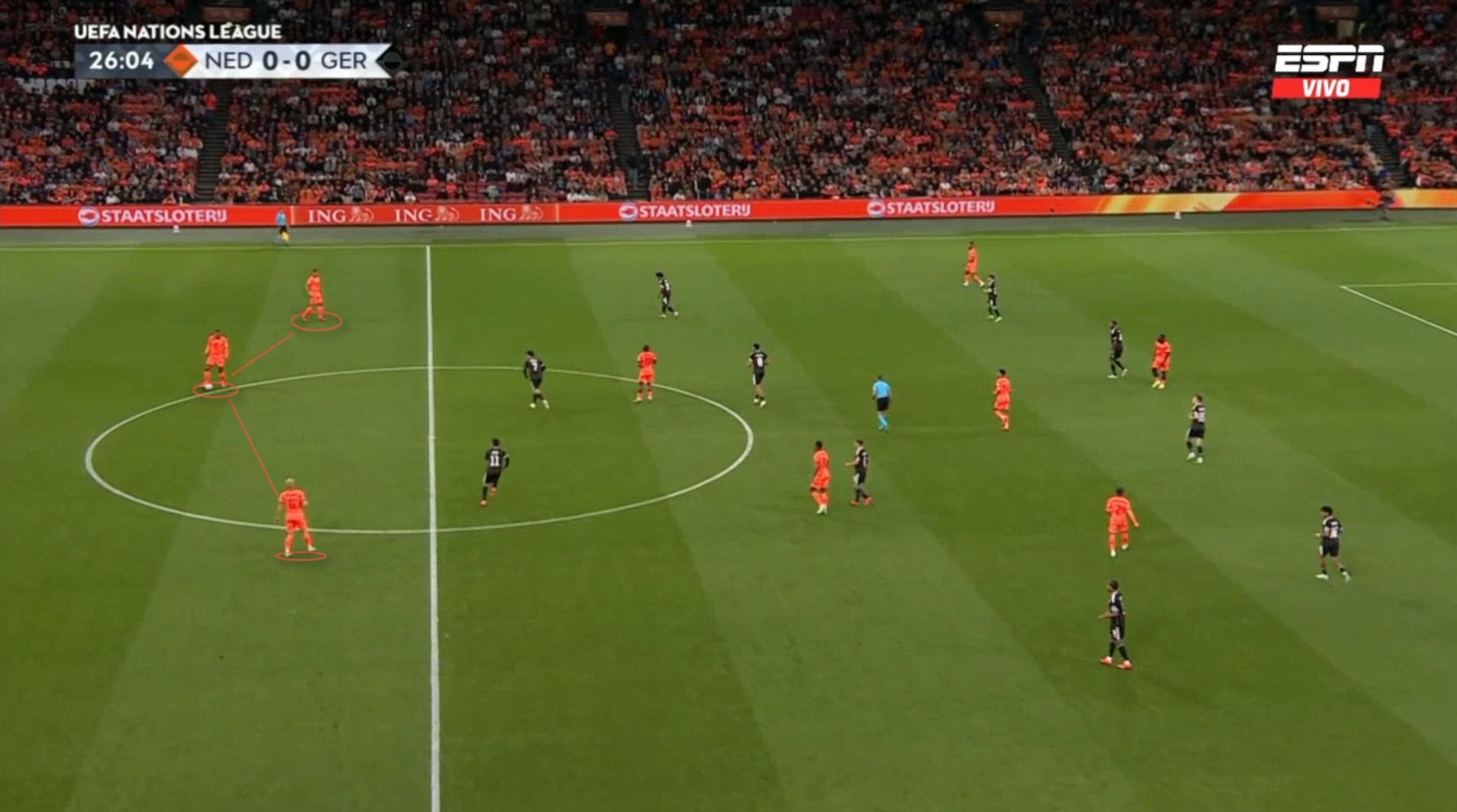
The team effectively builds up with a back three when in possession. As the image shows, Van de Ven lowers his position to stay cloose to the two centre-backs, while Dumfries stays high and wide to horizontally stretch the opposition block (he's out of shot).
With this tactical decision, Xavi wants to encourage closer connections in possession (especially in the first passes) and greater security after losing the ball.
Proximity matters in Xavi's positional football because the Catalan coach wants his team to play short passes as much as possible both to invite pressure and overload one side before quickly switching play to the far-side winger in one-to-one situations.
The national team has played 27 competitive matches since 2024 (excluding friendlies), and the Netherlands' average pass length against Germany (15.3 metres per pass) and Serbia (15.7) ranks among the five shortest of that period.
Ranked from shortest to longest, the average pass length against Germany sits second, behind only the Netherlands' game against Hungary in November 2024 under Ronald Koeman.
Another aspect benefiting from this back three is the team's ability to counter-press and protect itself against opposition transitions. This was key to Xavi's title-winning Barcelona: his side had the lowest PPDA (passes per defensive action) in LaLiga that season, and only two teams averaged more high recoveries (in the final 40 metres).
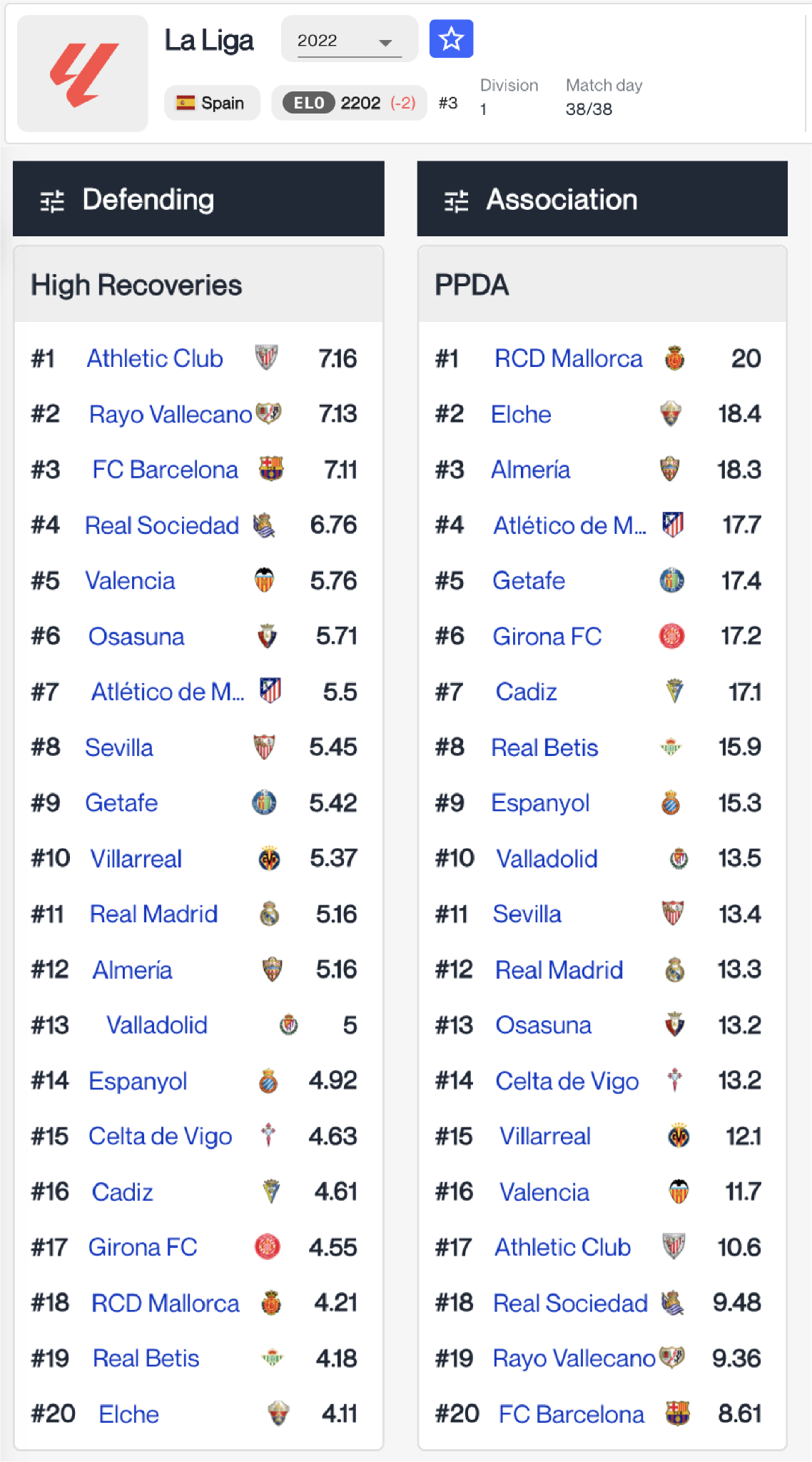
PPDA measures a team's defensive intensity out of possession. In other words, the lower a team's PPDA, the fewer passes it allows between each of its defensive actions.
The Netherlands' PPDA figures against Germany (11) and Serbia (9.9) are below the average for our sample (matches since 2024). In other words, their intensity out of possession has been higher than average.
They are not the lowest figures on the list, because the Netherlands have faced opponents who barely had the ball (Lithuania, Malta and Bosnia and Herzegovina) and others with very reactive game plans that allowed them to win the ball back quickly (Poland, Austria, Türkiye and Hungary).
However, the Netherlands also faced England, France, Spain (twice), Germany (twice, not counting this week's game) and Japan in seven of the twenty-seven matches in the sample, and their average PPDA in those games was 23.4 passes per defensive action.
A considerably higher figure, reflecting lower intensity compared with the PPDA recorded against Serbia and, in particular, against Germany, a top European side.

Higher up the pitch, the winger's roles are also different. The pass maps show that the left winger is more isolated than the right. On the left, the winger is tasked with providing width. On the right that same tasked is share between winger and full-back.
At Barcelona, Xavi found success by playing four central midfielders at once: Busquets, De Jong and Pedri as the nominal midfield three (one pivot, two interiors), and Gavi as a false winger who drifted inside to link play.
The Netherlands' answer to Gavi, the interior operating as a false winger, looks set to be not a midfielder at all but rather an attacker who, with some variations, takes on some of the duties the Spaniard carried out at Barça.
If we go back to the same screenshot…
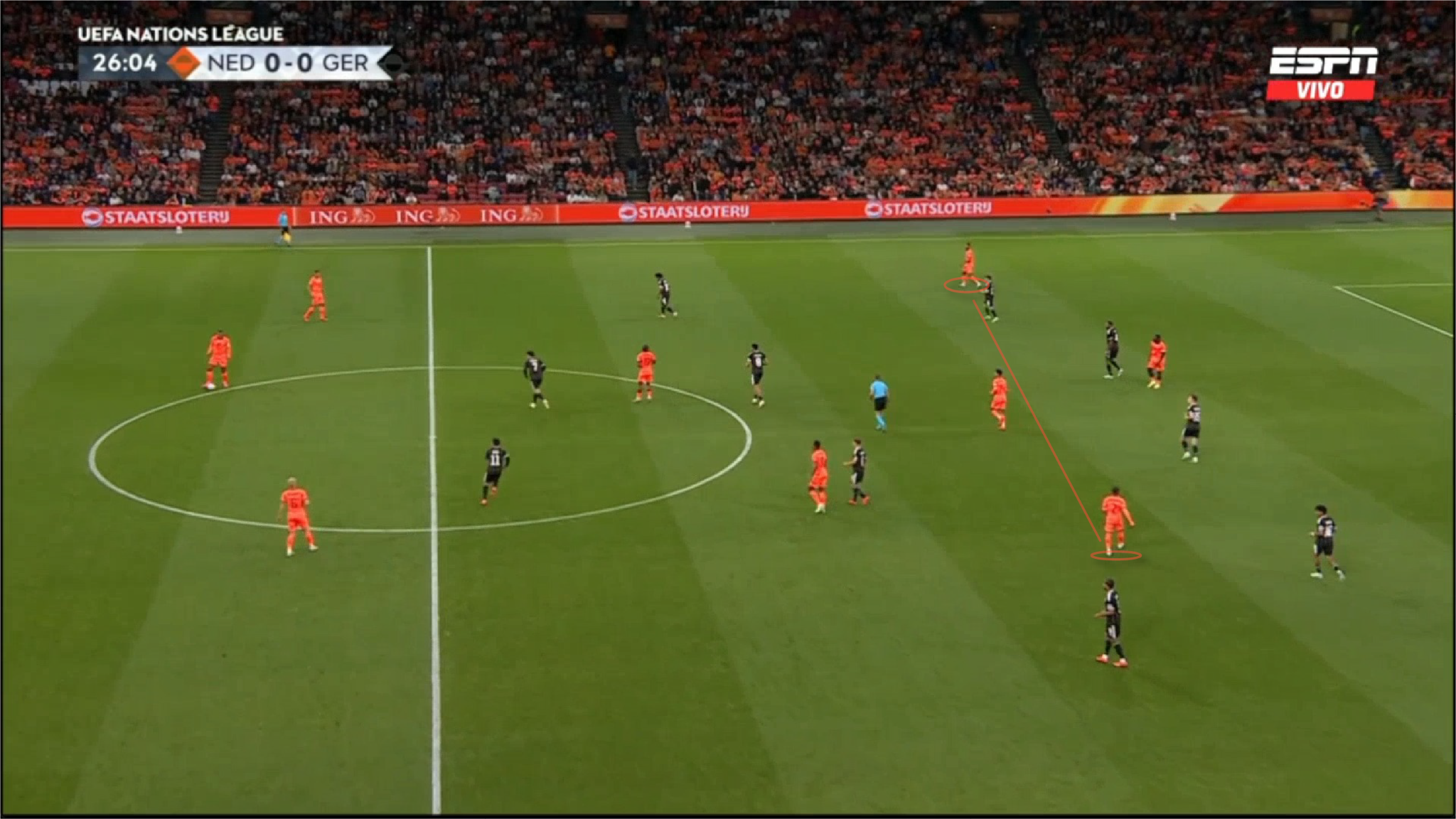
…we can see Summerville (right winger) is taking up an inside position, in the gap between the opposing full-back and centre-back, after a out-to-in movement. This means Germany's back line is pinned by four players, freeing Dumfries to push on and attack the space in behind down the right flank.
On the left, Gakpo offers an option out wide, both to run in behind and to receive to feet.
Wherever possible, and regardless of who is selected, Xavi wants his wingers to play different roles to give the team a range of attacking options.
On the left, both Gakpo and Van Bommel are direct attackers focused on the final action (a pass, usually a cross, or a shot). On the right, Summerville is a more mobile profile who roams freely across the pitch, can receive inside or out, is skilful in tight spaces and can interchange with Dumfries and Gravenberch, the latter of whom also tends to drift forward and wide.
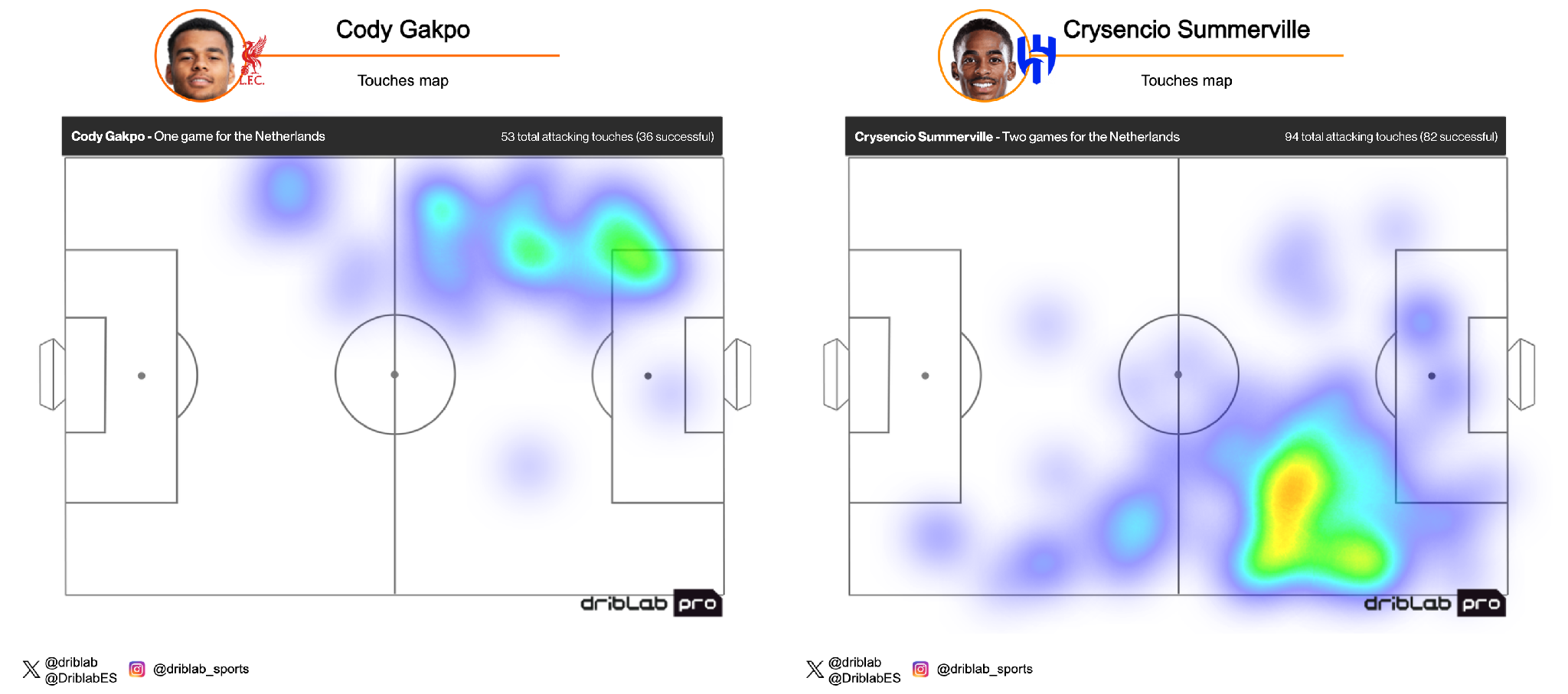
Our heat maps (based on each player's attacking touches) confirm the differences in the wingers' intentions and actions. In Gakpo's case, the map practically traces a diagonal line. For Summerville, who has been one of the Netherlands' most consistent players this international break, the more central areas show the most intense colours.
The more touches, the more intense the colour. Summerville has played more minutes and been more involved, but he is also a more mobile winger. That has been a big help for a Netherlands side that have created a huge amount of danger through intricate combination play.
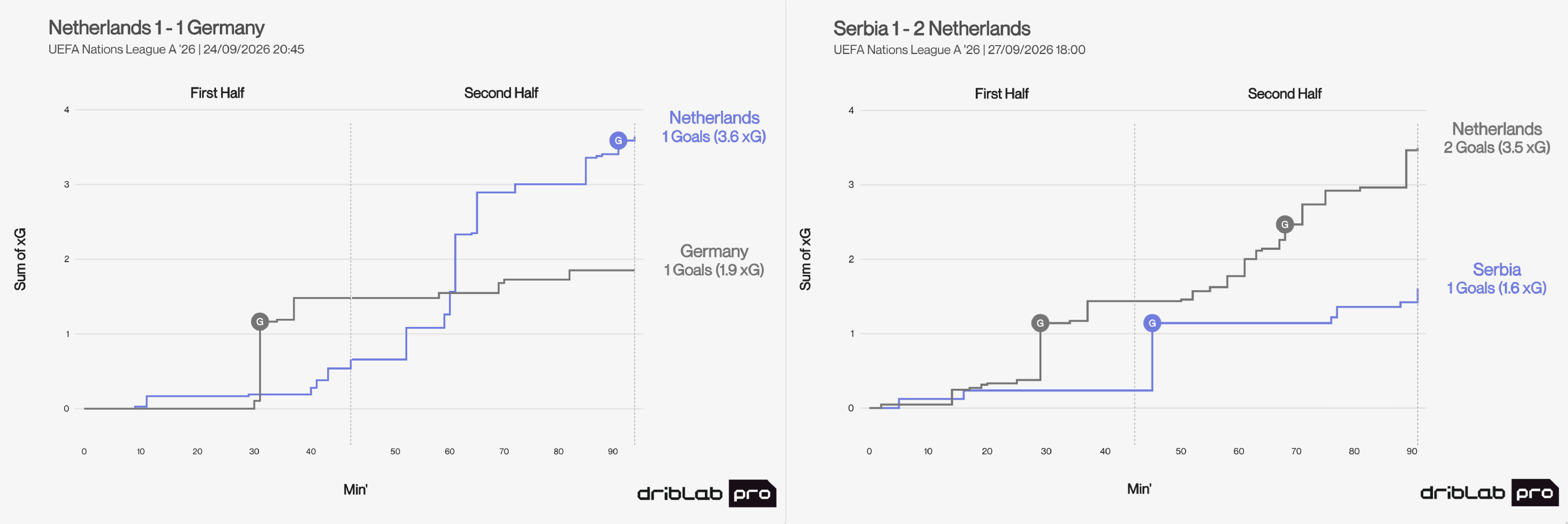
In terms of overall attacking output, the 2.6 xG and 3 xG against Germany and Serbia respectively rank among the five highest figures in competitive matches since 2024.
But what's really interesting is how that danger is being created. Once again, the Netherland's games against Germany (1.4 xA) and Serbia (2.2 xA) are among the six in which the national team have created the most expected assists (xA), excluding set pieces.
In other words, they have generated the most danger through passing and combination play, moving away from an ultra-individualistic style with no collective support.
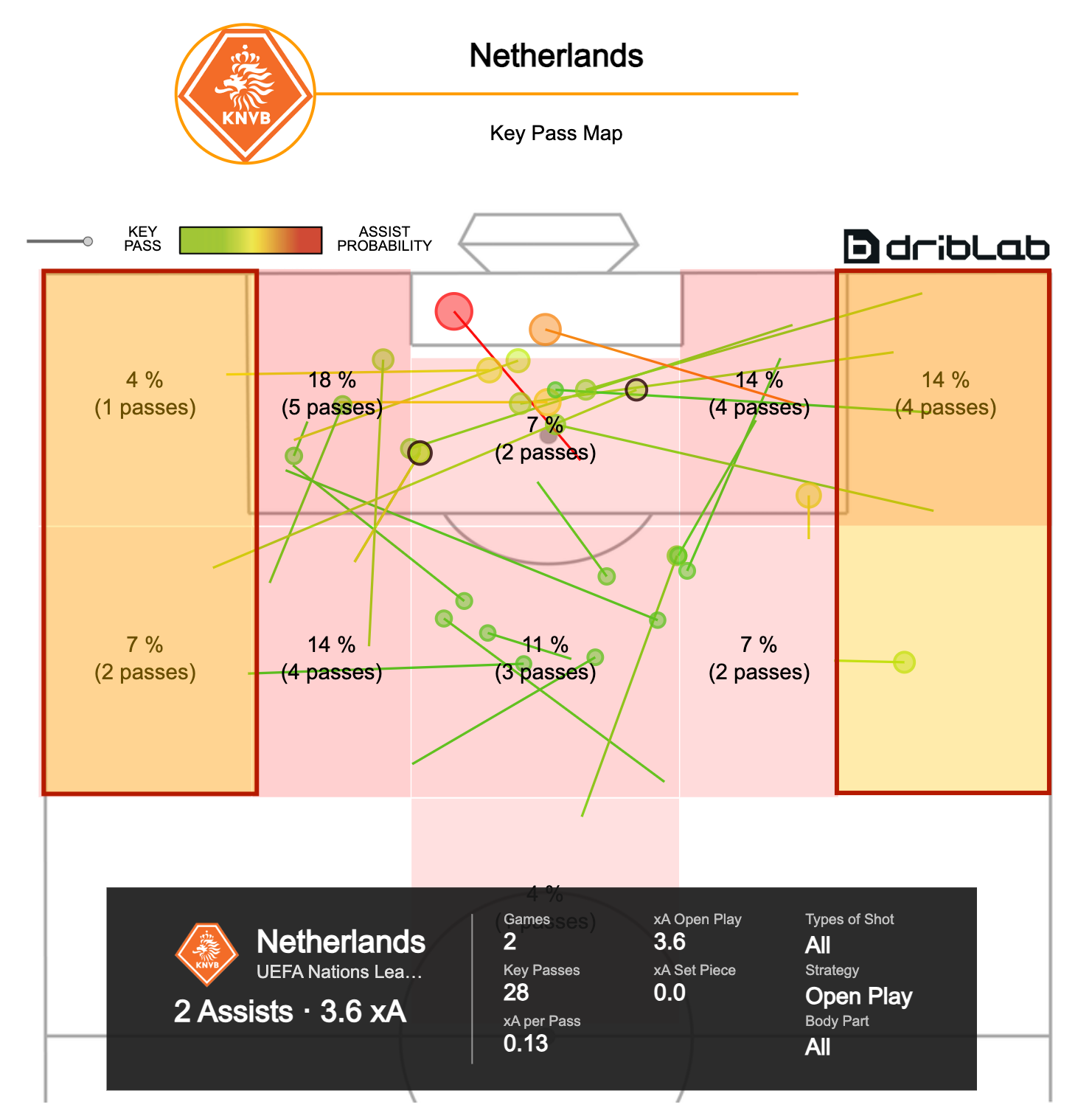
The key pass map (passes leading to a shot) shows the key role played by the rotations on the right flank in allowing the Netherlands to get in behind and pin opposition defences back.
In situations like the sequence below, Xavi's side take advantage of Van Hecke's vertical passing and the way Summerville draws the opposing full-back inside, so that Dumfries can attack the space behind him from a Reijnders pass.
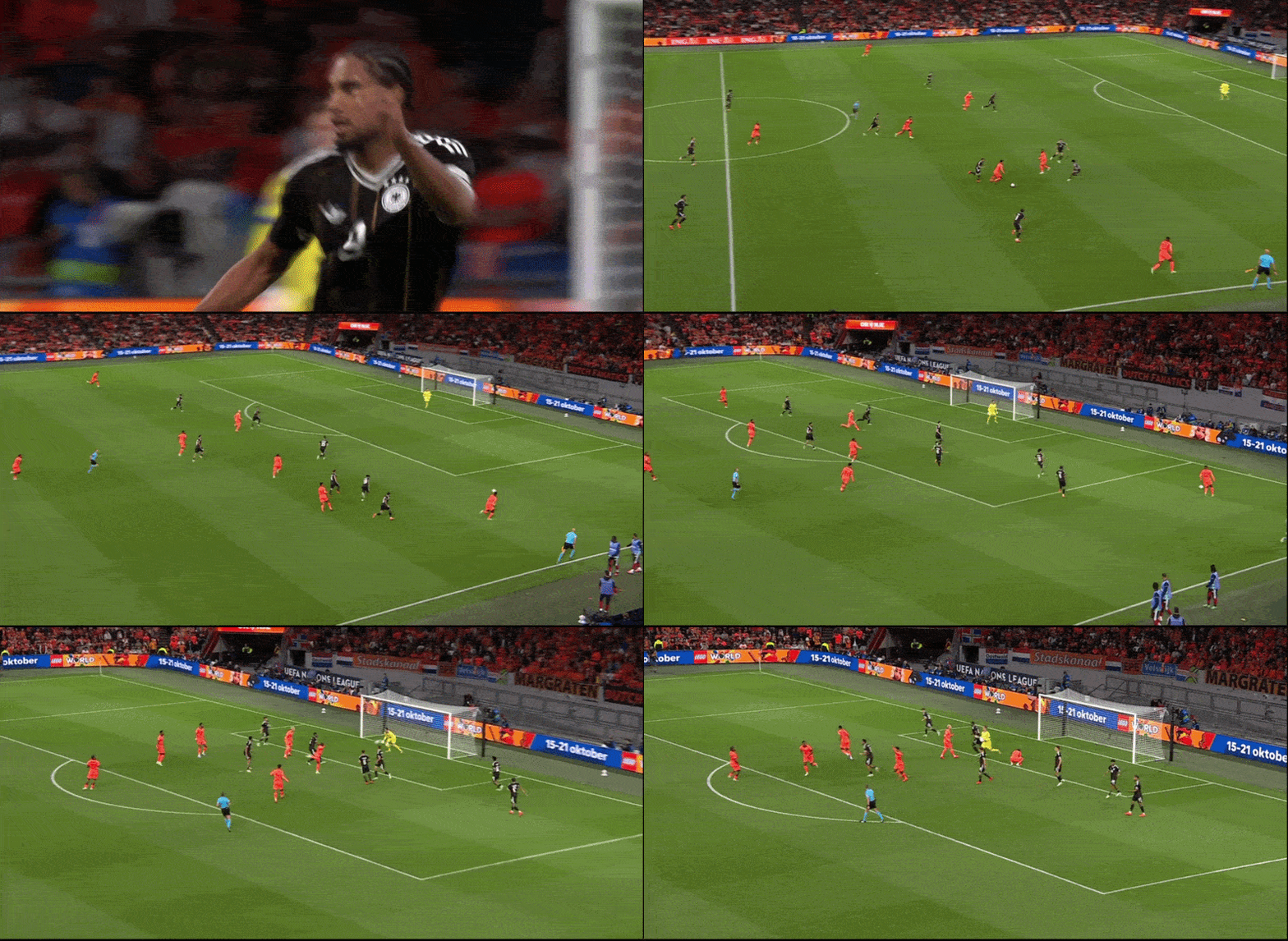
Simply by having Summerville inside, the Netherlands create a tension for Brown, Germany's left-back: he has to decide whether to track Dumfries' run or step out to a possible inside reception by Summerville.
In this other example, the Netherlands move the ball short and exploit the positional rotations on the right. This time, Summerville does receive the ball out on the touchline, but from a deeper than Dumfries.
The former West Ham man's movement towards the touchline opens up space inside, which Meerdink exploits by coming short, pinning his marker and laying the ball off for Dumfries, who is arriving at speed.
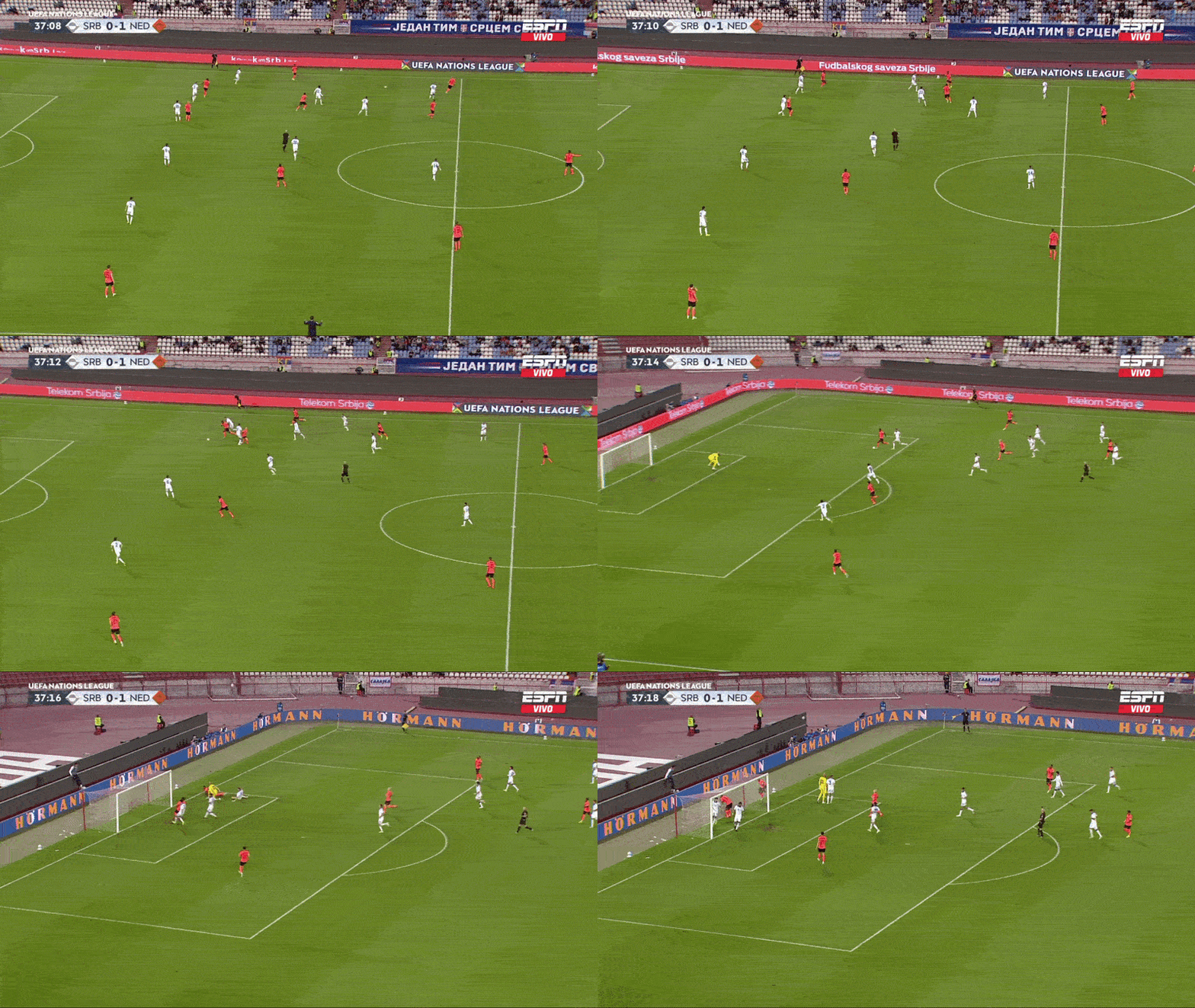
Starting wide, the Real Madrid full-back drags Serbia's left-back out with him, and the defender is then unable to stay with Dumfries as he moves from outside in.
Using heat maps, key pass maps and pass maps, along with other Driblab event data, we have tried to explain what Xavi Hernández is doing in his first games in charge of the Netherlands.
He has built a team that bears a strong resemblance to his Barcelona side of two years ago. With a back three in build-up, short passing distances and positional rotations, combined with the importance of high recoveries, Xavi is standing by his ideas and proving they still hold up, having had almost twenty-four months to work on and refine them.
The Netherlands have made a good start to the Xavi era, but the most interesting part is yet to come.



