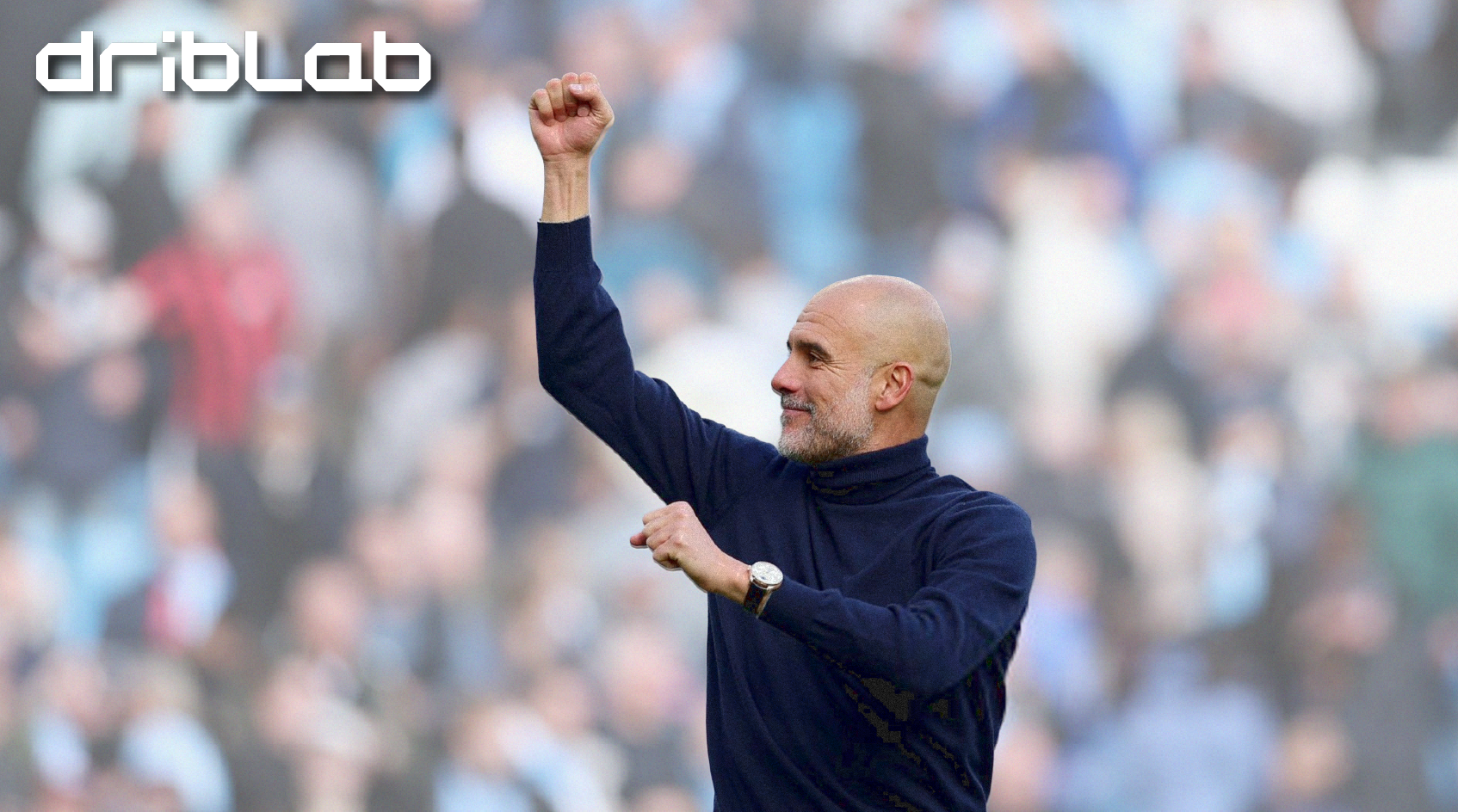
Pep Guardiola needs no introduction: he has won everything and beaten everyone. On his to-do list there are no titles left to harvest, no teams left to dethrone.
His figure, the idea of Pep in the collective imagination, has been so influential that no title he has won will be remembered as vividly as his way of understanding the game, of analyzing every last detail, and of stamping all of it onto his players and his teams. The type of things that go beyond the trophies. No one has influenced football more than Guardiola.
Now, as he leaves Manchester City after the ten most successful years in the club's history, we look back to understand how Guardiola changed English football.
Before doing so, Guardiola himself had to adapt to English football. Like someone infiltrating a cartel to understand how it works. After a first season of adjustment, Guardiola was able to lay the foundations of a winning project. But he needed that initial spell of conditioning first.
For this reason, the graphics in this piece treat Guardiola's true influence after his first season. The pre-Guardiola era, then, considers the seasons that came before him plus his debut campaign in England.
The Guardiola effect on the Premier League ran in two directions: the success of his Manchester City exerted an enormous influence on how the rest of the teams attacked and on how they defended.
The best sides in the English league began to defend through possession, on one basic principle: if I have the ball, you can't create any threat.
And the smaller clubs did the opposite: I'll let you have the ball and defend deep, so you push your block up the pitch and I can attack the space behind you. The stretch covering Guardiola's first three years was marked by a heavy presence of low blocks, which gave rise to that 10% climb in PPDA. A rise that would have been even steeper had we not factored in the last three years of masssive changed in the Premier League.
Teams with fewer resources were happy to defend deep and counterattack after winning the ball back. The league's physical level back then didn't allow for today's sustained, all-over-the-pitch pressing.
Guardiola built three title-winning teams at Manchester City across three clearly distinct stages, as Michael Cox lays out in this article in The Athletic. The league's recent change of paradigm, though (more physicality than ever, athletes chasing athletes all over the pitch, teams with a greater capacity to disrupt through pressing...) has meant Guardiola has been unable to put together a fourth title-winning City side.
But the three that came before reflect precisely his way of understanding the game. Teams built on very long spells of possession and eternal patience.
One trait that has always been there, in every version of Guardiola's Citizens, is the patient build-up. A team that works and moves together. The league caught that bug too.
Across the five seasons before Guardiola's second campaign (from 2012/13 to 2016/17), the average number of possessions of ten passes or more was 8.75 per match. The average over the following nine seasons rose to 11.03 per match. A jump of 26%.
Teams started to grasp that this way of playing, this way of understanding the game, was the one that would bring them closest to the titles. Manchester City won four in a row and teams tried to copy Pep. With their own weapons, of course.
Carrying out this kind of football is simpler when you almost always have the best squad in the competition. What's clear, in any case, is that the rest of the teams understood the purpose of Guardiola's football.
If we compare the style of the teams during Guardiola's first four seasons (leaving out 2016/17) with the style of the teams in the four seasons before Pep's arrival (that is, from 2013/14 to 2016/17), we see how the teams' way of playing took a major shift towards a style closer to the one Manchester City played.
However much the league turns the wheel back toward more end-to-end matches, I very much doubt the playing styles will return to the pre-Guardiola numbers. And that's the greatest compliment you can pay a successful manager: that not only his titles endure, but also his influence on the game.
Guardiola leaves Manchester City as a winner, but also as a manager who knew how to adapt to the league and then go on to change the history of the competition. For all the talk of Guardiola as a dogmatist, the Catalan reshaped his style and added variations to his teams that let him keep on winning.
The Premier League bids farewell to a historic manager, an obsessive winner, and one of the few coaches who still explains most of his tactical decisions in detail in press conferences. Something that, just as his teams did with the Premier League, has changed the way many others understand the game.


.jpg)