
Football is a sport that requires high levels of mental agility. Mental agility, in turn, is a combination of clarity in decision-making and precision in execution. A footballer is constantly evaluating: which mark should I follow, how should I position myself to receive the ball, who should I pass to, how will I finish, and so on. A key factor in a player’s mental agility is fatigue. The more exhausted a player is, the harder it becomes to think clearly and execute precisely, because their mental sharpness has diminished.
The striker is the position where fatigue has the biggest impact of all and where it is most decisive. Yet modern strikers are asked to do more and more: to lead the press during the opponent’s buildup (often outnumbered), to win aerial duels, to fight with opposing center-backs, to draw and commit fouls, and to make runs behind the defense, among other things. All of this comes before we even consider that they are expected to be efficient in front of goal. That means they have to maintain a high degree of mental agility to decide clearly and execute precisely in front of goal.
Think of a striker who, exhausted by all the non-finishing demands from his team, struggles to find the net and ends the season below their expected goals. It might simply be that he lacks the finishing efficiency of others, or it might be that fatigue is directly affecting his scoring output.
We are going to investigate how fatigue impacts goal-scoring performance. You will enjoy even more this text if you keep the next question in mind: is your underperforming striker being overworked?

We will work around the on the Striker Workload metric, essentially the “volume of work” a striker performs, discussed by Ali Maxwell in his article Have Championship strikers got the yips?. We will call it Workload, and it sums all non-shooting actions that involve notable physical exertion and generate fatigue. For this analysis, we'll use our XY metrics.
A striker’s workload is the total of actions that represent significant physical effort and are not related to finishing: interceptions, recoveries, attempted tackles, aerial duels, fouls won, and fouls committed.
To ensure our sample is large enough to produce reliable results, we selected data from the last two seasons of the five major European leagues (2023/24 and 2024/25). We filtered the dataset in two ways: players must be strikers and must have played more than 800 minutes. A total of 481 strikers across the last two seasons meet these criteria.

First things we see is that the 15 strikers who average the highest workload per match belong to mid-or-lower-table teams. These are teams that have less possession, play more direct football, and do not base their attacks on intricate passing sequences.
Still, we need to look at the distribution to understand how many strikers experience high fatigue.
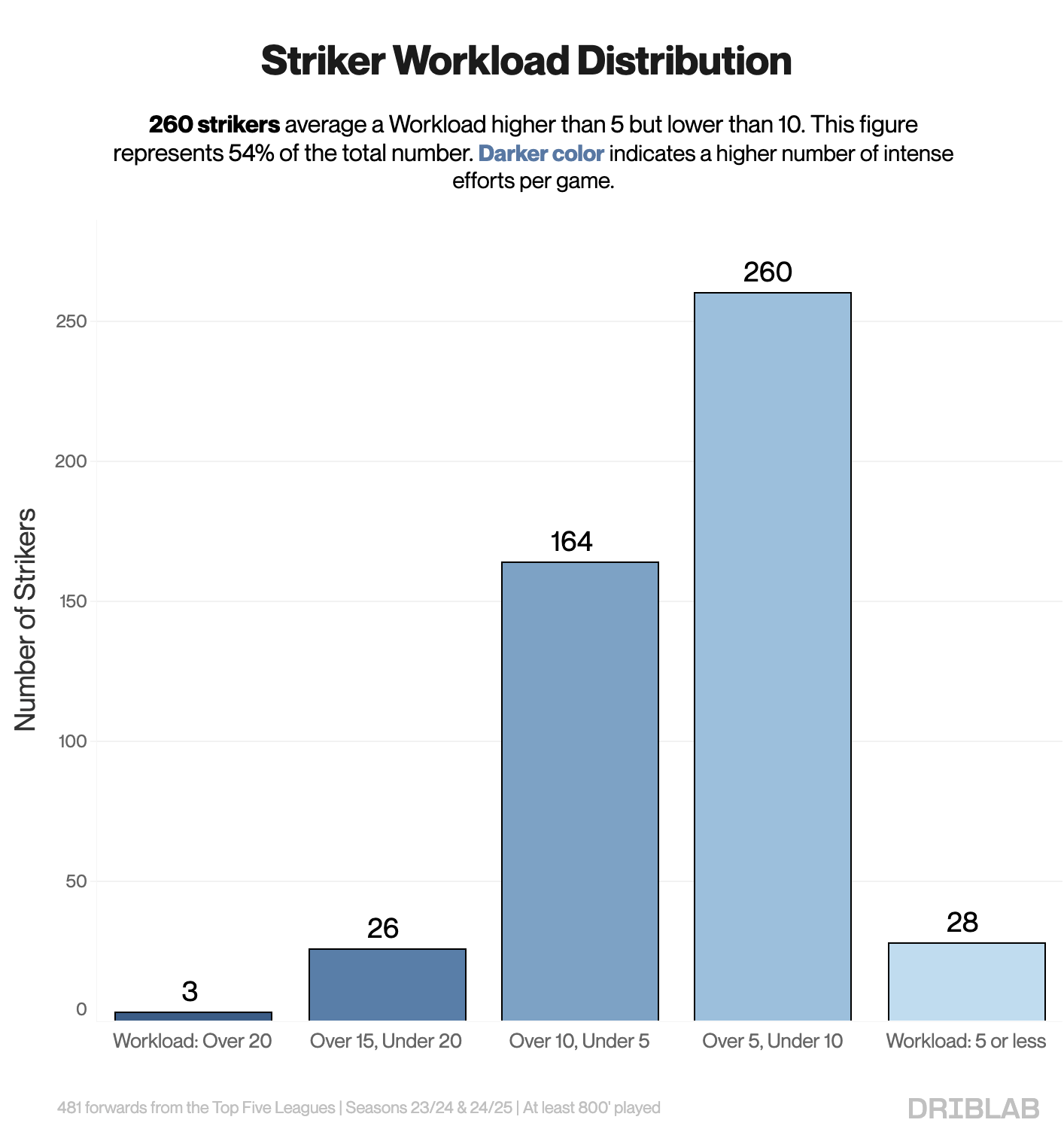
54% of strikers do not fatigue much. In addition, there are 28 who barely perform any actions that involve significant effort. In other words, 6 out of 10 strikers have a light or very light workload.
Our first conclusion comes from examining workload distribution. We consider a striker heavily loaded when they exceed 10 workload actions per match. This represents the 40% of strikers averaging 10 or more high-exertion actions per game.
Now that we understand the distribution of work, let’s examine goal-scoring ability, starting with how strikers are split between those who finished the season below or above their expected goals (xG). The famous over and underperformers.
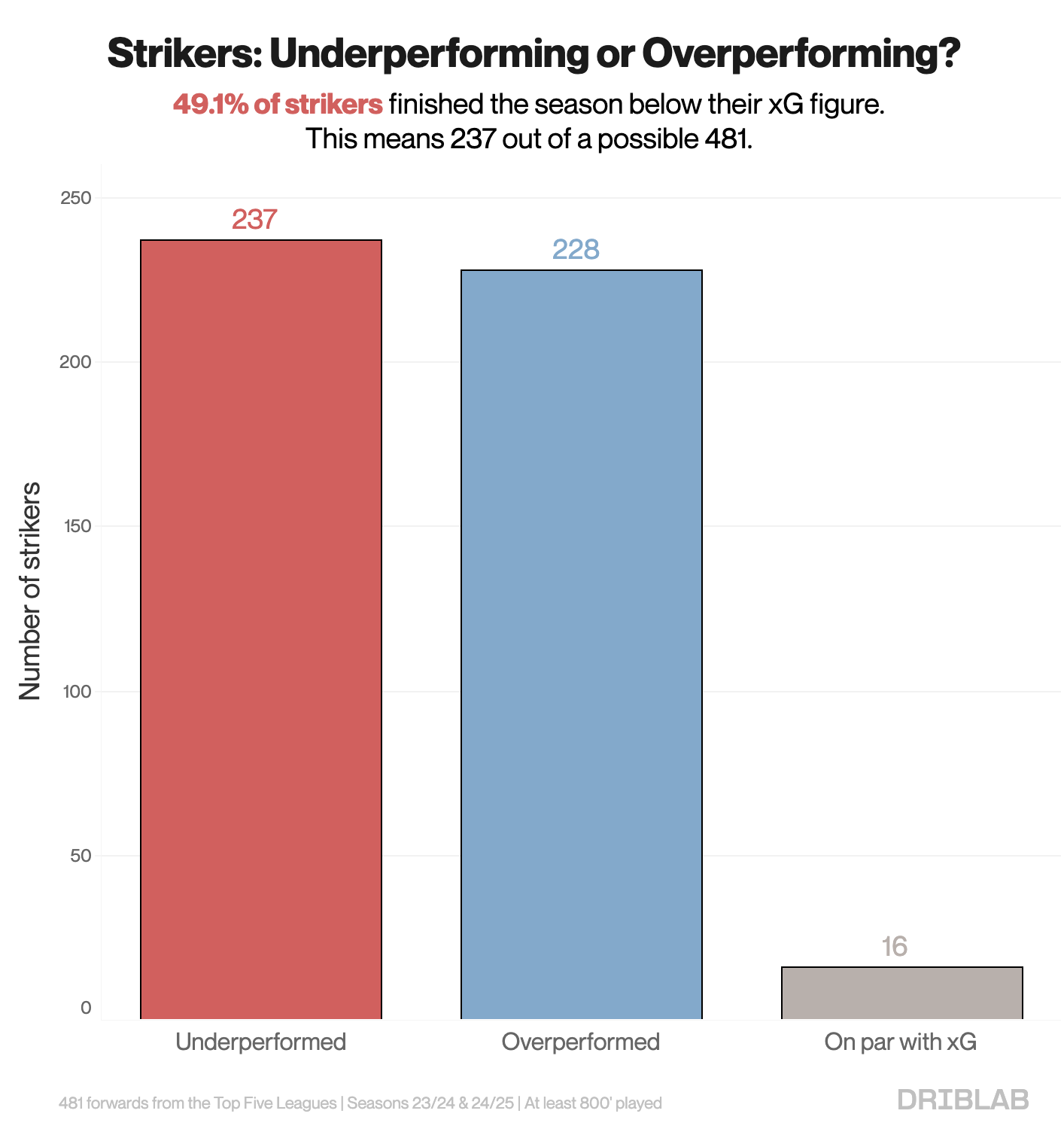
237 strikers underperformed their xG, representing 49.1% of the total. Among them, standout campaigns include Kike García (23/24), who had a -5.86 difference, and Cyle Larin (23/24), with a -6.46 difference, both strikers from mid- or lower-table LaLiga teams.
On the other hand, among the 47% of strikers who exceeded expectations, Sorloth stands out. The current Atlético de Madrid striker scored 17 more goals than expected across the last two seasons in Spain. Across his last three seasons, including the current one, Sorloth accumulated 46 goals from 27.7 xG.

Now that we know the workload distribution and the percentage of strikers above or below xG, the next step is to examine how fatigue and scoring performance interact and the consequences for finishing efficiency.
We will focus specifically on strikers who accumulate a high workload during matches, meaning those with 10 or more high-exertion actions.

In the last two seasons across the five major leagues, 193 strikers averaged at least 10 high-effort actions per match. Among them, nearly 6 out of 10 finished the season below their xG, or below the goals they should have scored.
If your style of play forces the striker to fatigue more than average, as a coach you must know that his chances of underperformance are significantly higher than otherwise. 59% of strikers with a high workload per match scored below expectations.
We can therefore state that as workload increases, so does the number of strikers with poor finishing performance (those who do not exceed xG). Across the total sample, 49% of strikers finished below expected goals. Looking only at those above-average in workload, that figure rises to 59%. A notable difference.
The difference is also evident among the strikers who did outperform their xG. 155 of the 228 strikers who exceeded their expected goals had a limited or very light workload.

If you want to prioritize effectiveness, your striker must avoid excessive fatigue. This is a significant conclusion: the vast majority of players who outperformed their xG remained fresh and lightly loaded during matches. In almost 7 out of 10 cases, a mentally sharp, fresh striker (with a workload under 10) is a striker who scores more than expected.
The more physical wear a striker accumulates, the higher the risk that their finishing efficiency will drop. And while not all fatigued strikers underperform, almost half of those who do belong to the highest workload groups.

The relationship between workload and efficiency in front of goal is intuitive but should play a more central role in evaluating overall striker performance. It is a structural element in their assessment. Our data show that at the elite level, asking a striker to act as the first defender, win duels, and earn fouls has a direct impact on what matters most: their ability to score goals.
The more high-exertion actions a striker performs, the greater the risk that their mental sharpness at key moments decreases, and with it, their efficiency. And efficiency equals points that may be lost over the course of a season. The percentages are clear: strikers with high workloads are much more likely to finish the season below expectations, while those who outperform xG usually do so by staying fresh and avoiding actions that compromise their mental clarity.
This is not to say a striker should not work hard, but every decision by the coach that increases fatigue comes with a hidden cost, which can reveal itself in the most sensitive moments: first touches in the box, speed of execution, and shot precision.
With this investigation, we aim to highlight the importance of fatigue in performance analysis, closing with a reflection: if you want your striker to score more, perhaps you need to ask them to do less.