With the progressive development of Arrigo, Driblab’s technology that combines eventing and tracking data, a huge range of previously unknown possibilities opens up around game analysis.
Today, we will focus on making the most of one of the many metrics born from Arrigo’s evolution: Passes Received in Space.
We define a pass received in space as one where a player receives the ball and, toward the opponent’s goal, faces no opposition within the first five meters.
The scope of this metric can vary, just as its usefulness does. For example, in opponent analysis, Passes Received in Space help determine whether a team is more aggressive or passive defensively depending on how frequently opposing players receive the ball in space ahead of the defensive block.
The analytical framework we have created for today allows us to identify which players receive the most passes in free space in the opponent’s half, in which areas, and why.
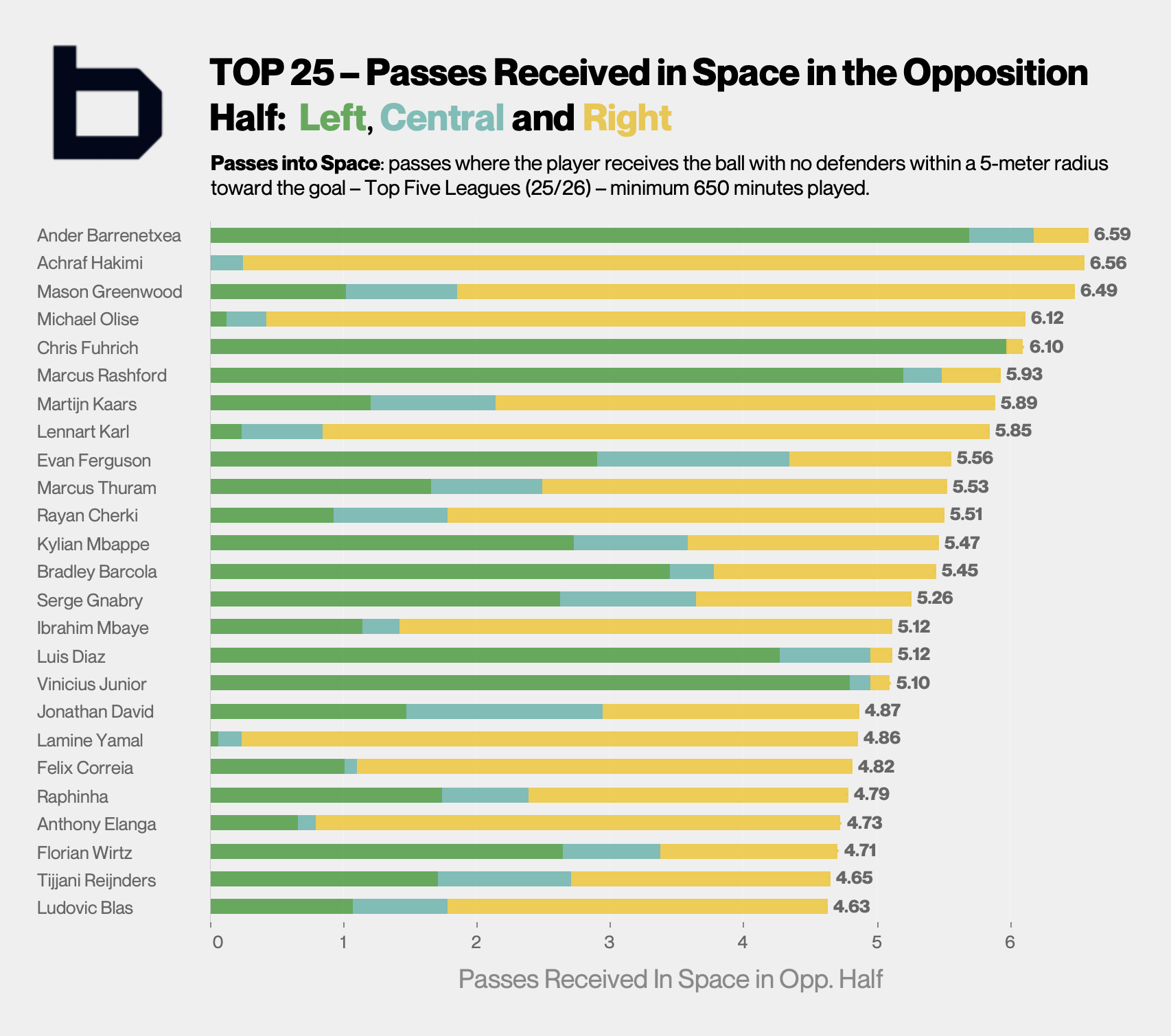
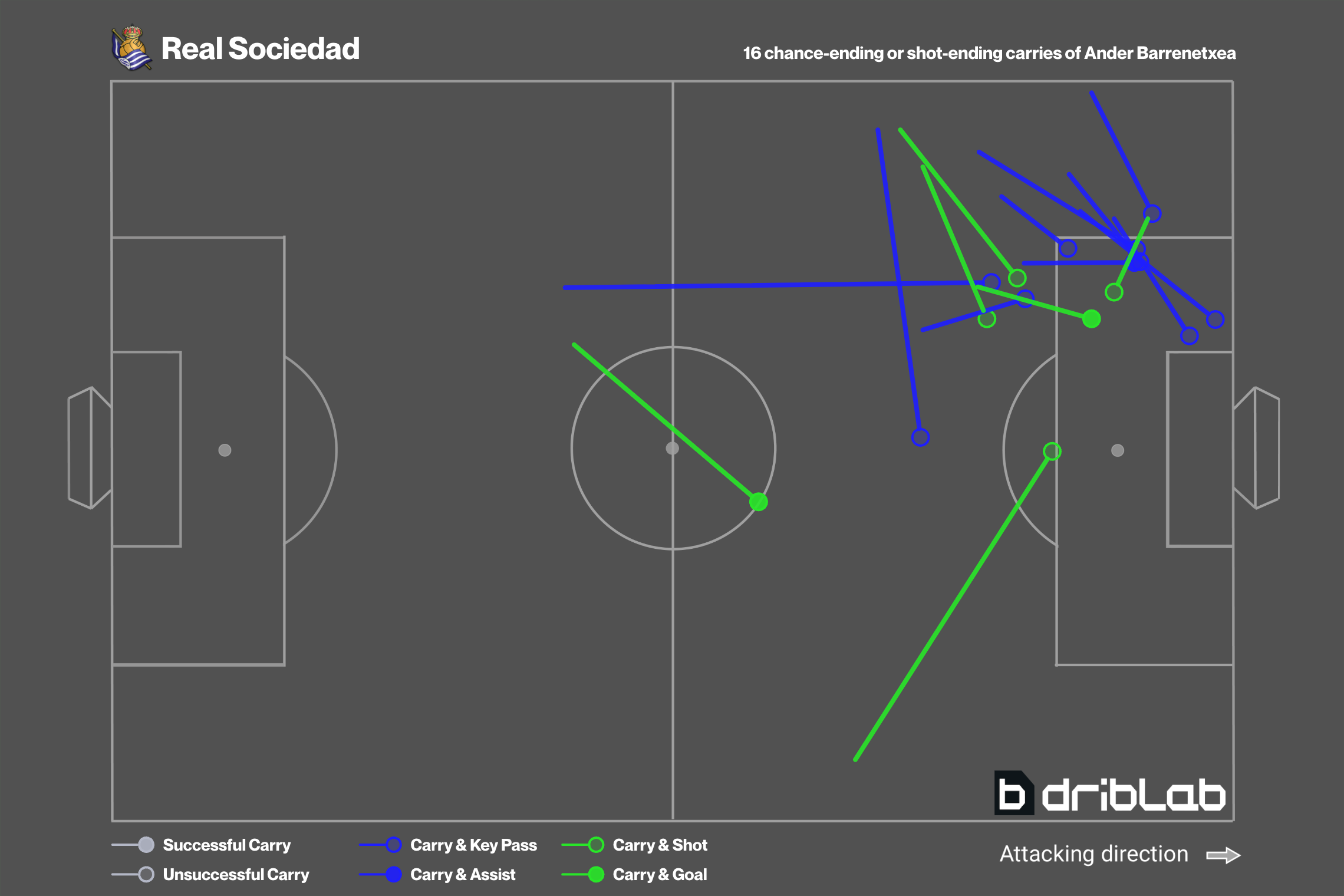
The first name is Ander Barrenetxea. The right-footed winger who plays on the left for Real Sociedad is the player who receives the most passes in space in the opponent’s half across the Big Five European Leagues, with 6.59 per match. In total, he has 80, the ninth highest figure, behind names like Kylian Mbappé, Mason Greenwood, Vinicius Junior, or Luis Díaz.
The Basque player is the main reference point in a Real Sociedad team where wingers play a significant role. The Txuri Urdin build their play to find Barrenetxea in advantageous positions so that he can drive forward powerfully, dribble, assist, or shoot.
Receiving passes in free space on the wing helps him average 0.7 carries per match that lead to a teammate’s shot, the seventh highest among wingers and attacking midfielders in the league.
On the other hand, the second player who receives the most passes in free space centrally is Achraf Hakimi, a very different type of player. The Moroccan is one of PSG’s most distinctive offensive weapons, despite playing in a theoretically deeper position as a right-back.
Hakimi is the right-back in the Big Five European Leagues who receives the most progressive passes (22.6 per match), the most progressive passes in the opponent’s half (18.1), the most in the final third (12.7), and the most in the opposition area (1.05). To emphasize further, we are talking only about passes that move the ball at least ten meters toward the opponent’s goal. Hakimi constantly pushes forward in attack.
He combines two aspects in his ability to receive the ball consistently high and in space: incredible physical capacity for repeated efforts (he is the sixth right-back in Ligue 1 with the most sprints per match, 13.1) with the intelligence and willingness to move off the ball at the right moments.
.png)
The players in the top twenty-five of our list are mostly wide players (whether wingers, full-backs, or other positions). Free space in the opponent’s half appears primarily in the wide channels.
Defenses structure themselves to prevent advancement through the central channel. It is the most direct route to dangerous situations and therefore requires the most attention. As a result, many teams place their best players in the outer areas, where space exists, so they can exploit these zones to destabilize the opposition.
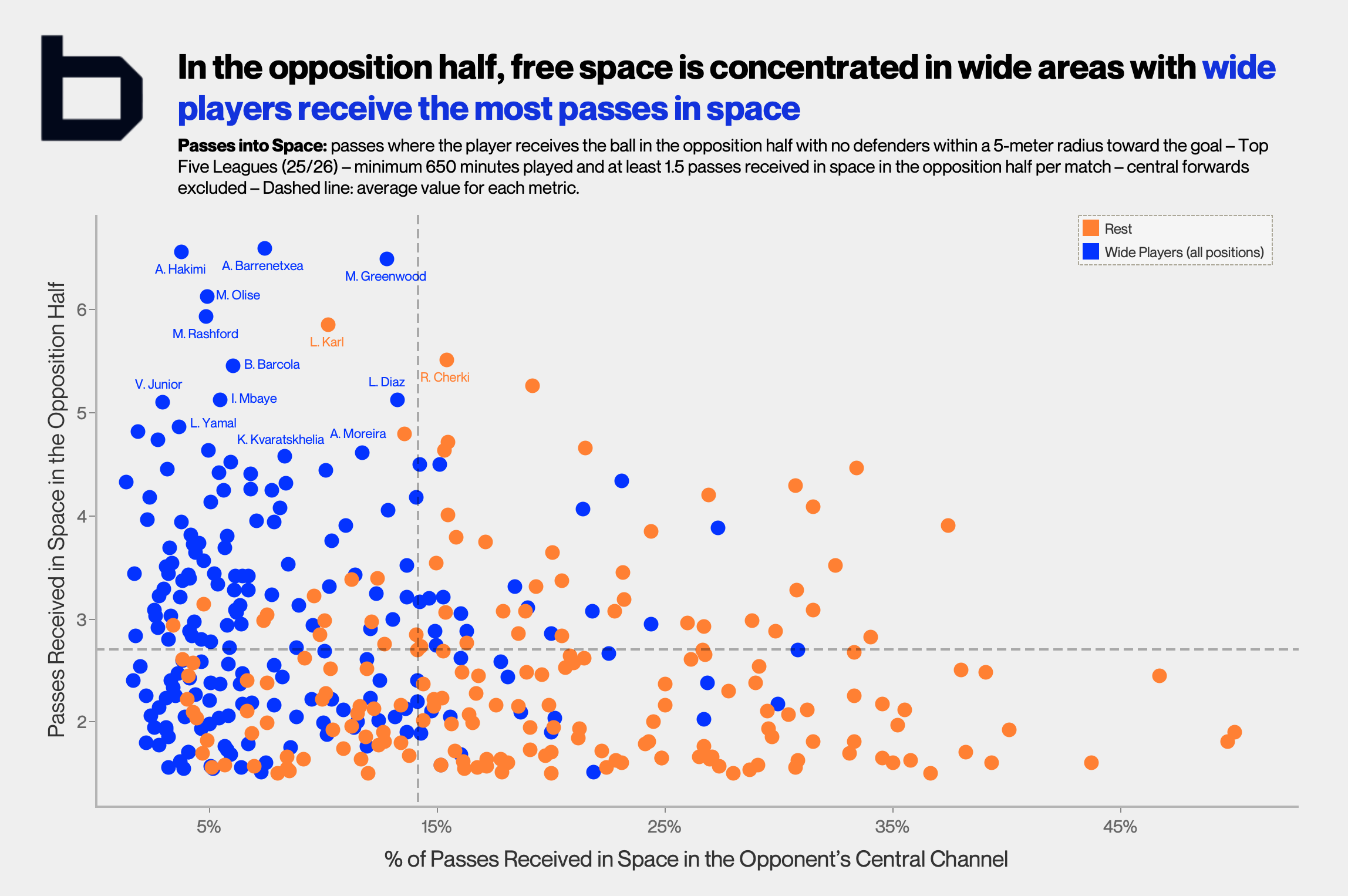
Known names like Hakimi or Barrenetxea hover around a very low 5% of passes received in the central channel. In other words, around 95% of passes received in space occur in wide areas.
For this reason, in the current context we should highly value the player capable of finding space in areas where it rarely exists. The player who starts from the wing but receives inside, and especially the one who positions himself centrally and receives freely in interior zones where the most valuable space is found.
Looking at the previous chart, players positioned in the central channel receiving inwards would be the orange points in the top-right quadrant. But don’t worry: I’ve highlighted the most interesting ones in the following chart.
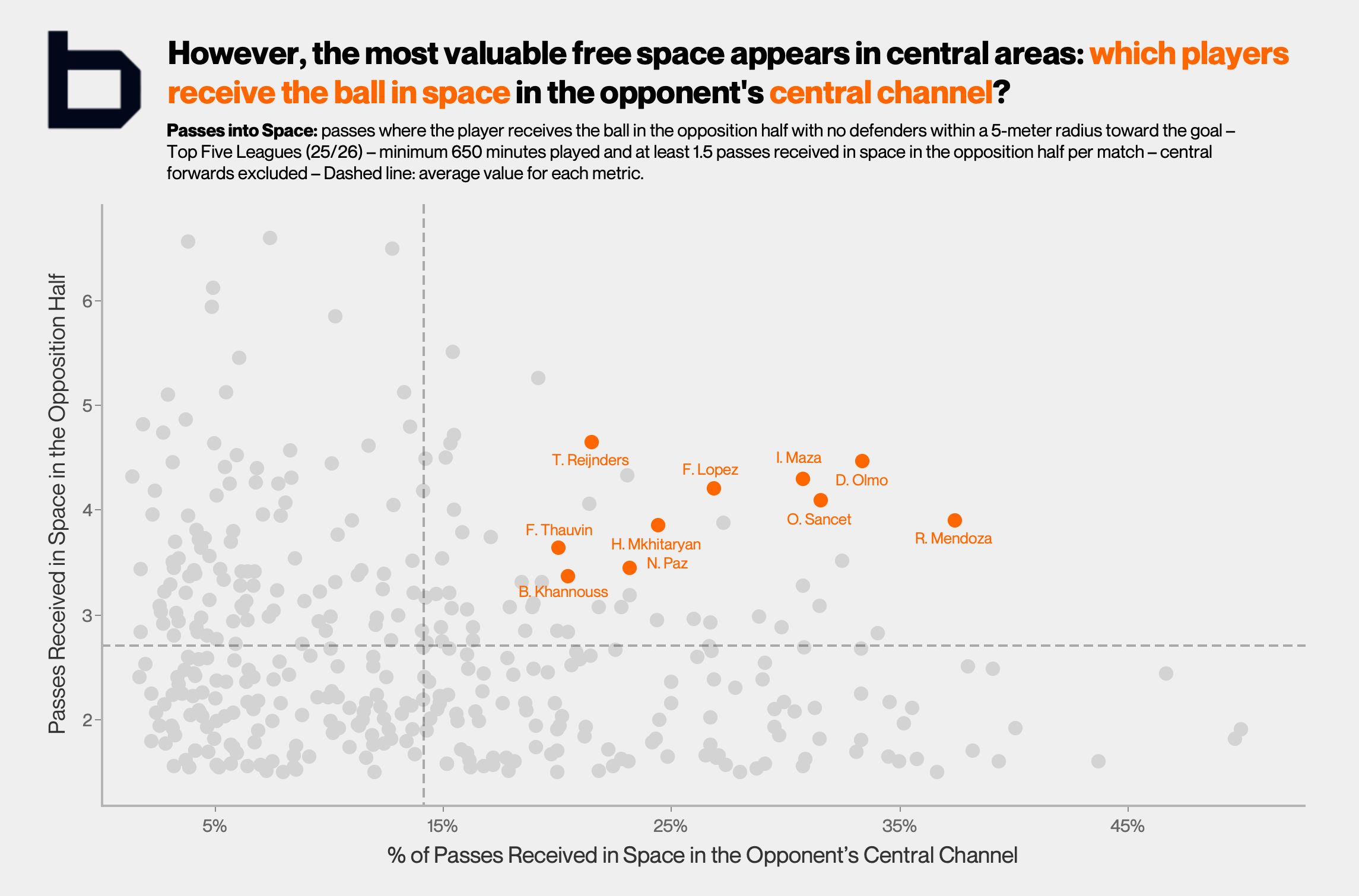
The context in which these players can shine is shaped by their teams. Bayer Leverkusen is the fifth team that averages the most passes breaking the opposition midfield per match (36.3), so it’s no surprise that Ibrahim Maza is one of the players who most frequently receives passes in the central channel.
But he is also a player who enables this to happen: Leverkusen can deliver passes with that frequency because it has players with the quality and intelligence to both give and receive them. Maza, while capable of the former, excels at the latter. So far this season, he has received 12 passes in space in the central channel of the opponent’s half.
It may seem low compared to passes received in wide channels, but these are extremely difficult passes to give and receive, and therefore rare. They must be received with at least 5 meters of space from the nearest defender toward goal.
Maza excels in these situations because he is extremely reliable under pressure—he is the fifth central midfielder in the Bundesliga completing the most passes under intense pressure—and his teammates trust him to receive in space and beat opponents once they close in.
He is also a very active player. He never stops moving, which is extremely useful for finding space. Maza averages 9.13 deep runs (movements ahead of the ball carrier without attacking the space behind the defensive line), the sixth highest among Bundesliga central midfielders.
.png)
Another young player with remarkable ability to find free space centrally is Fermín López. The Spaniard benefits from Barcelona’s second line being the widest in the Big Five leagues when in possession.
Wingers receive near the touchline with two possibilities: if you come to mark me, the team can shift, leaving space on the other side; if not, I receive with time and space to make a difference with my quality. In between, spaces open that Fermín exploits.

With players like these, we see a trend: they move a lot off the ball. Maza and Fermín average almost the same number runs ahead of the ball(9.13 vs. 9.59) because they are constantly offering themselves and complementing teammates’ movements to drag opponents and generate valuable space.
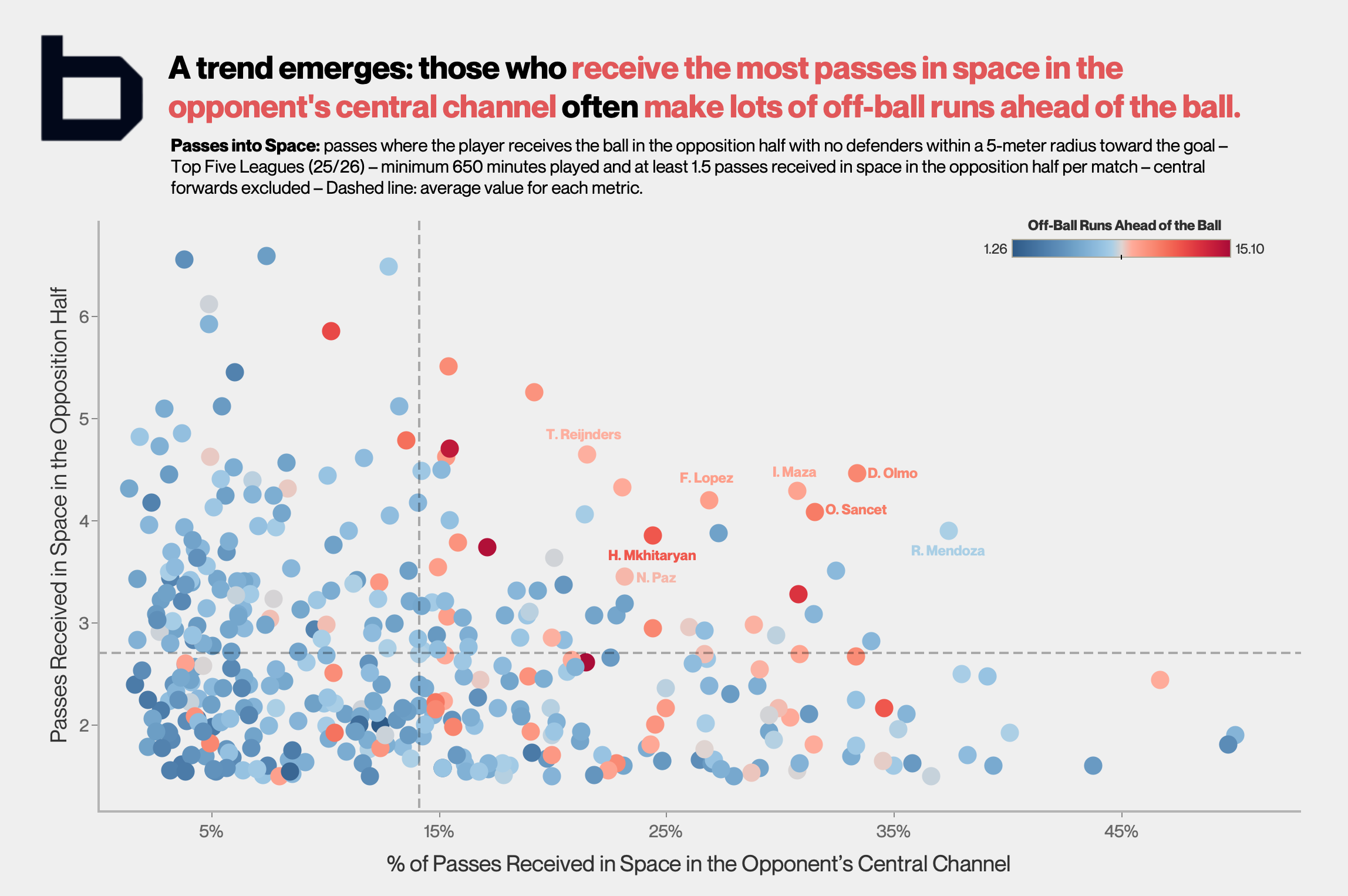
If we revisit the chart and color-code it according to average deep runs per match, we can see that those who move the most are the ones who most frequently receive in the opponent’s central channel. It is a trend, even though there are exceptions, such as Rodrigo Mendoza, who receives a lot centrally but does not move more than average.
Ibrahim Maza, Sancet, Olmo, Mkhitaryan, Nico Paz, and Tijjani Reijnders are our favorite receivers. And the players offering the most value in these interior zones are those whose task is extremely difficult in the current football landscape.