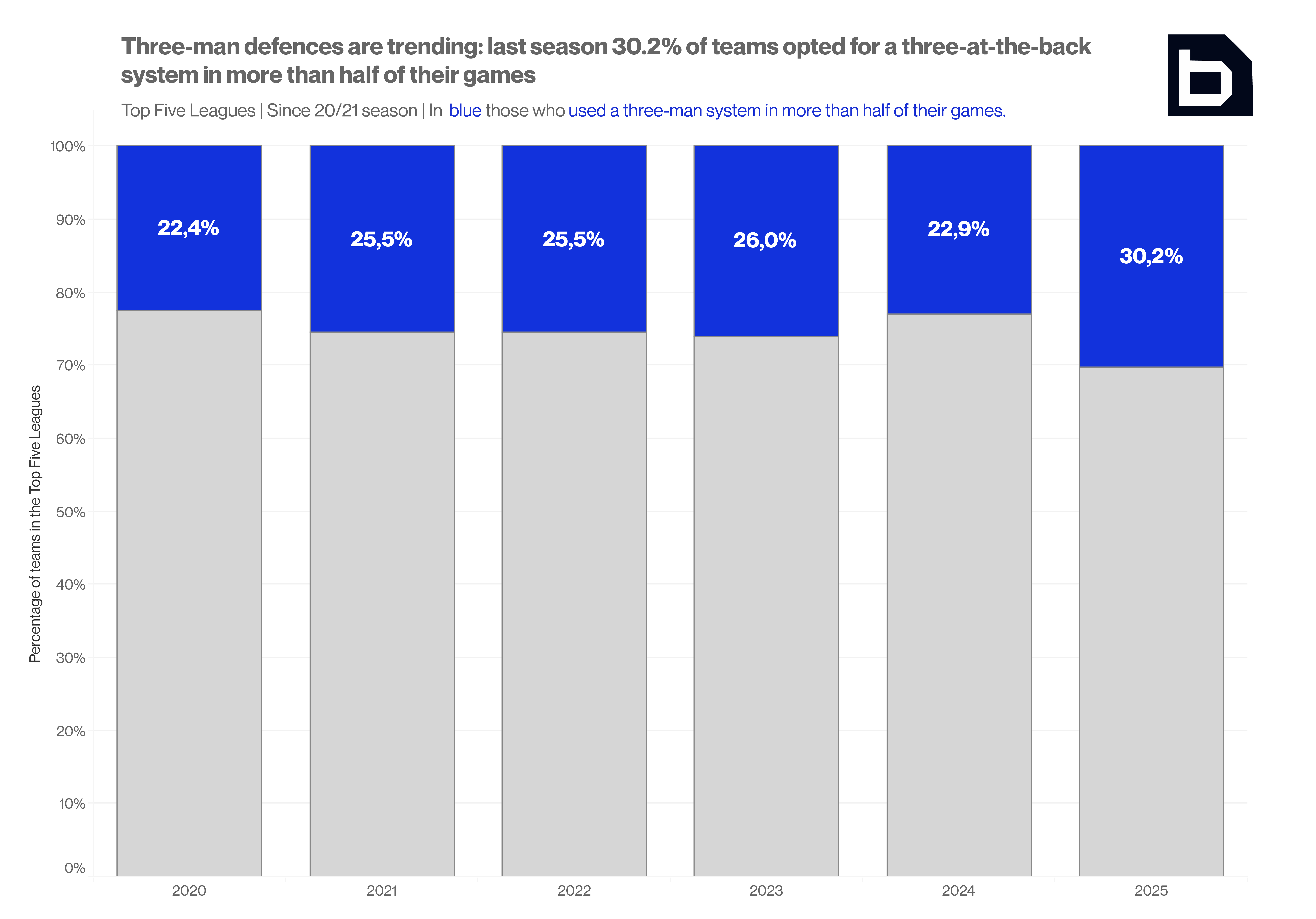
As football shifts towards three-man defences and man-to-man pressing spreads across the pitch, sporting directors and their scouting departments need to select with great precision the defender profiles their teams require.
The first major difference between defenders lies in the how, in their reaction to emerging danger. Some defenders prefer to nip it in the bud, while others wait for the right moment to arrive.
On defenders and how they perceive danger, Carlo Ancelotti once said:
"I always say there are two types of defenders: pessimists and optimists. And he (Nacho Fernández) is a pessimistic defender, because he always thinks something bad could happen, and that's why he's focused for all 90 minutes."
That would be one way to split defenders into types: between pessimists and optimists.
Using our 'Breadth' metric as our main tool, we're going to look for another way to differentiate them: between proactive (or aggressive) and passive.
'Breadth' is defined as the sum of tackles attempted, interceptions, challenges faced and fouls committed in the outer zones of the pitch.
It's a metric that helps us identify which centre-backs show a greater willingness (or are forced by their team's style of play) to carry out defensive actions on the flanks of the pitch. That means they have to leave the central zone, which is naturally a defender's territory.
.png)
If a centre-back leaves his position and jumps out to an outer zone to nip a dangerous situation in the bud, we consider that an active response. Always bearing in mind that football isn't black or white, and that every player is the product of both their own characteristics and their circumstances (their team).
This circumstance is very important when it comes to differentiating profiles. That's why we mark a distinction through colour depending on whether each player's team lines up with three centre-backs or not.
The outer centre-backs in a back three are, for the most part, proactive centre-backs. Because of their position on the pitch, they're going to rack up a lot of 'breadth' actions. They're the ones tasked with chasing down attackers who make supporting runs or drop off from the opposition's front line. During high-press phases, they also tend to step up and join the efforts of the lines ahead of them.

The proactive centre-back in a back three
The defender who we think best reflects this profile is Honest Ahanor (2008). The Italian-Nigerian stood out in his first year as a senior footballer at Atalanta for his proactivity and his good performances as the left-footed centre-back in the back three that Atalanta used with enormous frequency.
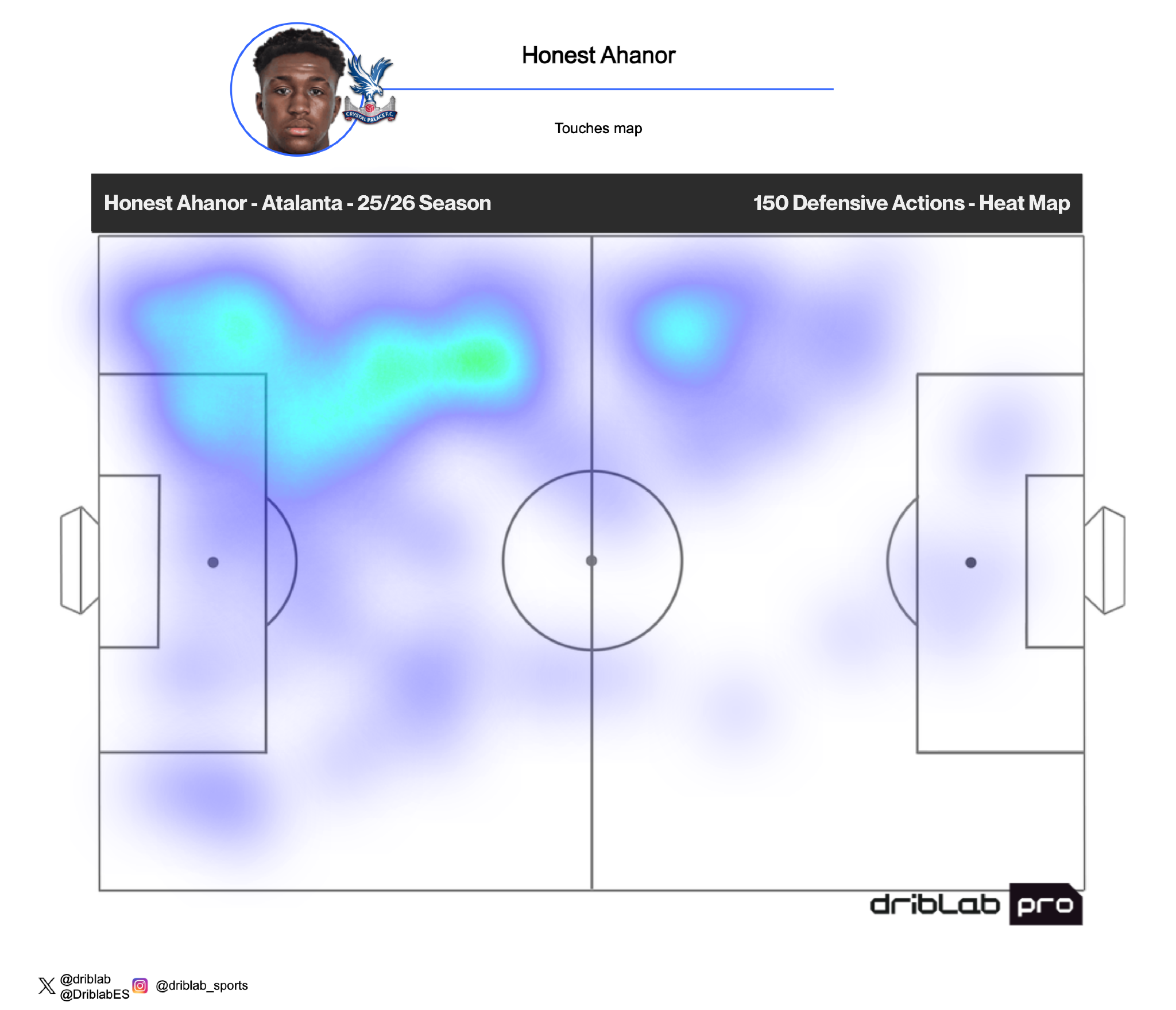
Ahanor carried out 92% of his defensive actions on the outer flanks of the pitch. Mostly, as we can see in the heat map, in his natural zone, the left side.
His 8.08 'breadth' actions per 90 minutes were the second-highest figure among the 97 centre-backs in Serie A with over 450 minutes played in 25/26.
The moves his made over the summer reinforced our view of him as the ideal outer centre-back for a back three. In August, both his transfer to Xabi Alonso's Chelsea (3 of 4 league matches with a back-three system) and his loan to Pierre Sage's Crystal Palace (Oliver Glasner's former team) were confirmed.
Both Sage and Glasner are true devotees of three-man defensive lines. If we add up last season's matches from Sage's Lens and Glasner's Crystal Palace, we get 62 games with a back three (30 from the French side and 32 from the English one). We'd say that, in terms of profile and team context, Ahanor has chosen a good destination for his loan spell.
The proactive centre-back in a back four
Outside of three-man defensive systems there's also room for aggressive centre-backs. One example of this could be Otavio, Paris FC's Brazilian left-footed centre-back. Despite isolated moments during games where the team did actually resort to these options, Paris FC were mostly a 4-2-3-1 team.
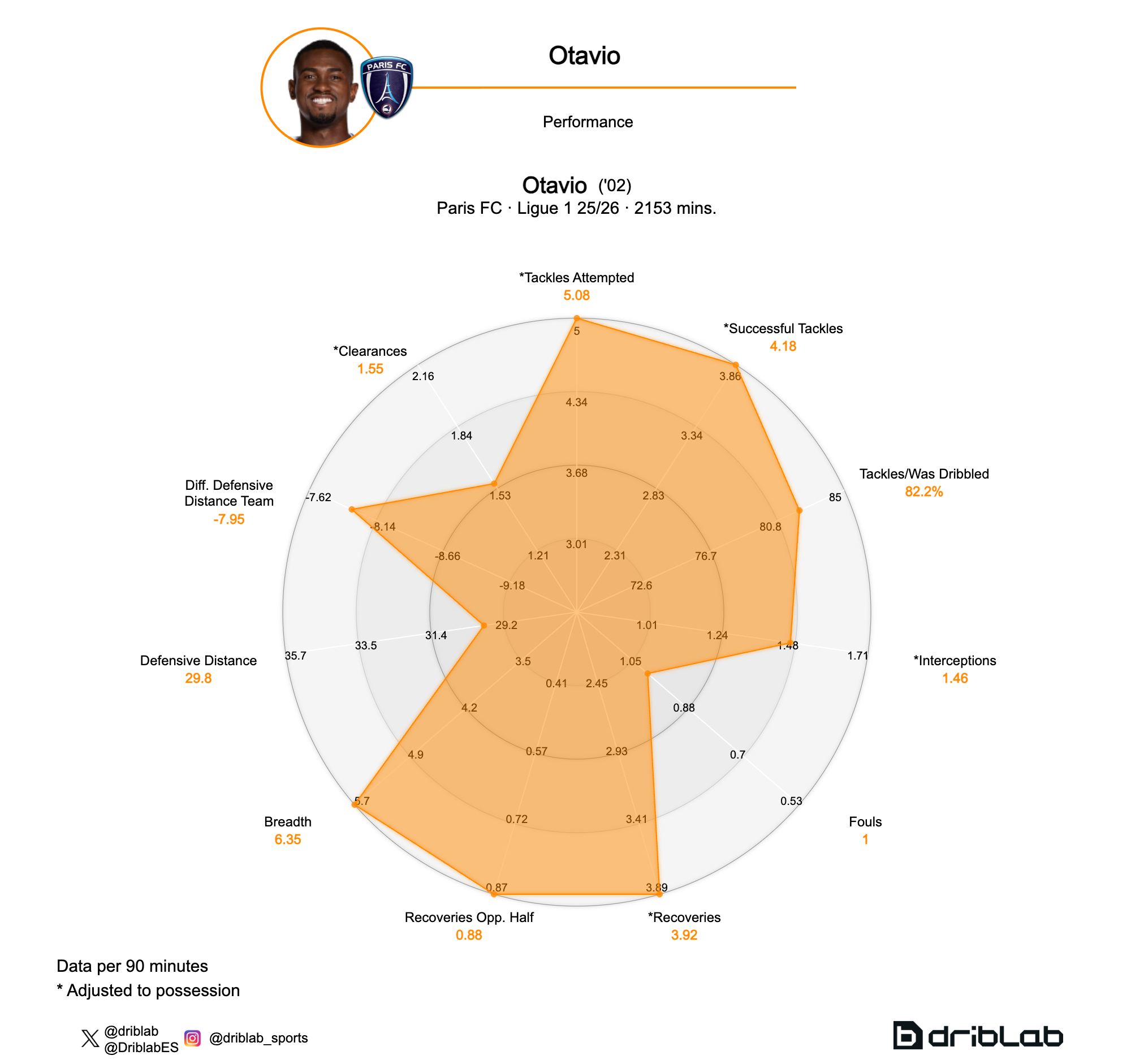
Therefore, Otavio showed himself to be extremely aggressive despite not having the protection offered by a three-centre-back line. Among Ligue 1 defenders, he was the 7th who attempted the most tackles and the 4th who won the most on average per match.
This willingness to be active when defending is also reflected in the opportunities he creates for his team: his 0.88 recoveries in the opposition's half per match was the third-highest figure in our sample, behind only Ismaelo Ganiou and Facundo Medina (we only selected centre-backs with over 1,000 minutes played). If we factor in those who played over 450 minutes, he would have moved up to a far-from-negligible 8th position.
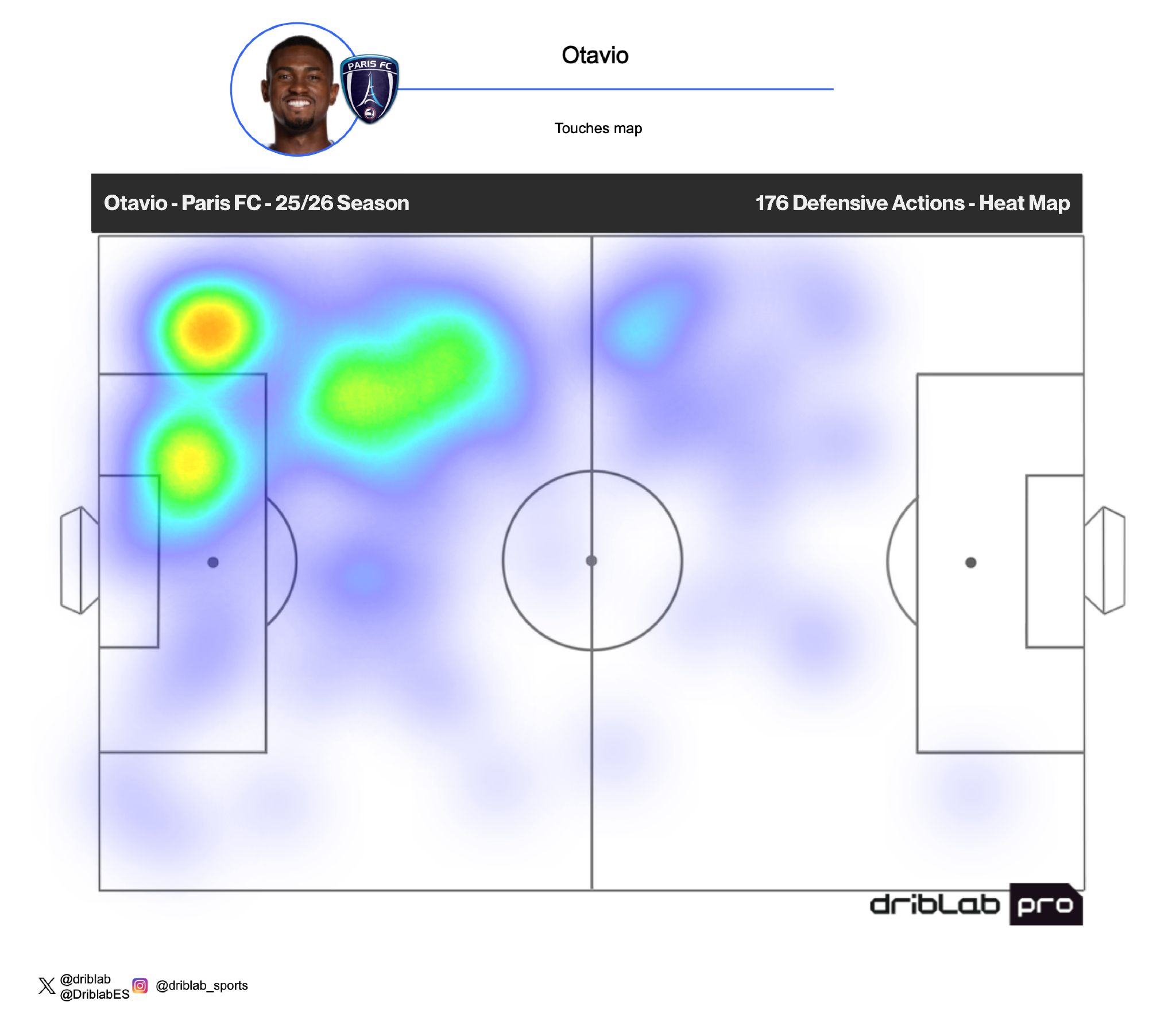
As for the defensive actions he carried out on the flanks, he had the 4th-highest average, and those 'breadth' actions made up 86% of his total defensive actions.
Now that we've talked about active centre-backs, who step out of their defensive line to apply pressure and force the opponent into their own territory, it's time to look at the opposite profiles.
Passive centre-backs: context
To set the scene, we're going to compare two well-known names: Alessandro Bastoni and Ezri Konsa. One more active, empowered by a system that gives him a lot of freedom, and the other more passive, or patient.
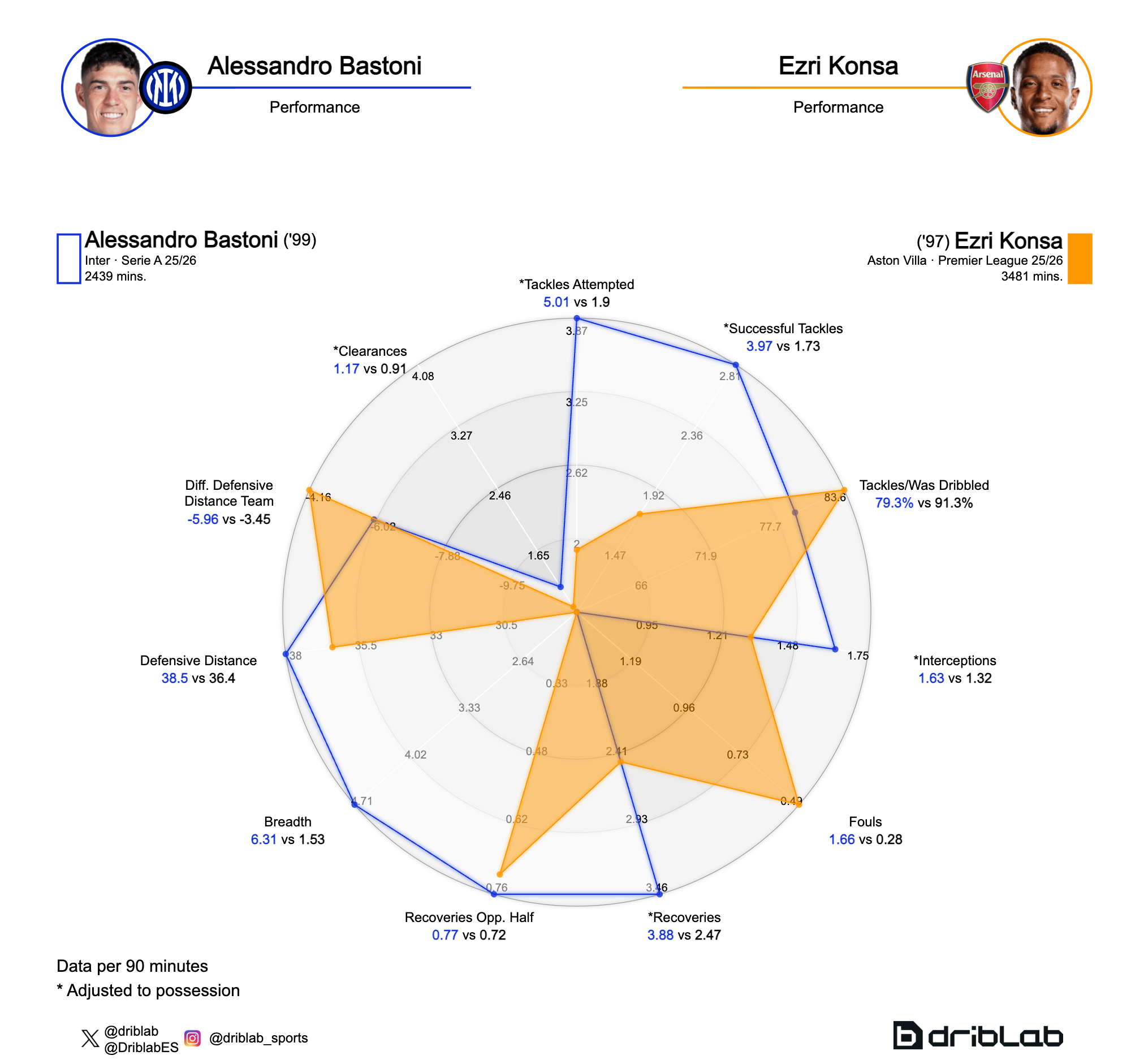
These are two sides of the same coin. Bastoni stands out as a player who takes on a lot of duels in which he looks for a quick solution, unlike Konsa. Konsa was the centre-back from the top five leagues who carried out the fewest 'breadth' actions per match last season: just 1.53.
Bastoni takes on risk, and his success rate in the dribbles he faces is lower than Konsa's, who you could say proactively engages in a duel when the situation is ideal for a positive outcome.
They're clearly different profiles, even though, for example, the average distance of their defensive actions sits at practically the same level. Bastoni's sit 38.5 metres from his own goal, Konsa's two metres less than that.
Two average distances well above what's normal among defenders and yet, two very different defender profiles.
The Englishman is a passive centre-back: one who organises, directs and commands but rarely intervenes directly, with actions that change the course of play. On the other hand, there are centre-backs who, despite being unlikely to carry out 'breadth' actions, can still be active.
Central defenders in a back three: does the proactive profile exist within this context?
Yes, although with some nuances. The widest freedom will always belong to the outer centre-backs, because their runs don't leave the central zone (the most prized area) exposed. But they do exist, even if not in the way we defined the proactive centre-back earlier. This is the case with Isak Hien, Ahanor's partner in Atalanta's back line, and with Mariano Troilo. They're active defenders thanks to their team's context.
The Parma defender carried out just 49% of his defensive actions in the outer lanes, and yet his 8.6 total defensive actions are the 7th-highest figure in our sample.
He has frequently been the central centre-back in Carlos Cuesta's back three at Parma. We could have guessed as much simply by looking at the numbers and knowing his team's tendencies.
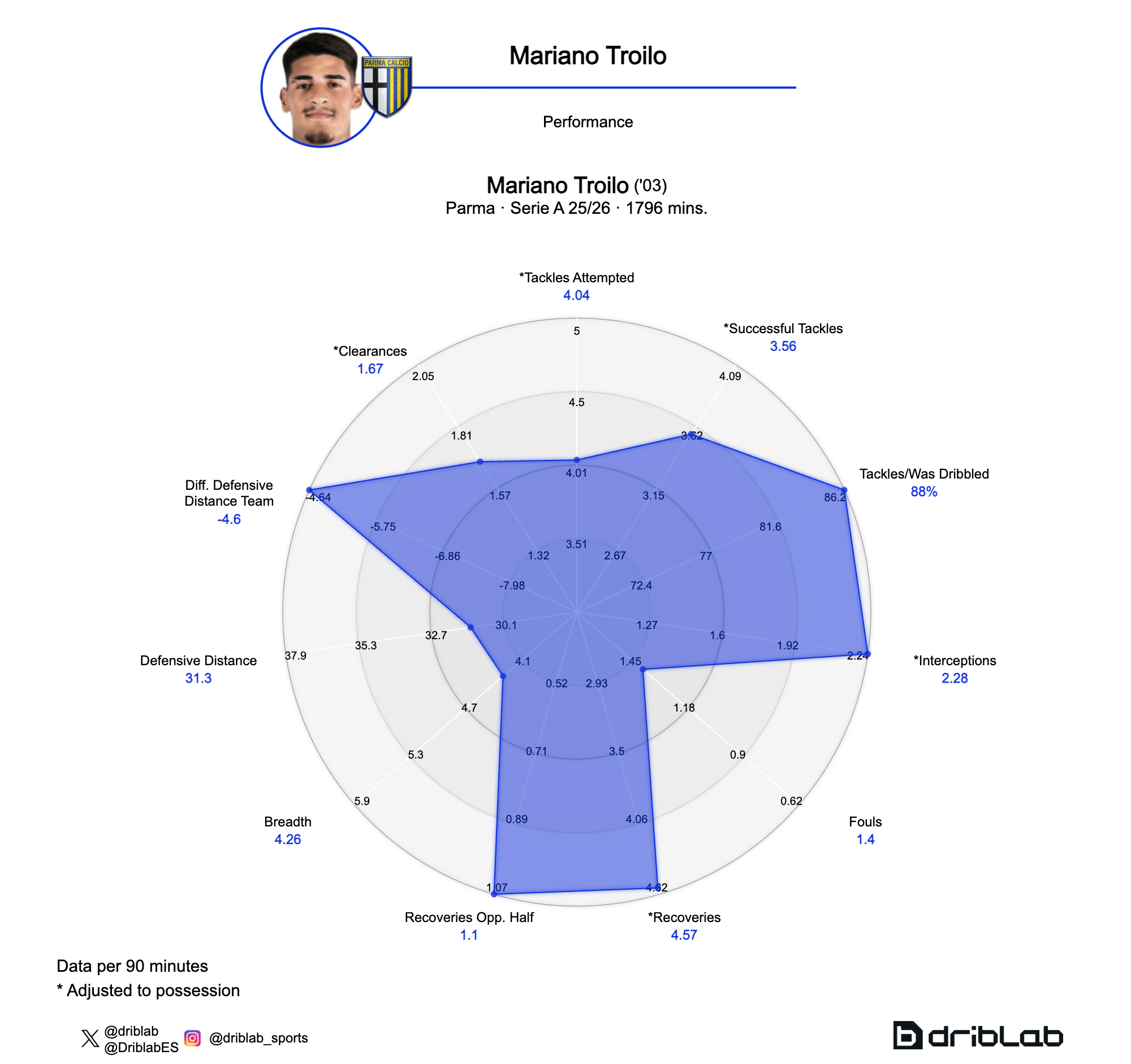
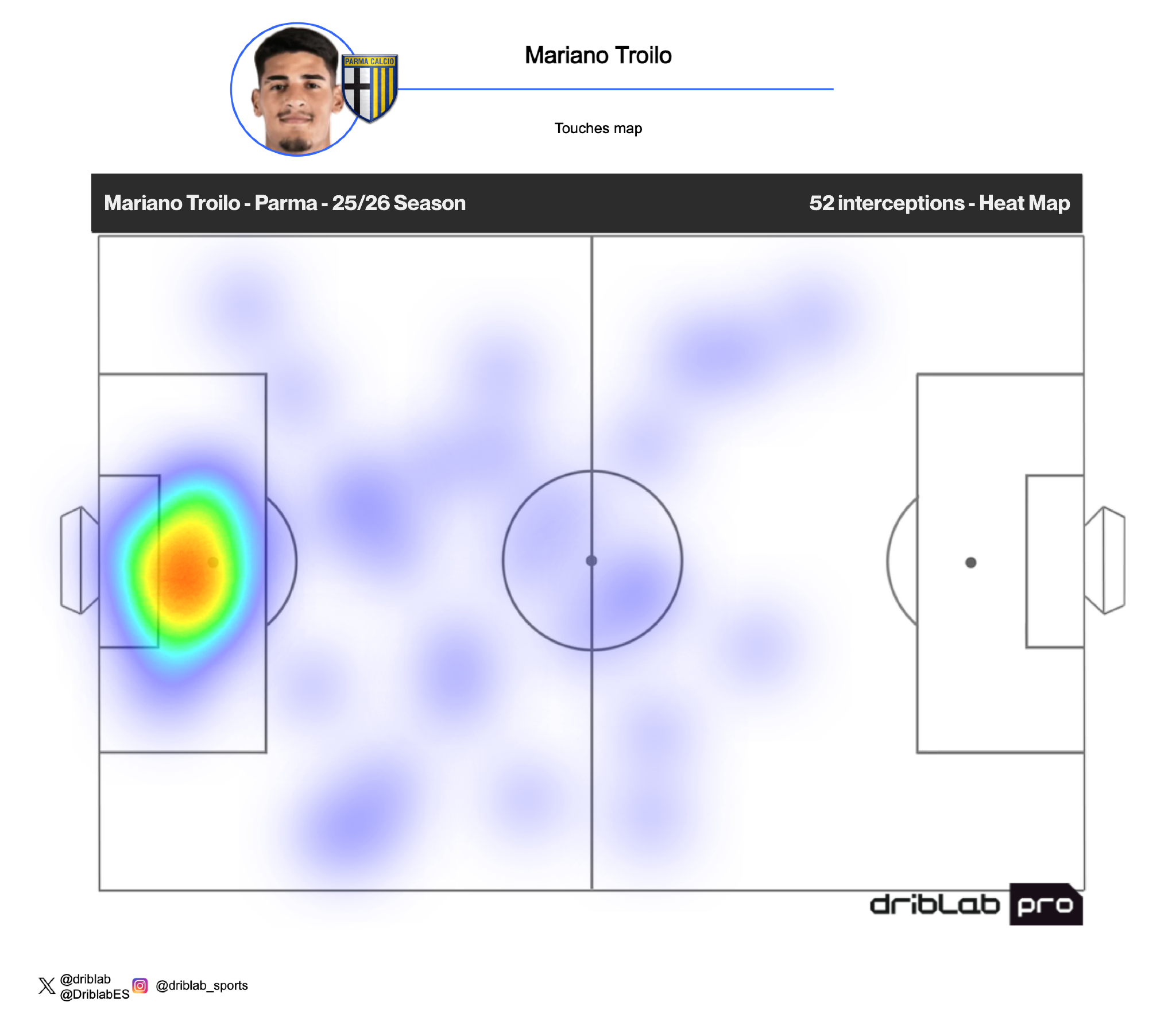
They're active centre-backs in deep zones or close to their own box. Another particular metric that helps us discern the middle centre-back profile in a back three is interceptions: instead of standing out for their ability and willingness to step out and defend outer zones, these centre-backs tend to rely on clearances, but above all on anticipation in areas close to the box.
And an interception always requires anticipating what's about to happen.
The passive centre-back in a back four
Going back to the Konsa profile, another example of this kind of defender, one who barely takes part actively in his team's defending, is Nobel Mendy. Another centre-back who has flown off towards the Premier League, and whose role last season at Rayo Vallecano was fairly easy to spot.
Last season's Nobel Mendy showed the characteristics of a complete box defender, partly thanks to averaging a lot of clearances and interceptions. He was the third centre-back with the highest average of clearances per game in LaLiga 25/26.
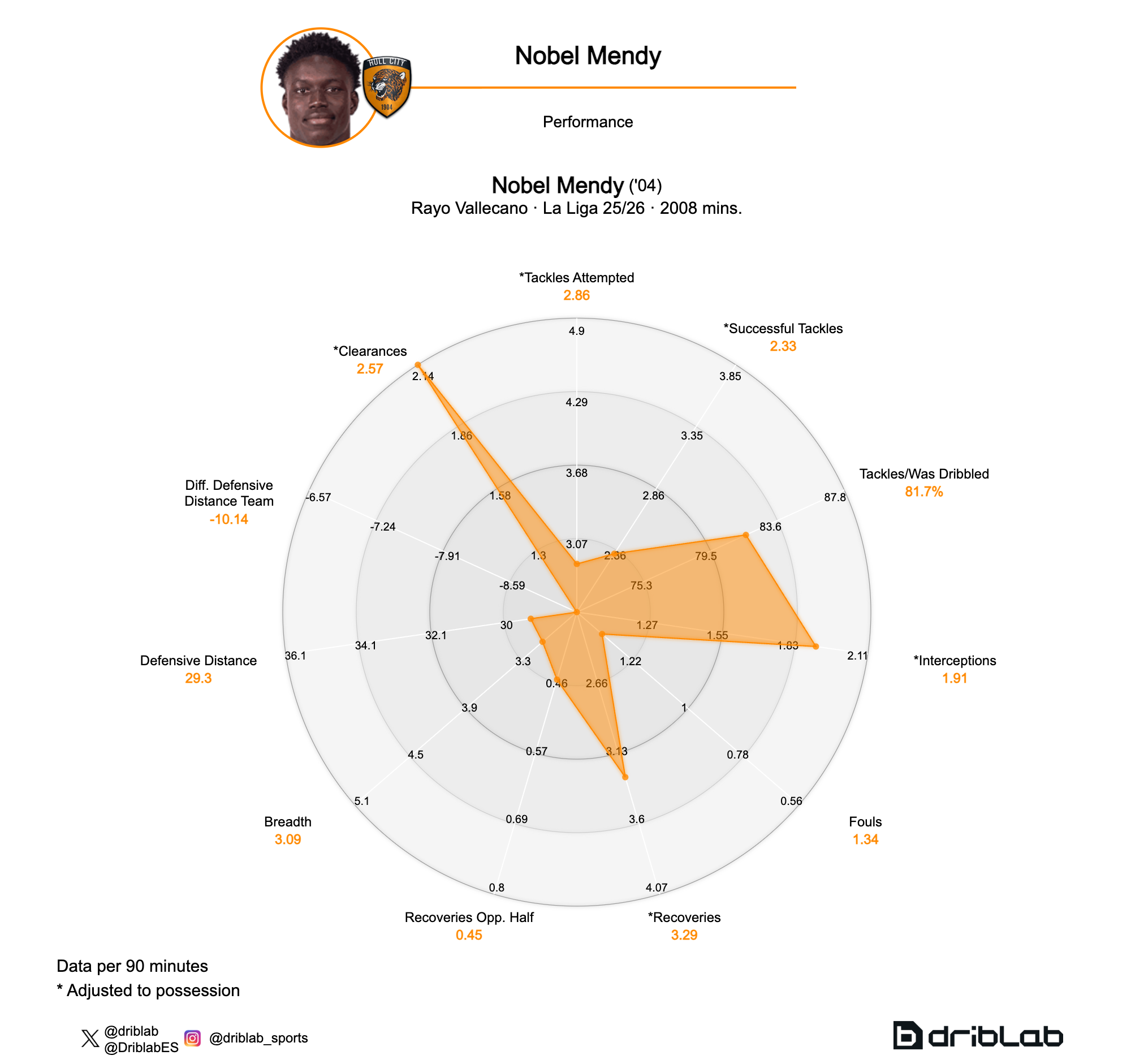
But he also has shown the characteristics of the passive centre-back: Mendy wasin the bottom 20% of LaLiga centre-backs in 'breadth' actions and in tackles attempted last season.
Nobel Mendy showed strong physical performances, and reducing him to just a box-defending centre-back might be unfair, even though that was his dominant role under Iñigo Pérez last season. Now, at Jakirovic's Hull City, he's showing that he's a centre-back adaptable to many roles.
One more example that we can profile players, but we should never forget the nature of a player, which is the result of the sum of their characteristics and their circumstances.