It has been a summer of huge change at Newcastle upon Tyne. With the sales of Sandro Tonali, Bruno Guimarães and Anthony Gordon for 108, 87 and 80 million euros respectively, Newcastle have raised 275 million euros.
At first, the arrivals of Sandro Tonali, Anthony Gordon and Alexander Isak represented an unprecedented investment for Newcastle and were a show of strength from newly-arrived majority owners PIF (Saudi Arabia's Public Investment Fund).
These proven-player signings who could also be sold on for a profit set the course PIF wanted to follow, with the aim of returning Newcastle to European qualification places. But in order to sustain that spending, Newcastle needed to keep producing very strong league performances year after year. Something that, given the extremely high level of competition in the Premier League, is difficult to achieve.
By failing to do so consistently, the club was ultimately forced to sell several of its best players.
After accepting that they needed to sell more players than they had hoped, Newcastle changed their route. In-league signings within the Premier League were getting more and more expensive, and looking further afield could pay off more than one might think.
Despite having invested 313 million euros in eight new players to reshape the squad, only one of them was bought from another Premier League club: Nico González, from Manchester City, for 56 million euros.
Of the remaining seven, only three arrived from clubs in Europe's other top four leagues (Bazoumana Touré, Hoffenheim; Aladji Bamba, Monaco; Matías Fernández-Pardo, Lille).
Only one of those who arrived to strengthen the midfield, the area of the pitch we're focusing on today, has played more than one season as a first team regular.

Similar attributes spread across several sorely-needed alternatives
Losing two players of the stature and importance of Tonali and Guimarães was undoubtedly a hard blow. Two proven, like-for-like replacements would have been seen as the easy, go-to solution. But that would have been expensive, risky and, frankly, complicated.
Newcastle adopted a different solution and went for three new midfielders, each with their own characteristics, while also promoting Lewis Miley up the pecking order. Academy graduate Miley has been around the first team since Eddie Howe's injury-hit 24/25 season, and has started in both of Newcastle's league games this season.
That doesn't mean Newcastle have gone from having an advanced playmaker in Bruno Guimarães and an all action engine in Tonali to having none of that. They still have those foundations, those characteristics, just spread more evenly.
Having multiple midfield options will allow the team, and Mathias Jaissle, who has replaced Eddie Howe in the dugout, to approach matches and answer the questions opponents pose in ways they couldn't in the past.
For example, with Sean Steur (2008; signed from Ajax), Newcastle have brought in a young midfield conductor to orchestrate Newcastle's build up from the very first passes, much like Bruno Guimarães used to. I need to be clear: Steur is obviously not at Bruno Guimarães's level just yet. Guimarães, after all, signed for the English champions. However, in terms of profile there are similarities, and that's what we are looking at here.
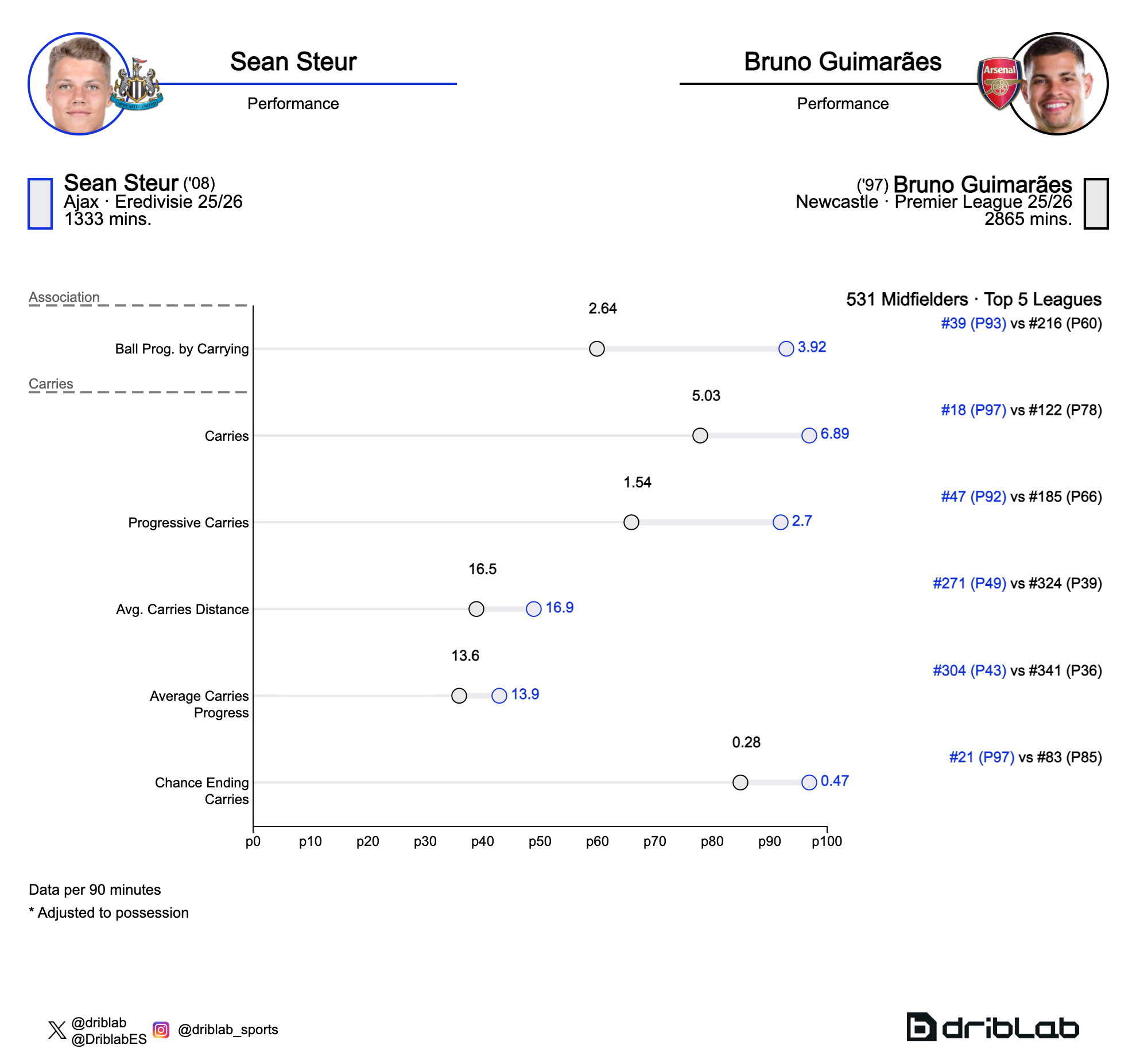
Steur differs from Guimarães in that he tends to receive the ball in deeper zones, closer to the centre backs, and relies much more on carrying the ball than the Brazilian does. He dribbles past players in central zones and quickly releases the ball once he has invited the opponent's pressure.
If we were to add Steur's 25/26 numbers at Ajax to the list of midfielders across Europe's top five leagues with more than 450 minutes played, the Dutchman would rank above 93% of them in ball progressions by carrying per 90 minutes (instances in which a player progresses 10 or more metres by carrying the ball, or carries it into the opposition box).
By comparison, Bruno Guimarães ranks above only 60% of midfielders. He's much more of a passer. Not that he's limited at driving with the ball but it's just not his preferred option.
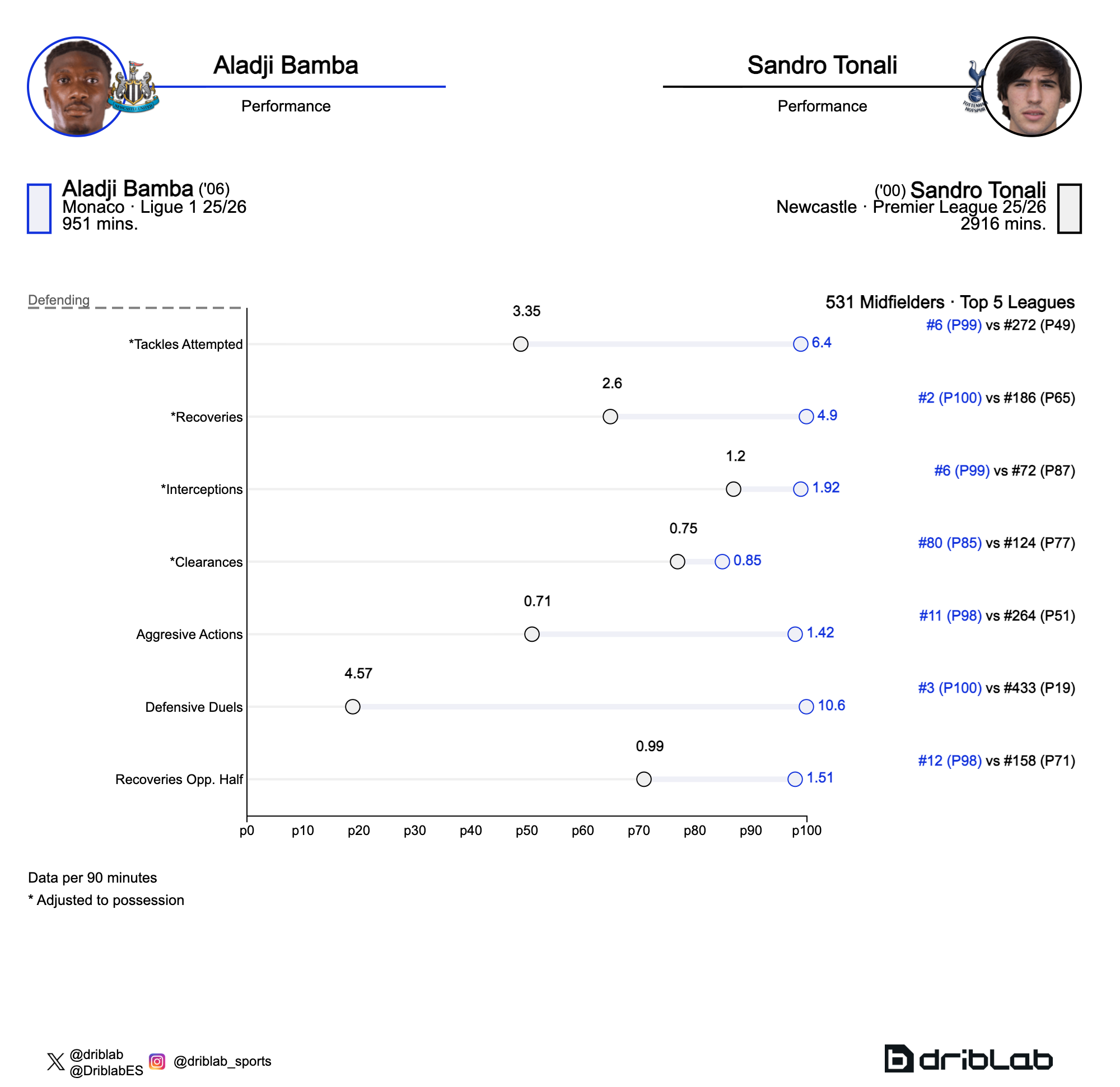
On the other hand, the defensive solidity Newcastle supposedly lost with Tonali's departure could well be reinstalled with the arrival of Aladji Bamba (2006; signed from AS Monaco).
In terms of passing ability, Newcastle don't come out worse off either. Bamba is on the same level as a passer as the Italian, who isn't an exceptional one himself and shines more at running with the ball. What's more, the Frenchman often succeeds when trying to get the ball into the final third or the opposition box through crisp passing and by using different parts of his foot. His technique is considerably more polished than the Italian's.
Both in volume and in efficiency, Bamba showed a very good defensive level last season, even though he covers less ground and shows less willingness to put in effort than Tonali, facets in which the Italian has historically excelled.
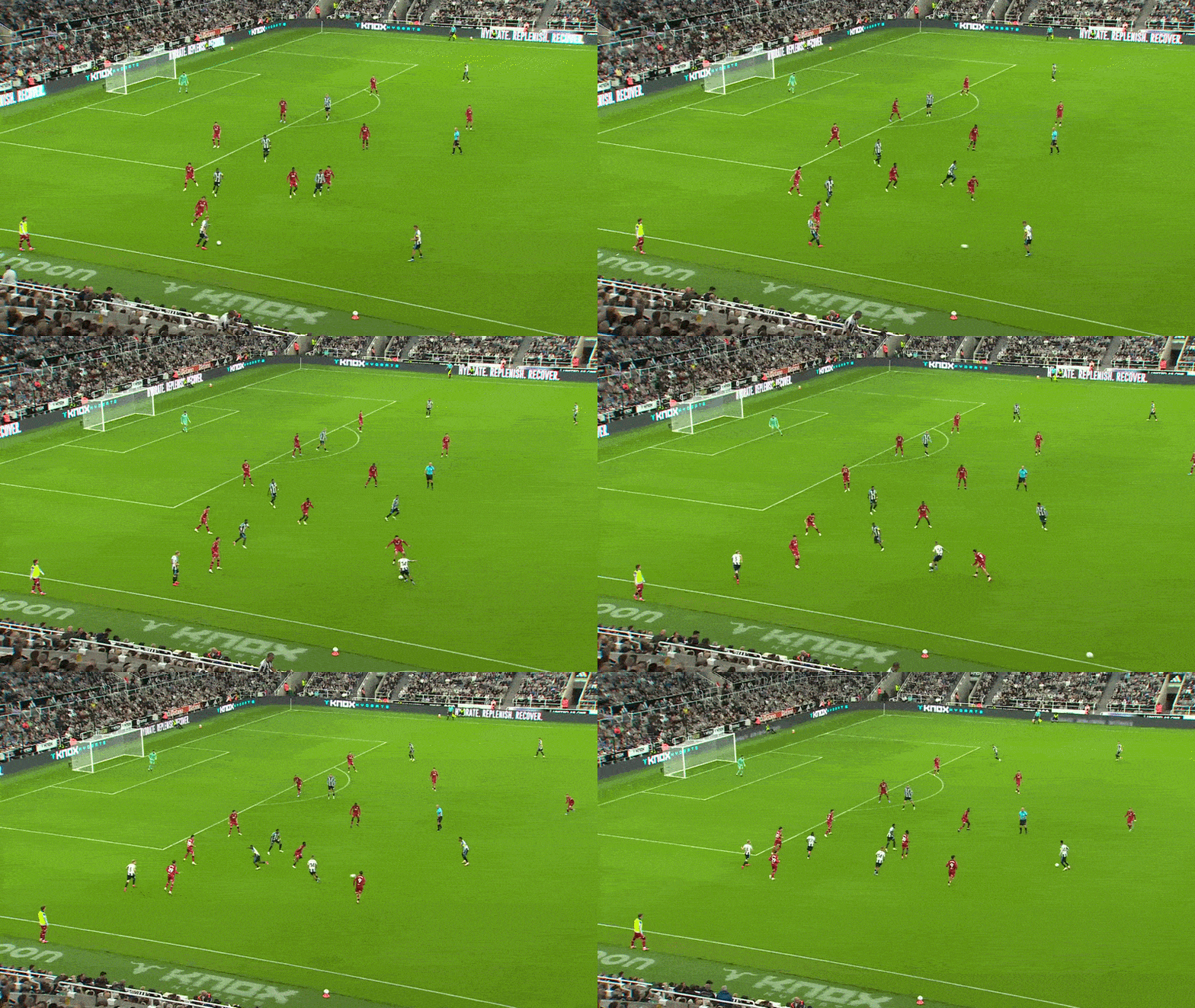
In this clip from last season, we can see Bamba's ability to sweep up the ball, and, once he receives it again, his willingness to be aggressive and ambitious with the next pass.
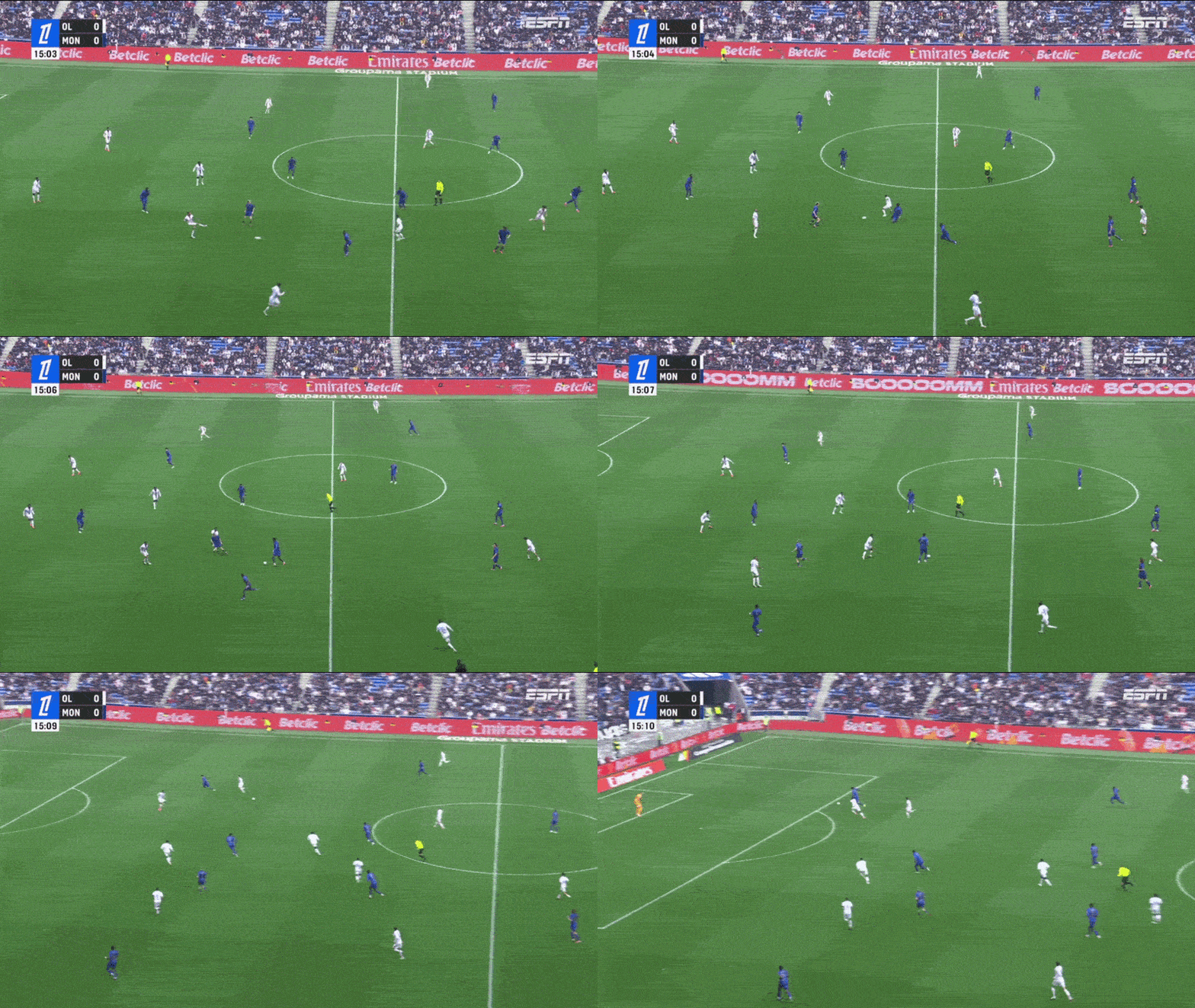
In a Jaissle-coached side that has so far shown willingness to counter-press aggressively and press high, Bamba fits perfectly: only seven Ligue 1 midfielders averaged one or more quick recoveries per match last season (Bamba, 1.42).
We define a quick recovery as one that takes place at least 40 metres from one's own goal (an advanced recovery) and within 8 seconds of the team losing possession.
In other words, Aladji Bamba is aggresive, proactive defender who also uses his considerable size and long legs to be effective in these situations, qualities that should suit his team perfectly.
Steur shares similarities with Guimarães in that both are short passing, to-the-feet receivers who dictate the tempo of the game. Steur is less incisive, his passes don't carry as much venom as the Brazilian's, but he's more energetic and covers more ground. In this case, there are arguably several similarities.
Between Bamba and Tonali, the resemblance is fuzzier. Bamba, who I believe could develop into a two-way midfielder who, while putting up high-volume defensive numbers, could also receive from the centre backs and dictate play through passing, lacks Tonali's physical range, but he is capable of matching (or even exceeding) the volume of the Italian's defensive actions.
As a counterpart to Bamba, the ball security the Italian provided is now supplied by Lewis Miley. Miley differs from Bamba and is closer to Tonali in being a player who prioritises ball security and retention.
It's a matter of looking at the numbers: Bamba averages 1.04 open-play chances created per 90 minutes, while Miley is on a one-in-two average. On the other hand, the Englishman retains the ball in 91 out of every 100 involvements, compared to Bamba's 85.

The Frenchman is a more progressive passer than Miley, who moves ahead of the ball with greater frequency.
We can see this in the radar above: when it comes to keeping the ball under control, recycling possession or moving the play forward, Miley adapts better. However, when it comes to being aggressive and getting the ball into dangerous areas, the box, for example, it's Bamba who shines.
Besides ball retention, Miley gives Newcastle great presence in the air: no midfielder among the 95 in the 25/26 Premier League beat his score of 5.57 in our Aerial Efficiency metric.
In a league where play is becoming increasingly direct and long balls are common, Miley is an absolute dominant force on the right side of the pitch, an area that tends to receive plenty of long balls from opposing right-footed goalkeepers and centre backs.
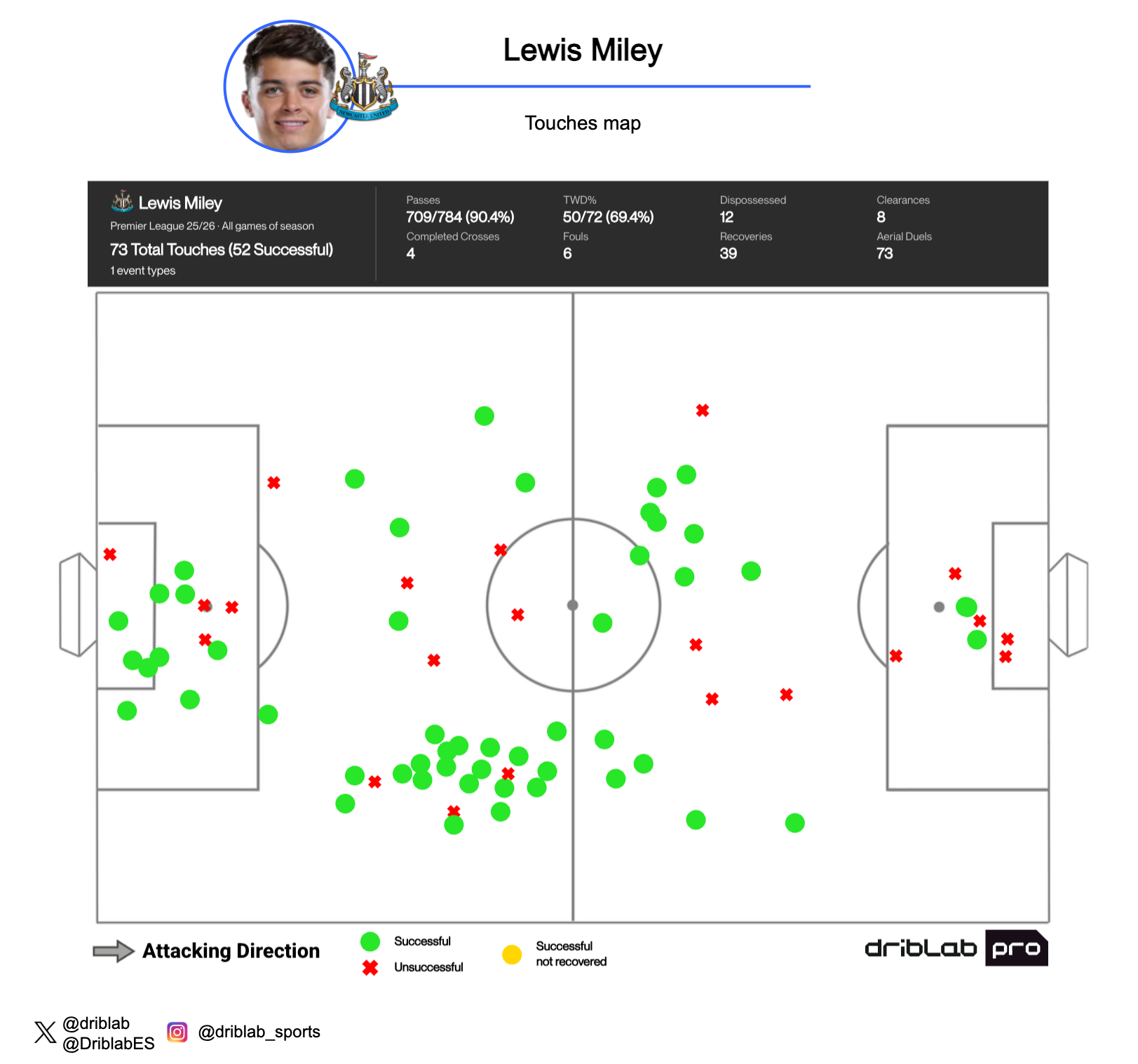
Steur and Bamba are heading into their second season as part of the first team squad at a top flight club; for Miley, it's his third. Newcastle needed experience in order to be able to give them time. Experience doesn't just mean more age, although that matters too, but more mileage.
At 24 years old, with five full seasons in the first teams of Barcelona, Porto and Manchester City, Nico González arrived at Newcastle as the marquee signing for the midfield.
González combines many of the qualities of the two midfielders who left Newcastle this summer: a workload-heavy midfielder off the ball (no one in the English top flight bettered his average of 3.66 recoveries per 90 minutes) who is also hugely involved in build-up play. Nico González's 0.71 xG Buildup per game was the third-highest figure among his Premier League peers last season.
I mean: you don't play under Guardiola unless, as a midfielder, you're capable of doing these kind of things.
It's a cliché, but given that he's a midfielder, Spanish, and a Barcelona academy graduate, it would be easy to think of him as a new Busquets or Rodri. In terms of playing style and profile, the cliché holds up for once: Nico builds his game around an idea similar to those two, a positional player tasked with organising his team with and without the ball who quickly switches into recovery mode once possession is lost.
His short passing was ideal for Guardiola, and he effectively deputised for Rodri during several stretches of last season. But his long passing is just as strong. Against Tottenham, in his first start for his new club, Jaissle decided that Nico's long passing would be the key to Newcastle's gameplan in London.
This is the first sequence of the match: Nico González receives a pass from center-back Botman, turns, and, unpressured, is able to send the ball over the top onto the run of Amar Dedic.
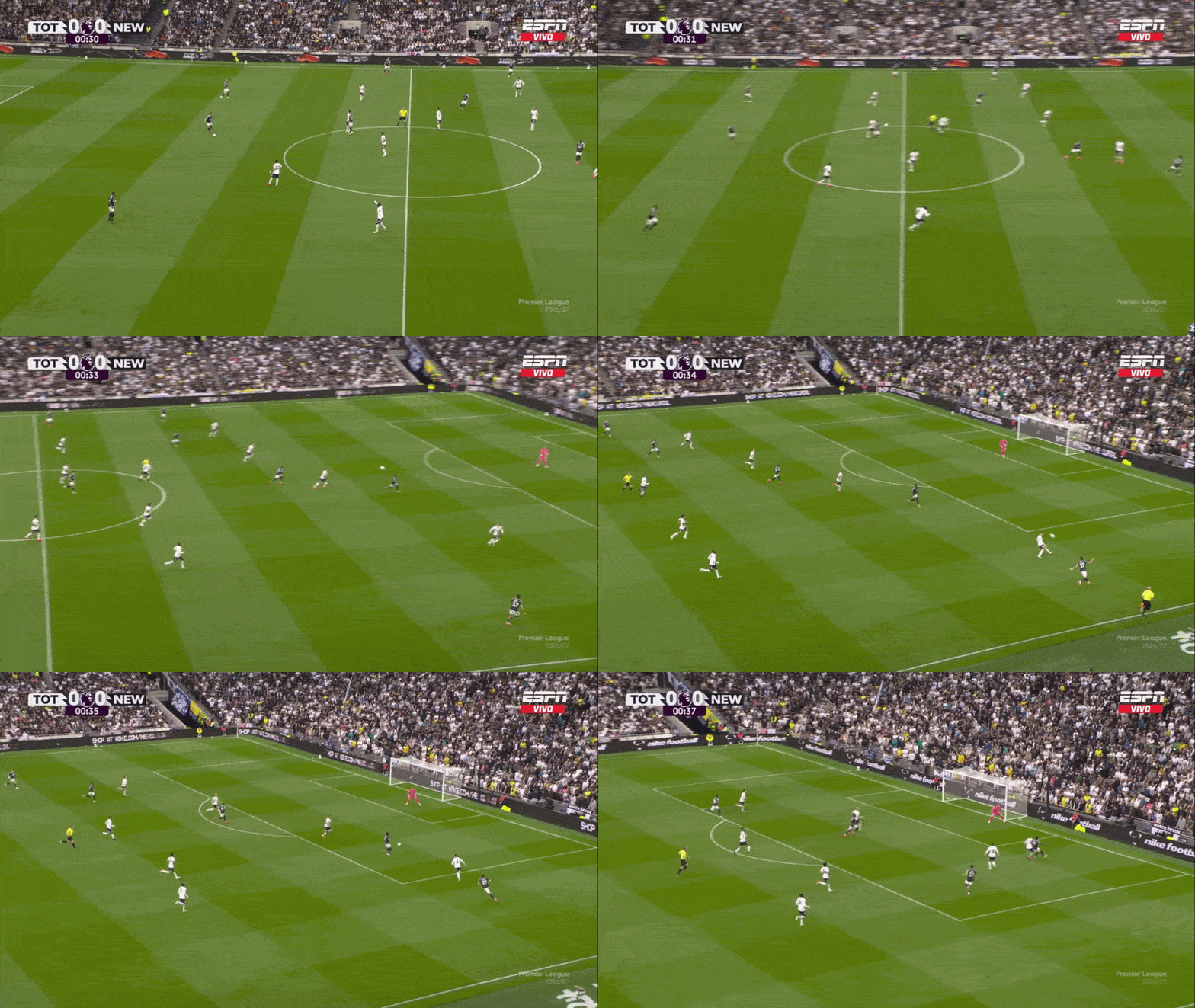
In this same sequence we can also see a glimpse of what Jaissle's Newcastle is going to look like, with attacking players making very aggressive runs in behind to stretch opposing defences and create space for the full backs to advance into.
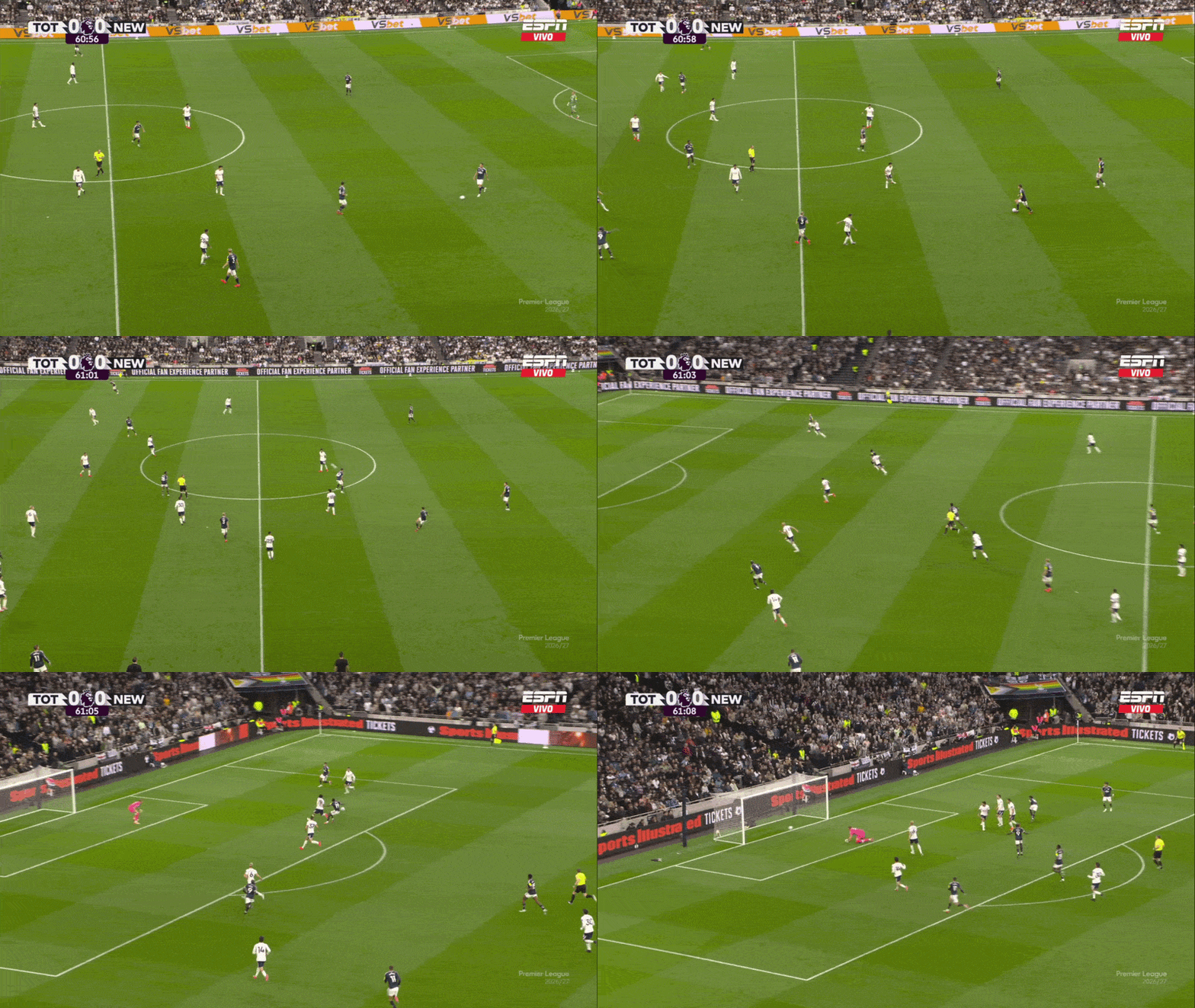
The Magpies' second goal is essentially a replay of the sequence we just saw. Nico González again receives the ball ahead of the opposition's first line of pressure, completely unpressured, and in Newcastle's front line both Elanga and Dedic peel off into space.
In this case, the ball played towards Dedic forces him into an aerial duel with Robertson, which he wins, allowing Elanga to then get a shot away.
Along with Miley, Newcastle's three new arrivals will allow Jaissle to explore paths the team either hadn't tried in recent years or that Eddie Howe simply didn't trust, given the characteristics of the starting players and the level of the squad's alternatives.
We've made it clear throughout this piece that the current level of Tonali and Bruno Guimarães is above that of any of the Magpies' current midfielders.
That doesn't take away from how positively we should view the process Newcastle have carried out this summer. It's a new midfield that retains the characteristics Tonali and Guimarães brought, but now spread across a set of profiles that, if they go on to establish themselves, could add a huge variety of alternatives to the team's game.
Newcastle United have shown throughout the summer that they are a club with a clear idea of what they want to do. When a club is aligned around that same idea, both footballing and business, replacing your best players is always going to be easier. When the process is right, it's easier for the end result to fall in your favour.

.jpg)