As we reach the end of the MLS regular season, with just one matchday to go, now is the perfect time to present our Young Team of the MLS Regular Season: the players who have caught our attention the most at Driblab.
To make the XI, and also the list of substitutes we recommend you follow on your own, players must have been born in 2002 or later, meaning they were U24 at the start of the regular season, and must have played at least 450 minutes. The only exception is the goalkeeper, where we have allowed players born from 2001 onwards.
In total, 219 players met our requirements, and we have selected 22 of them. That said, when we compare a player with his group (for example, “the 119 center-backs in MLS”), we are referring to all players in the league in that position with at least 450 minutes, not just U24 players.
Unless otherwise stated, all data is normalized per 90 minutes.

GK: Brian Schwake (Nashville SC, 2001) - 🇺🇸
Brian Schwake has become one of the great revelations between the posts in MLS this season, putting in an outstanding performance with Nashville SC that has even led him to debut with the United States senior national team.
His path to reaching this level has been unusual. After leaving DePaul University, he made the jump to professional football in Scotland, where he began to accumulate minutes during his loan at Greenock Morton. Later, he spent time at Castellón before joining Nashville at the beginning of 2025, a destination where he has managed to establish himself as a starter and show his best version.
His performance stands out especially for his shot-stopping ability, recording figures well above the competition average both in save percentage and in number of shots needed to concede a goal.
One of the statistics that best reflects his season is goals prevented: between MLS and CONCACAF, Schwake has conceded only 26 goals against the 45.5 expected according to the xGOT faced, a difference that shows his enormous influence between the posts.
To these performances he adds a very positive performance in the air, showing confidence in dealing with crosses.
We are looking at a goalkeeper who has taken an important step up in level this season, standing out especially for his reflexes, ability to prevent goals and performance in the air.
His evolution at Nashville and his recent presence with the US national team reflect the growth of a goalkeeper who, after an unconventional path, has earned a place among the most prominent names in MLS.
RB: Francis Westfield (Philadelphia Union, 2005) - 🇺🇸
Included in our U20 World Cup best XI, Westfield has experienced enormous growth as part of the Philadelphia Union first team. Both in minutes, having played 80% of the minutes in which he has been available (he surpasses the 2500 mark), and in performance.
Frankie (or Francis) Westfield is a medium-height fullback whose profile is complex to fit into an opaque definition. Active and with good performances in individual duels, he always defends forcefully.
His 74.2% success rate in individual duels places him ahead of 89% of MLS fullbacks, averaging a number of attempted tackles above the average. At first glance we might think that his small size is a problem for him in aerial actions, but his physical build is also what gives him a lot of spring in his jump.
His willingness to go into the challenge without feeling inferior and his spring to gain height make him a competent fullback in these situations. Our aerial efficiency metric backs it up: his score of 4.4 is the fourth-highest among MLS fullbacks.
He is an intelligent player in both directions. In attack he provides width but links his movements with the winger ahead of him. Movements that vary depending on who the winger is. Sometimes he participates by pinning the fullback, that is, already being in an attacking position, and other times he gets involved arriving from deeper areas. His touches before crossing stand out, with which he manages to leave the ball in the ideal position to cross.
Among MLS fullbacks, and just as with Dos Santos, he is a player who generates attacking danger through passing and crossing. He generates 1.14 xT per 100 passes and 97% of the expected threat he generates comes through passing. Westfield is one of the most complete young players in the league. His numbers last season were good, but this has been his breakout season. With good performances in many facets, he is a completely adaptable fullback who will perform in different contexts.
RCB: Neil Pierre (Philadelphia Union, 2007) - 🇺🇸
Developed in the United States and with a curious experience on loan at Lyngby in the Danish second division, which allowed him to log his first minutes in professional football, Neil Pierre has established himself as a key piece at the heart of Philadelphia Union’s defense since July, playing 91% of the minutes at 19 years old.
His performances have also earned him his debut with the national team in the friendlies played in September and November.
The first thing that stands out about Pierre is his height: 201 centimeters that allow him to be the center-back with the highest volume of aerial duels won and the second with the highest success rate in MLS 2026, winning 79% of his individual aerial contests. He is a defender who is standing out for his good positioning and his forcefulness.
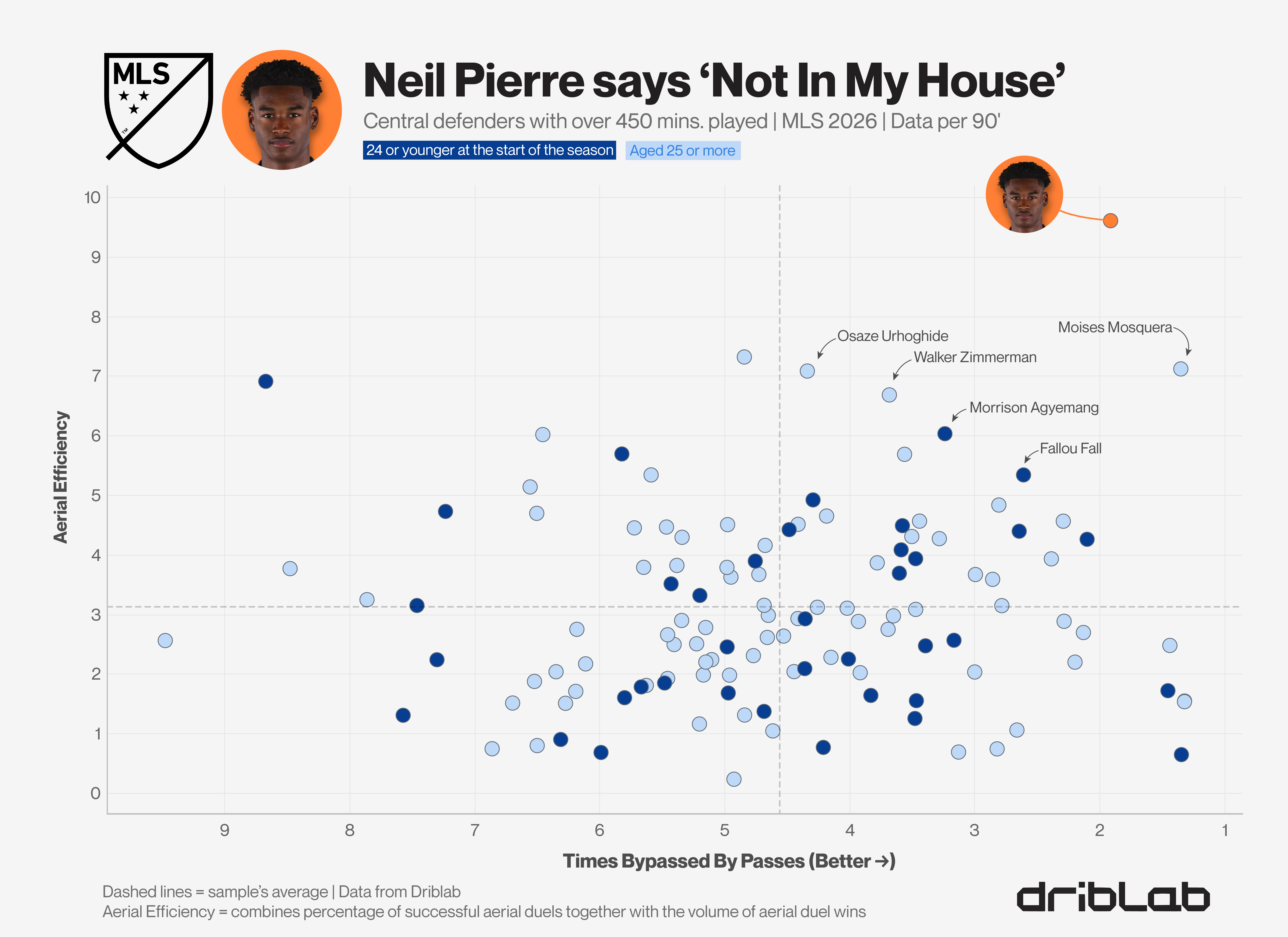
Our Score system, which allows us to create a ranking of players in each position based on a series of metrics, places Pierre as the third-best center-back in MLS in 2026. In the last four MLS seasons, only two center-backs surpassed Neil Pierre’s Score (72.5).
The young center-back knows his limitations and makes good use of his strengths, shows notable composure with and without the ball and is delivering very consistent performances. Without being a slow player, he doesn’t stand out for his intensity or his pace, so he tends to avoid open-field situations as much as possible.
He defends better going forward, colliding with the striker and winning the duel. He doesn’t shine in build-up, but he is capable of playing short and may have room for improvement in terms of progression.
It is very likely that we are looking at a center-back with more than enough potential for Europe’s top five leagues in the short or medium term. His maturity, projection and current level make him one of the great national prospects in the United States alongside his teammate Cavan Sullivan.
LCB: Mbekezeli Mbokazi (Chicago Fire, 2005) - 🇿🇦
Having overcome a muscle injury that made him miss fifteen matches after the World Cup, Mbokazi has accumulated more than 1700 minutes in his debut season in MLS after arriving from Orlando Pirates. The South African is a center-back with enormous potential who is performing at the level of the best in the category at just 21 years old (2005). His qualities paint the profile of a complete defender with no marked weaknesses.
He is active when it comes to getting involved in defensive actions on the ground and also has the qualities and willingness to be a difference-maker with the ball at his feet.
Before going into detail on each facet, and to contextualize much of what we will discuss, it must be mentioned that there are hardly any defenders who match Mbokazi’s performance in the physical aspect. He is not tall (around 1.77m) but his body is balanced, with strong legs that give him explosiveness off the mark and a wide waist to turn lightly and collide without losing his balance.
Among the 119 center-backs in MLS, the South African ranks 2nd in our Speed and Power Score and 8th in the Endurance Score.
In cases where he has to run backward, Mbokazi is able to combine his good acceleration from a standstill, which prevents him from falling behind in the first meters, with sustained speed to match the league’s fastest attackers in a race. Once he is level, in addition to colliding forcefully, he uses his arms and unbalances the opponent before putting his foot in (with either the right or the left).
His explosiveness allows him to step out of the defensive line and close down to intercept or put pressure on the receiver of the ball. Mbokazi is the third center-back in MLS who averages the most recoveries per 90 minutes (4.48). Of those recoveries, 55% are interceptions, an aspect where he also ranks third (2.5 interceptions).
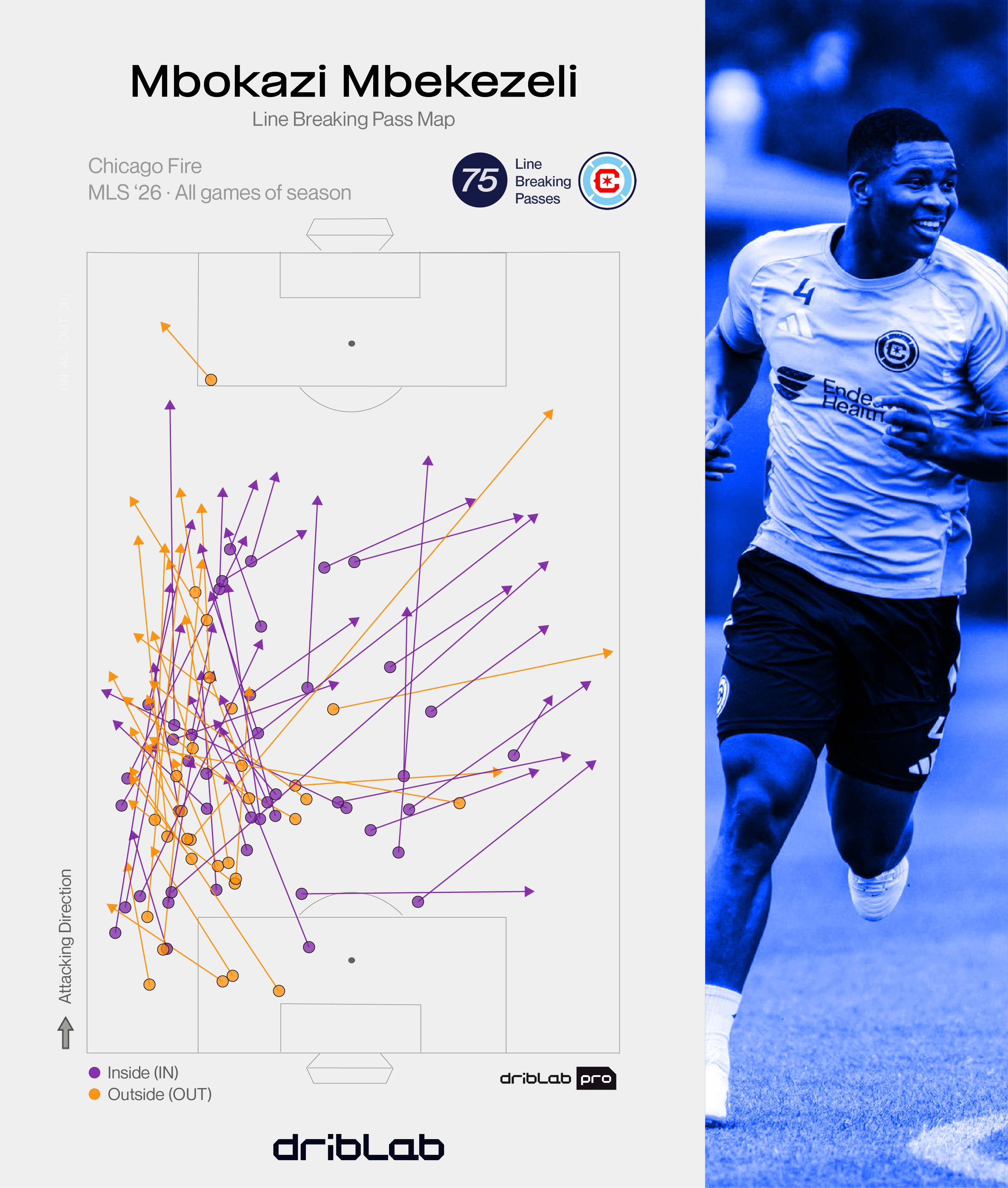
Mbokazi is the ninth center-back in MLS who averages the most line-breaking passes per match (3.85) and the seventh in terms of frequency (8% of his passes are line-breaking passes). His passes are firm, often aimed at a layoff by the player receiving them. Being able to turn his waist easily adds unpredictability to his passes, which he tries to disguise until the last instant. His ability to thread passes from different heights and get the ball inside the opponent’s block to attack central areas is of enormous benefit to his team.
With an ultra-competent physical profile for the highest level, innate defensive qualities combined with notable technical education and high doses of personality (and willingness) to make the difference with his passes, Mbokazi has become one of the biggest prospects in MLS.
LB: Matthew Dos Santos (New York Red Bulls, 2008) - 🇧🇷/🇺🇸
In his first season in MLS, Dos Santos has played 56% of the minutes for which he has been available. He is another young New York Red Bull player who has had relevance throughout the season.
With dual Brazilian and American nationality, Dos Santos is a fullback of enormous energy, not so much for carrying the ball forward, but for getting into advanced areas and crossing.
His good striking, both on the early cross and from the byline on the run, we measure in his ability to find his teammates in dangerous situations. He is the third fullback who produces the most expected threat (xT) on average and the fifth who generates the most expected assists through crosses. His good striking is also combined with good delivery selection, using floated crosses but also passes back (he is seventh out of 92 fullbacks in MLS in cutbacks averaged).
He is not an explosive player and his second touches after receiving are often ineffective (he tends to fail at relatively simple controls). He also doesn’t make much use of his arms when carrying and leaves everything to his powerful lower body, with which he looks to create space by getting ahead of his opponent on the run.
Defensively he has room to grow, but in any case it doesn’t seem he will be much more active defensively than he already is. His room for improvement relates more to increasing efficiency than volume.
Overall it is a good debut year in MLS. Dos Santos has the potential to be an attacking fullback who makes the difference in the final third by finding his teammates in dangerous positions.
CM: Adri Mehmeti (New York Red Bulls, 2009) - 🇺🇸
Despite his youth, Adri Mehmeti has become an important piece for New York Red Bulls this season, showing a maturity unusual for a player his age in a position as demanding as the pivot.
He is a technically gifted central midfielder, very reliable in ball circulation and capable of taking on a leading role in build-up play.
In terms of involvement in build-up play, only 13 of 162 central midfielders exceed his figure of 0.6 xG Buildup (a metric that accumulates the xG value of every move in which that player participates, not counting shots or passes that assist a shot).
His influence is not limited to keeping possessions going; he also stands out for his ability to move the team forward through passing, participating both in the first phase of build-up and in more advanced areas.
One of the most interesting aspects of his profile is his ability to create danger despite playing mainly as a holding midfielder. His expected assists (xA) numbers reflect that ability to find teammates in advantageous positions and play through balls that lead to chances.
To these on-ball qualities he adds a very complete defensive performance. Mehmeti shows a good ability to get involved in duels, make successful tackles and recover balls, as well as performing efficiently in the air.
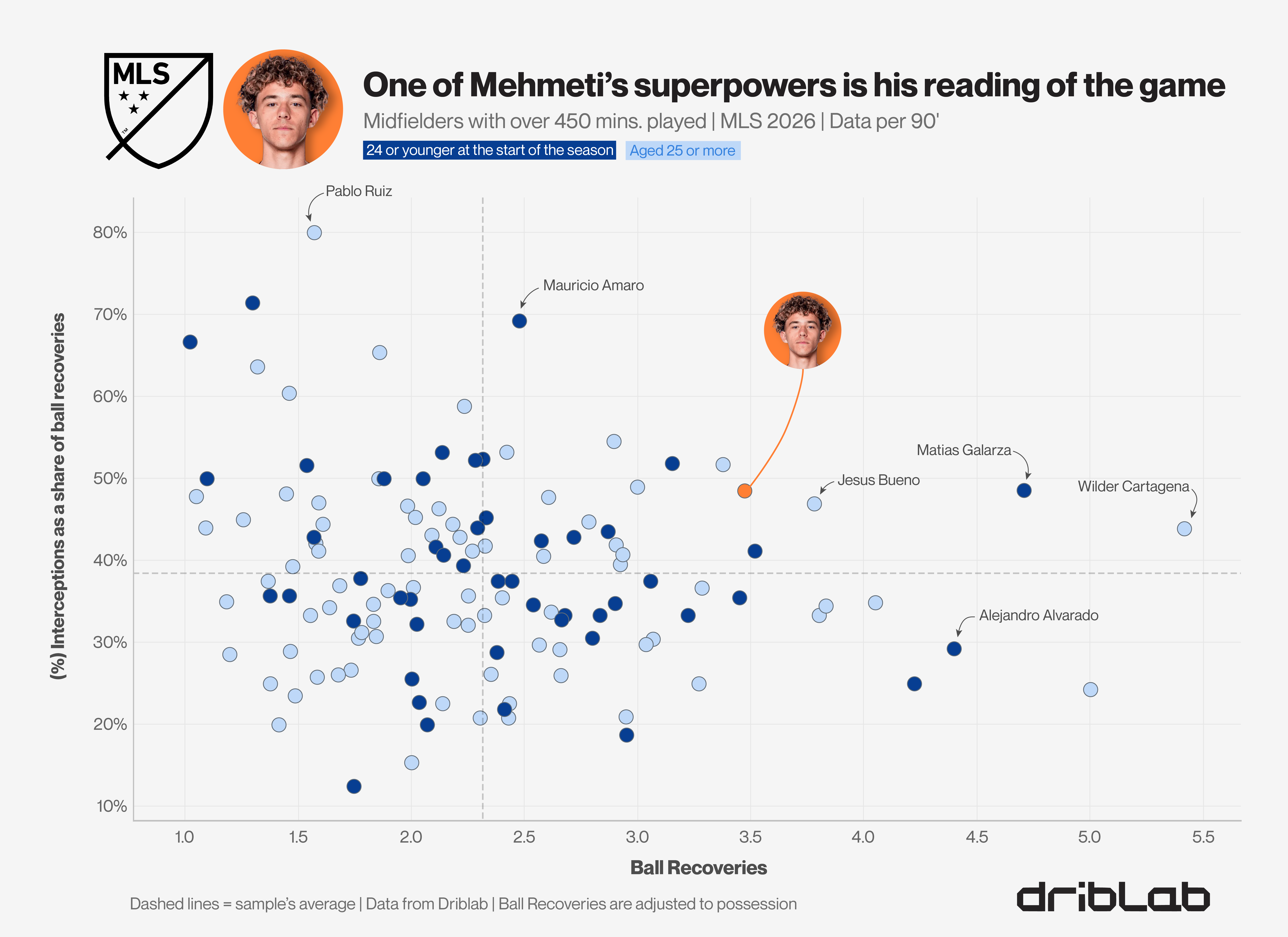
For a player of just 17, standing out in reading the game defensively is surprising and at the same time extremely positive. Mehmeti is above 96% of his peers in interceptions (1.68).
In short, we are talking about a very complete central midfielder with enormous potential, who combines judgment in distribution, progression ability and defensive solidity. In his first season in MLS he has already shown the qualities to take on important responsibilities, establishing himself as one of the young players to follow in the competition.
CM: Kaick Da Silva (FC Dallas, 2005) - 🇧🇷
Last season, after arriving from Gremio’s U20 side in a transfer of almost four million euros, the Brazilian central midfielder played 57% of the minutes in which he was available. Now he is close to 80% of the minutes with a completely different role.
But before going into specifics, there are attributes that make Kaick a very interesting central midfielder regardless of the position or role he occupies. He is a player with wide legs and a powerful lower body who stands under 180 centimeters tall.
Kaick’s compact physical build and his intelligent use of his body and arms make him a reliable player when the opponent presses him and he is under pressure. His ability to win fouls is remarkable and he is above 91% of central midfielders in fouls received (1.84). He is a central midfielder who frustrates his opponents when he positions himself between them and the ball.

Another important aspect to understand the player Kaick is, is his ability to change state very quickly. To go from jogging to quickly accelerating and covering ground at sprint speed. Both with and without the ball. He is a player who, in our physical performance data, is above average both in Distance covered in HSR (high intensity) and in Distance covered at Sprint. This reflects a complete profile that doesn’t depend solely on the maximum possible intensity (Sprint).
We notice Kaick’s change of role compared to last year in the reduction of defensive volume and in an increase in his responsibilities on the ball. Kaick is a player who uses both feet and prefers passing to carrying the ball. In his new role, he manages possessions in high situations, not so much from the base. A greater responsibility that doesn’t weigh on him: he is a player who hardly rushes, who shows calm under pressure and who is also capable of creating danger with his passes.
Our Pass Contribution metric (which measures the danger of each player’s passes taking into account the position of the receiver) shows that Kaick has gone from -8.7% to 7.2% contribution from one year to the next. That is, with his passes he is adding danger to his team’s possessions by finding players in advanced positions and not choosing the safe pass.
Tthis year has been very good for his progression, but there are still doubts about his ability to be expansive with his passing. However, the Brazilian has a complete profile without overly pronounced negative aspects. He is a complete central midfielder, whose physique is among the best in the league and who is also capable of taking on great responsibilities.
LW: Bruno Caicedo (Vancouver Whitecaps, 2005) - 🇪🇨
Yes, Caicedo has played only 34% of the available minutes and is the starter in our XI with the fewest regular-season minutes (1144). Even so, the Ecuadorian attacker has shown the ability to add differential value to one of the best teams in the league with 11 goal contributions (6 goals and 5 assists). An optimal return in his first season in the US.
He is an attacker more involved in the final phase of sequences than in building them. He has both physical and technical resources to beat his man from a standstill or on the run, but also to create shots for himself with diagonal carries.
Even while being above 75% of MLS wingers and attacking midfielders in three important metrics for his role as a direct, skillful winger (average Top Speed, Sprint Distance covered and Percentage of total Distance covered at Sprint), Caicedo is not limited to beating his opponents through pure acceleration or sustained speed.
He has resources such as feints, dummies and other types of dribbles that give him a way out on both sides and keep him from always depending on his power when carrying. He is a player who accelerates and decelerates smoothly and who is strong in the challenge, with which he manages to absorb the impact and take advantage of it.

Regarding finishing, despite his good performance in front of goal, Caicedo’s shot map can be improved. He shows many shots from tight angles or from positions from which only a consistently effective finisher could take advantage.
Perhaps Caicedo will confirm himself as one in the future, especially because it is noticeable that his preparation touches for the shot and also his placed finish to the far post are very well worked.
If he is able to work on his decision-making and optimize his shots, he could become a top attacker in the league and, who knows, continue growing in Europe, a path that several of his compatriots have already taken.
AMC: Cavan Sullivan (Philadelphia Union, 2009) - 🇺🇸
Born in 2009, Cavan Sullivan has burst onto the scene in MLS this season, taking on an important role at Philadelphia Union despite his young age. He is one of the biggest prospects in the history of American soccer, so much so that he already has caps with the national team at just 17 years old.
His 7 goals and 7 assists in the 2026 campaign reflect the output of a player who stands out especially for his influence in the final meters.
He is a winger with a markedly vertical profile, who constantly looks to create advantages and hurt opposing defenses. A player capable of beating his man through dribbling, attacking spaces and providing depth, always with the opponent’s goal as his target.
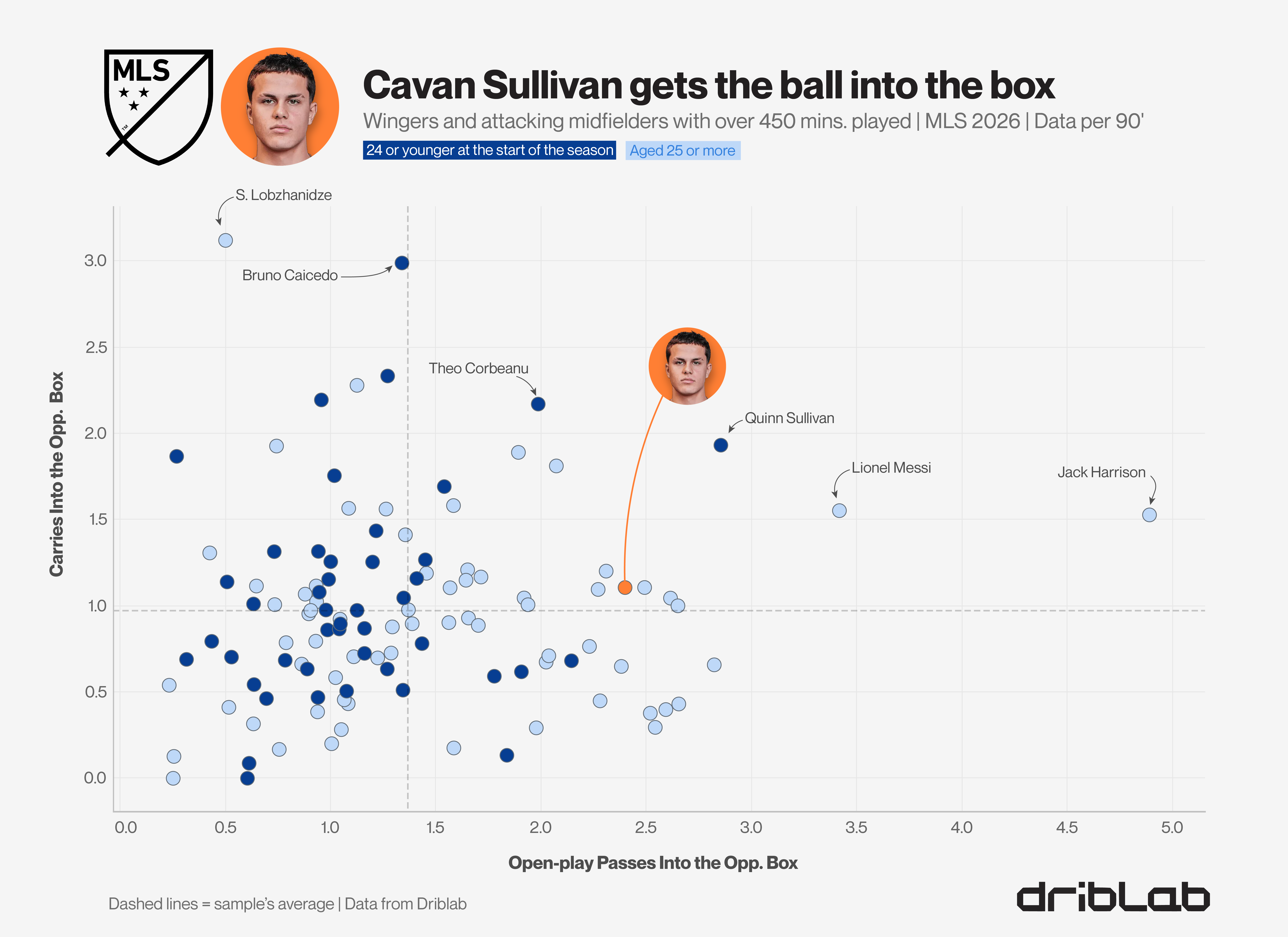
In particular, his ability to dribble in congested areas is remarkable. He completes more dribbles in the final third than 86% of MLS wingers and attacking midfielders, and his 72.7% success rate in those areas is the sixth-best figure.
One of the most interesting aspects of his game is his ability to turn that verticality into dangerous situations. Sullivan records shot and expected goals (xG) figures per 90 minutes above the competition average, showing a notable tendency to get into the opponent’s box and look for shooting situations.
However, his attacking contribution is not limited to finishing, as he also has the resources to combine, find teammates in advantageous positions and create chances through passing. Only 9 wingers average more expected threat from open play than Sullivan (0.39).
We are looking at a very complete winger in the attacking phase, with a vertical mentality and an outstanding capacity for output in the final third. His ease in combining dribbling, depth, chance creation and finishing at such a young age makes him one of the talents with the most potential in MLS.
RW: Hennadii Synchuk (CF Montréal, 2006) - 🇺🇦
Hennadii Synchuk is one of the most interesting young talents at CF Montréal, a winger who stands out for his technical qualities and his ability to create danger in individual situations.
He is a player who finds it easy to progress by carrying the ball, beat opponents through dribbling and draw fouls in the opponent’s half. His game is especially oriented toward individual imbalance, showing a clear tendency to take on his opponents and look for finishing situations.
In terms of carries leading to a shot, Synchuk averages 1.14 per 90 minutes. The sixth-highest figure in the competition among wingers and attacking midfielders. One of the standout aspects of his profile is his ability to find favorable shooting positions. Synchuk records expected goals (xG) and shot figures above the average for MLS wingers, as well as showing a frequent presence in the opponent’s box.
However, he still has room for improvement in his finishing, as his goal output is below what would be expected based on the chances generated.
On the other hand, he doesn’t stand out particularly for his combination play or for creating opportunities through passing, being a player more oriented toward dribbling and finishing.
We are looking at a young winger with interesting attacking qualities and significant room for growth. His ability to beat his man, progress with the ball and find shooting situations is a very promising base.
As he accumulates minutes, gains experience and improves his efficiency in front of goal, Synchuk could become an increasingly decisive player in CF Montréal’s attack.
FW: Julian Hall (New York Red Bulls, 2008) - 🇺🇸
A United States international, Hall is a striker who offers mobility from the tip of the attack and also positional versatility, considering that he has played 12% of his minutes on the left wing. He has been involved in 16 goals (13 goals and 3 assists) so far this regular season. Exciting figures for his second year in MLS.
Hall has shown better qualities than end product, even having scored more than ten goals and having turned 13.3 xG into 17.2 xGOT (expected goals on target, which measure the probability of a shot being a goal based on the quality of the shot).
He is a striker with an explosive physical profile that allows him to make short, aggressive sprint efforts frequently. Something that ties in with his ability to make dual runs inside the box. That is, making two movements in quick succession to deceive opponents.

Hall makes this type of run to get shooting situations at the near post, but equally he is a player with an instinct for finding shooting situations along the six-yard box and the penalty spot area. Our Arrigo data places him above 81% of strikers in terms of number of runs to attack a cross and runs in behind the opponent’s defensive line.
In terms of shots, the American striker needs fewer shots than average to score and the average distance of his shots is below that of the average striker in MLS. In addition, his shots have a 20% chance of becoming a goal (0.2 xG per shot), more than 83% of the league’s strikers.
Hall is not a striker who catches the eye for his height or strength, but his physical profile allows him to exploit spaces both inside and outside the box. And to do it again and again: only five strikers cover, on average per match, more sprint distance than Hall.
The American’s (2008) weak points are in the final action: at times he forces the shot too much with his right foot, his dominant one, instead of using his left, and at moments he gets hasty from wanting to shoot so quickly. He will also need to become a self-sufficient striker, but at 18 that would be an unattainable demand.
If he manages to improve on that set of aspects, Hall could become a striker of more than 20 goals per season in MLS and a very interesting player who combines speed, aggressiveness and a quick trigger.